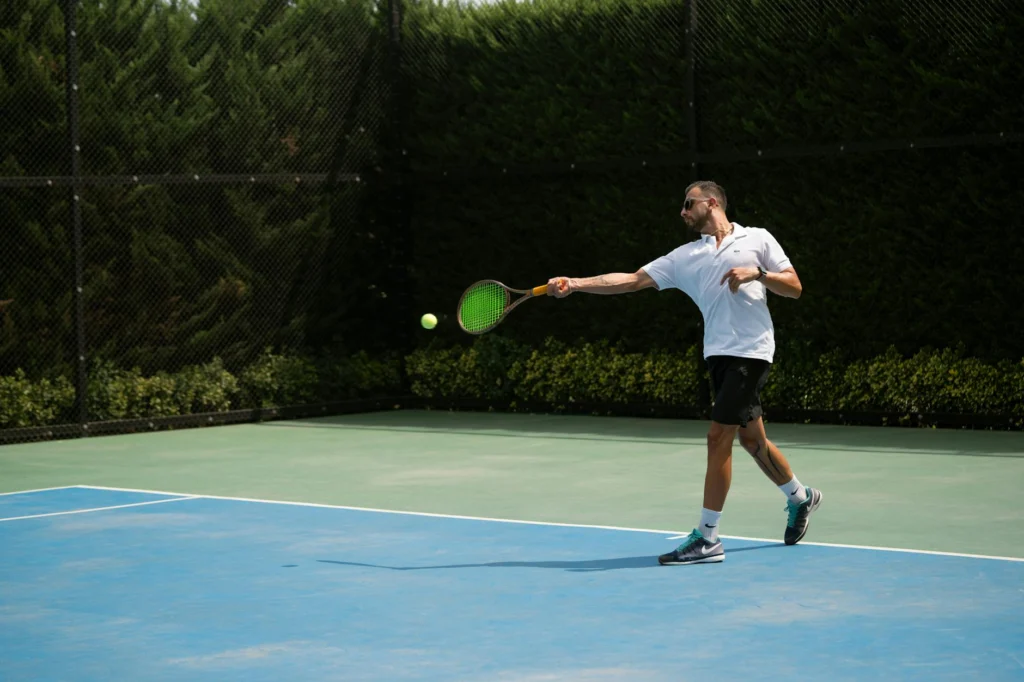
Marta Kostyuk arrived at Roland Garros this year carrying a strong two-handed backhand.[s] The 23-year-old from Kyiv also walked into a sport increasingly intent on measuring that stroke. Recent camera, sensor and artificial-intelligence systems have turned racket swings into streams of numbers, and the field doing the measuring has a name: tennis biomechanics.
Kostyuk is a useful place to begin, not because her backhand has been wired up and dissected in public, because it has not, but because her rise shows what the modern game rewards. Seeded 15th and arriving on a 10-match clay-court winning streak after titles in Rouen and Madrid[s], she is known for quick footwork and the knack of flipping from defense to offense inside a rally.[s] The part of her game that visibly improved is her forehand, once a target for harder hitters and now a stroke she can drive down the line[s], part of a broader rise Bolavip links to coaching under Sandra Zaniewska rather than to any gadget.[s]
What tennis biomechanics actually measures
For most of the sport’s history, technique was judged by eye. Modern tennis biomechanics replaces the eye with measurement. A 2026 study from the University of Bath showed that a high-definition eight-camera markerless video setup, processed by AI that estimates body position frame by frame, can track how much mechanical work a player’s body does during a session, and that this measure closely followed a sprint-based fatigue measure.[s] The authors called it a promising tool for non-invasive, on-court workload monitoring.[s] No suit, no body markers.
The other half of the data comes from sensors. Inertial measurement units, the same chips that sense rotation inside a phone, now sit in wristbands, apparel and racket handles, capturing the fine detail of every swing.[s] They read racket head speed, swing plane and spin, while in-match wearable rules remain uneven: tour events have allowed approved devices, but Grand Slam tournaments still handle approval event by event.[s]
Why the numbers matter: keeping players on court
A major payoff is injury prevention. A 2026 paper in Scientific Reports used wearable-sensor measurements from professional tennis to train machine learning models to identify injury patterns and predict injury risk. The best model reached 91.5% accuracy, and the injuries clustered in two regions: the shoulder and elbow, and the lower back and hip.[s] Together those two areas made up about 79% of cases.[s] The study frames early warning as the foundation for smarter prevention, though it does not prove that a flagged player will avoid injury.
Some elite players are already buying in. World No. 1 Aryna Sabalenka has said the analytics firm DDSA shaped how she studies opponents and develops her game[s], and in December 2025 the sports-science company Orreco announced it had acquired DDSA to build what it calls tennis’s first integrated platform, fusing biomarkers, AI match analytics and computer-vision biomechanics.[s] Some of those tools need no wearables at all: a smartphone recording is enough to extract a skeleton and read serve speed, spin and footwork.[s] What was once lab-grade analysis is heading toward anyone with a phone.
The blind spot in tennis biomechanics
There is a catch that matters for a player like Kostyuk. Much of the serve-biomechanics literature was built on small groups of expert men. A 2026 review of serve mechanics found the research leaned on small groups of expert male players and openly called for more study of female athletes[s], noting that the review identified just one study comparing the loads on men’s and women’s joints during a serve.[s] That means parts of the women’s game are still being interpreted through evidence gathered mostly from men’s bodies. And the games are not identical: when researchers used entropy-based metrics to map shot patterns across more than 200 Grand Slam matches, women showed more directional variety on the backhand than men.[s] Even so, the study’s main lesson was sobering for anyone chasing flash: consistency of technique mattered more than variety, while losing players trended toward busier shot menus, a small difference that was not statistically significant.[s]
For Kostyuk and her peers, the promise of tennis biomechanics is not a robot coach. It is fewer injuries, smarter scheduling, and a clearer picture of a game that, until recently, ran largely on instinct. The open question is whether the data will finally be gathered on the players actually hitting the shots.
Strip away the marketing and modern tennis biomechanics rests on two measurement shifts: capturing three-dimensional motion without markers, and capturing physiological load without a laboratory. Each has matured fast enough that a player’s body and a player’s choices can now be quantified from footage and sensor streams that no longer always require a laboratory.
Markerless capture and the mechanical-work signal
The University of Bath system illustrates the first shift. Eight synchronized cameras record at 200 Hz[s]; an AI pipeline using Faster R-CNN for detection and HRNet for pose estimates two-dimensional keypoints in every frame, which are then triangulated into 3D and used to drive a constrained skeletal model in OpenSim. From the resulting centre of mass and segment trajectories the team computed mechanical work, the energy cost of accelerating and lifting the body. Across 15 players, that work and sprint-measured neuromuscular fatigue moved in near lockstep, a correlation of roughly 0.93 in absolute terms.[s] Cheaper proxies for the body’s centre of mass were off by around 40% in raw magnitude, but the error was systematic, so the method holds for tracking one player over time, not for comparing two.[s]
Entropy, stability and the shape of a rally
Data-driven tennis biomechanics is not only about bodies; it is also about decisions. To quantify how varied a player’s shot selection is, researchers borrowed entropy-based metrics from information theory, dividing Shannon entropy by its maximum to produce a diversity score between 0 and 1.[s] Analyzing more than 200 singles matches from the 2023 Australian Open and US Open, they found women carried higher directional diversity on the backhand, 0.71 against 0.66 for men, while men spread their forehands and shot types more widely.[s] The headline cut against intuition: stability of technique mattered more than range, and losing players showed slightly greater shot-type diversity than winners, though the difference was small and not statistically significant.[s] A wide repertoire is not the same as a winning one.
The serve, the shoulder and the data gap
The serve, rather than the backhand, dominates the kinematic data discussed in the 2026 review, and the figures are brutal. During the serve’s acceleration phase, shoulder internal rotation velocity in world-class men reaches roughly 2420 degrees per second, against about 1370 in women[s], the male value running about 77% higher. Serve ball speeds sit near 53 metres per second for men and 44 for women, around 119 and 98 mph.[s] That load leaves marks: a prospective study found seven of nine peak joint loadings during the serve were higher in players who went on to be injured[s], and college data attribute 10.3 to 12.0% of stroke injuries to the serve, against 3.0 to 5.2% for the backhand.[s]
Here the discipline’s weakness shows. The same 2026 review that compiled these numbers found most serve studies used small samples of able-bodied men, and identified one study comparing joint loads between the sexes.[s] The instruments of tennis biomechanics are sharp; the population they have been pointed at is narrow. Recent Orreco acquisitions point in that direction: the company paired its DDSA tennis purchase with the acquisition of Jennis, a women’s health platform built around training and the menstrual cycle.[s]
Sensor fusion and predictive models
Injury risk is where the machine learning models earn their place in tennis biomechanics. A 2026 Scientific Reports study fused 9-axis inertial units, optical heart-rate sensing, GPS and force sensors, then ran the streams through LSTM and Transformer networks. The Transformer hit 91.5% accuracy with a 0.956 AUC[s]; injuries concentrated in the shoulder-elbow complex at 47.3% and the lumbar-hip region at 31.8%[s], and 73.2% of the variance came from the interaction between when load was applied and where it landed.[s] Accuracy that high is striking, though a single-cohort model still has to prove it travels to new players and seasons.
Even officiating data is becoming a performance feed. Tennis Australia says Bolt6 has delivered the Australian Open’s electronic line-calling technology since 2025;[s] a technical writeup describes the system as using a continuous motion model with six degrees of freedom rather than discrete in-or-out events.[s] Because it already tracks player movement, it can surface measures such as serve arm speed alongside ball speed as a by-product, with no extra capture.[s] The officiating camera and the biomechanics lab are merging into one feed.
The trajectory of tennis biomechanics is clear: cheaper capture, richer models, data pulled from infrastructure that already exists. The discipline’s next task is less technical than demographic, turning those instruments on the women, juniors and lower-ranked players whose mechanics remain, for now, largely unmeasured.