The physics of hypersonic missile defense presents a problem that no amount of funding can solve: the math simply doesn’t work. When a weapon travels at Mach 20, covering seven kilometers every second while maneuvering unpredictably at altitudes that strain satellite tracking and sit below most radar horizons, current defense systems face an engagement window measured in single-digit seconds.[s] Understanding why requires examining the fundamental physics that governs both the weapons and the systems designed to stop them.
What Makes Hypersonic Missiles Different
Hypersonic flight means traveling faster than Mach 5, or five times the speed of sound.[s] But speed alone isn’t new. Intercontinental ballistic missiles have reached hypersonic velocities since the 1960s, routinely exceeding Mach 20 during their flight.[s]
The difference lies in trajectory. Traditional ballistic missiles arc high into space on predictable paths, like a thrown ball following a parabola. Hypersonic glide vehicles stay low, skimming through the upper atmosphere at altitudes between 30 and 100 kilometers while maneuvering continuously.[s] This combination of speed, low altitude, and maneuverability creates the hypersonic missile defense challenge.
The Radar Horizon Problem
Earth’s curvature limits how far ground-based radars can see. A hypersonic glide vehicle flying at 30 kilometers altitude can only be detected by terrestrial radar at a maximum range of about 700 kilometers.[s] At Mach 20, that distance closes in roughly 100 seconds.
The Congressional Research Service confirms this limitation: most terrestrial-based radars cannot detect hypersonic weapons until late in their flight due to line-of-sight constraints.[s] By contrast, ballistic missiles traveling through space can be tracked for the majority of their 20-plus minute midcourse phase.[s]
Why Current Systems Can’t Keep Up
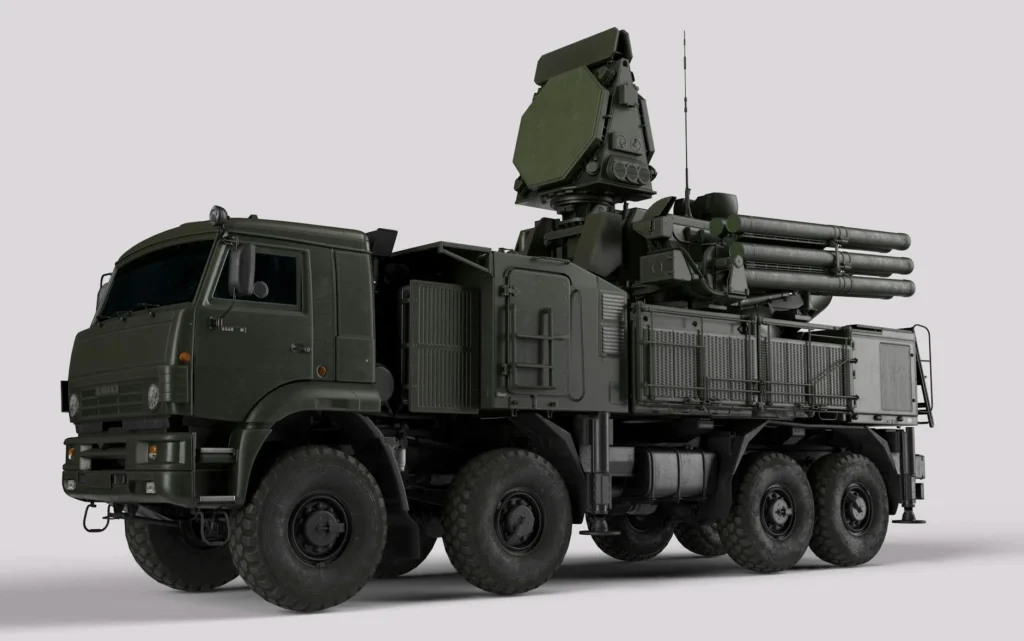
The Patriot system, the most combat-tested air and missile defense platform engaged against hypersonic-speed threats, fires interceptors at roughly Mach 5.[s] When an incoming weapon travels at Mach 10 or faster, the interceptor cannot catch it in a tail chase. The only option is a head-on engagement, which requires knowing exactly where the target will be.
But hypersonic weapons maneuver. Russia’s Kinzhal, an air-launched ballistic missile, rapidly accelerates to Mach 4 and may reach speeds up to Mach 10 while following what CSIS describes as an “erratic flight trajectory.”[s] The Avangard glide vehicle reportedly travels at Mach 20 to 27 and is described as capable of sharp horizontal and vertical evasive maneuvers in flight.[s]
Against such targets, technical analysis estimates an engagement window of just 3 to 6 seconds for current systems.[s] The fire control system must detect the threat, calculate an intercept solution, launch an interceptor, and guide it to impact, all within that window. Analysts have argued that current command and control architectures are incapable of processing data quickly enough to respond.[s]
The Satellite Gap in Hypersonic Missile Defense
Space-based sensors offer a potential solution to the radar horizon problem, but they face their own limitations. Former Under Secretary of Defense Mike Griffin noted that hypersonic targets are 10 to 20 times dimmer than what U.S. satellites normally track.[s]
Hypersonic glide vehicles fly at altitudes lower than ballistic missile warheads, which means the same satellite achieves smaller coverage against them.[s] Current geostationary early warning satellites were designed to spot the bright infrared signature of rocket boosters, not the comparatively dim thermal signature of an atmospheric glider.
What’s Being Attempted
The Pentagon is developing new hypersonic missile defense capabilities through several programs. The Space Development Agency is building a Proliferated Warfighter Space Architecture with hundreds of low-Earth-orbit satellites designed to track hypersonic threats.[s] The Missile Defense Agency is developing the Glide Phase Interceptor, designed to engage hypersonic weapons during their atmospheric flight, with initial operational capability targeted for 2029.[s]
Whether these systems can overcome the fundamental physics remains an open question. The weapons themselves face severe physical constraints, including extreme heating and energy drain. But for defenders, the mathematics of time, distance, and sensor coverage currently favor the offense.
Hypersonic Missile Defense and Velocity Physics
Hypersonic flight, defined as speeds exceeding Mach 5, imposes severe physical constraints on both weapons and interceptors.[s] Aerodynamic drag increases with the square of velocity: a glider at Mach 20 experiences 400 times the drag force of one at Mach 1.[s] Energy dissipation is worse, scaling with the cube of velocity, meaning a Mach 20 vehicle loses energy 8,000 times faster than at Mach 1.[s]
These physics create thermal conditions that push material science to its limits. Leading edges of boost-glide weapons at Mach 10 and above reach temperatures exceeding 2,000 Kelvin for sustained periods.[s] The lift-to-drag ratio for hypersonic vehicles remains below 3, compared to 15 or higher for subsonic aircraft, severely limiting range and maneuverability budgets.[s]
The Detection Mathematics
Ground-based radar detection range against a target at altitude h is constrained by the radar horizon, approximately d ≈ sqrt(2 · k · R · h) where R is Earth’s radius and k ≈ 4/3 accounts for atmospheric refraction (the geometric line-of-sight horizon, sqrt(2Rh), gives roughly 620 km at 30 km altitude). For a hypersonic glide vehicle at 30 km altitude, the radar horizon is roughly 700 km.[s]
At Mach 20 (approximately 6.8 km/s at altitude), 700 km closes in 103 seconds. But detection is only the first step in the hypersonic missile defense kill chain. The sequence requires: radar acquisition, track establishment, fire control solution, launch authorization, interceptor flight time, and terminal guidance. Each step consumes precious seconds.
Geostationary infrared sensors face a different constraint. Former Under Secretary of Defense Mike Griffin stated that hypersonic targets are 10 to 20 times dimmer than strategic missiles tracked from geostationary orbit.[s] The thermal signature of an atmospheric glider, while intense at 2,000+ K, produces far less total infrared radiance than a rocket booster.
Interceptor Kinematics
The PAC-3 MSE interceptor achieves approximately Mach 5.[s] Against a Mach 10 target like the Kinzhal[s], tail-chase engagement is kinematically impossible. Head-on engagement requires predicting the target’s future position with sufficient accuracy for a hit-to-kill intercept.
Hypersonic glide vehicles defeat this prediction through continuous maneuvering. Russia’s Avangard, traveling at Mach 20 to 27 (approximately 6.8 to 9.2 km/s), is described as capable of sharp horizontal and vertical evasive maneuvers in flight.[s] At these velocities, even small angular changes translate to kilometers of displacement per second.
Technical analysis estimates the resulting engagement window at 3 to 6 seconds for terminal-phase hypersonic missile defense systems.[s] Within this window, the fire control system must generate a firing solution against a maneuvering target, launch the interceptor, and guide it through terminal homing. Analysts have questioned whether current command and control architectures can process data quickly enough.[s]
The Kinetic Energy Calculation
The Avangard’s kinetic energy at Mach 20 illustrates the challenge. With a mass of approximately 2,000 kg traveling at 6.8 km/s, kinetic energy equals 0.5 × 2000 × 6800² = 46.2 gigajoules, equivalent to roughly 11 tons of TNT.[s] At Mach 27, this rises to approximately 21 tons TNT equivalent. Even a failed intercept that fragments rather than destroys the vehicle may not prevent catastrophic damage to the target.
Sensor Architecture Development
The Proliferated Warfighter Space Architecture attempts to address detection gaps through a constellation of 300 to 500+ low-Earth-orbit satellites providing tracking and transport layers.[s] The Hypersonic and Ballistic Tracking Space Sensor provides medium-field-of-view coverage with sensitivity designed for the dimmer hypersonic signature. A March 2025 test demonstrated the ability to detect, track, and perform a simulated engagement of a maneuvering hypersonic target.[s]
The Glide Phase Interceptor program targets initial operational capability by 2029, with full operational capability by 2032, though reports suggest delivery may slip to 2035.[s] The system will integrate with Aegis, potentially enabling naval hypersonic missile defense.
Strategic Stability Implications
Hypersonic weapons introduce “warhead ambiguity,” where defenders cannot determine whether an incoming weapon carries nuclear or conventional payloads.[s] Combined with minimal reaction time, this creates escalation risk: a nuclear-armed adversary might assume it is under nuclear attack and respond accordingly.
The physics currently favors offense. Whether emerging sensor architectures and interceptors can shift this balance depends on solving problems that lie at the intersection of material science, orbital mechanics, and fire control mathematics. The fundamental constraint remains: time cannot be created, only better utilized.