The building resonance physics that keeps skyscrapers standing defies common sense: the tallest structures on Earth are designed to move. A rigid tower fighting against wind and earthquakes is a tower waiting to fail. Engineers learned this lesson the hard way, and the solution they developed involves swinging steel spheres the size of small houses.
Every Structure Has a Heartbeat
Push a child on a swing at random intervals, and they wobble awkwardly. Push at exactly the right moment, matching the swing’s natural rhythm, and they soar higher with each push. This same principle governs every structure ever built. Every building, bridge, and tower has a natural frequency: the rate at which it wants to vibrate when disturbed[s].
The danger comes when outside forces, whether wind, earthquakes, or even footsteps, match that natural frequency. When this happens, the structure experiences resonance, and each push from the outside world amplifies the previous one. Small vibrations compound into violent oscillations[s].
When Bridges Danced to Their Own Destruction
On November 7, 1940, the Tacoma Narrows Bridge in Washington State began to twist violently in winds of only 42 mph. Engineers had designed what they considered the most modern suspension bridge of its era. Within hours, it tore itself apart while a film crew recorded the spectacle[s].
The problem was not the wind’s strength but its rhythm. The bridge’s shallow 8-foot deck and extreme slenderness created a structure so flexible that moderate winds could match its natural frequency. Investigators later determined the fundamental weakness was “great flexibility, vertically and in torsion”[s]. The failure revolutionized building resonance physics and bridge engineering, making aerodynamic testing mandatory for suspension bridges.
Sixty years later, London’s Millennium Bridge demonstrated that engineers had not fully grasped every mode of resonance. When 2,000 pedestrians crossed on opening day in June 2000, the bridge began swaying side to side. The more it swayed, the more people adjusted their steps to match the motion, which made the swaying worse. This feedback loop, called synchronous lateral excitation, forced engineers to close the bridge for two years[s].
Building Resonance Physics: The Flexibility Solution
The counterintuitive lesson from these failures is that buildings must be designed to move, not resist movement. A skyscraper that stands perfectly rigid in a storm is a structural liability[s]. Engineers design the world’s tallest buildings to sway a little because controlled lateral movement dissipates energy that would otherwise concentrate at structural weak points.
On a breezy day, the tallest skyscrapers can sway up to three feet in each direction[s]. The building remains structurally sound, but occupants can feel seasick. Engineers aim for a maximum sway of 1/500 of the building’s height; beyond this threshold, people become uncomfortable even though the structure is perfectly safe[s].
Giant Pendulums in the Sky
To keep buildings flexible enough to survive but stable enough to inhabit, engineers install tuned mass dampers: massive weights that swing in opposition to the building’s movement. When the building sways left, the weight swings right, absorbing the kinetic energy and reducing oscillation[s].
Taipei 101 in Taiwan houses the most famous example: a 730-ton steel sphere suspended between the 87th and 92nd floors[s]. When Taiwan experienced its most powerful earthquake in 25 years in April 2024, registering magnitude 7.4, the building swayed visibly but suffered no structural damage. The damper reduced the building’s movement by up to 40 percent[s].
Shaping Buildings to Cheat the Wind
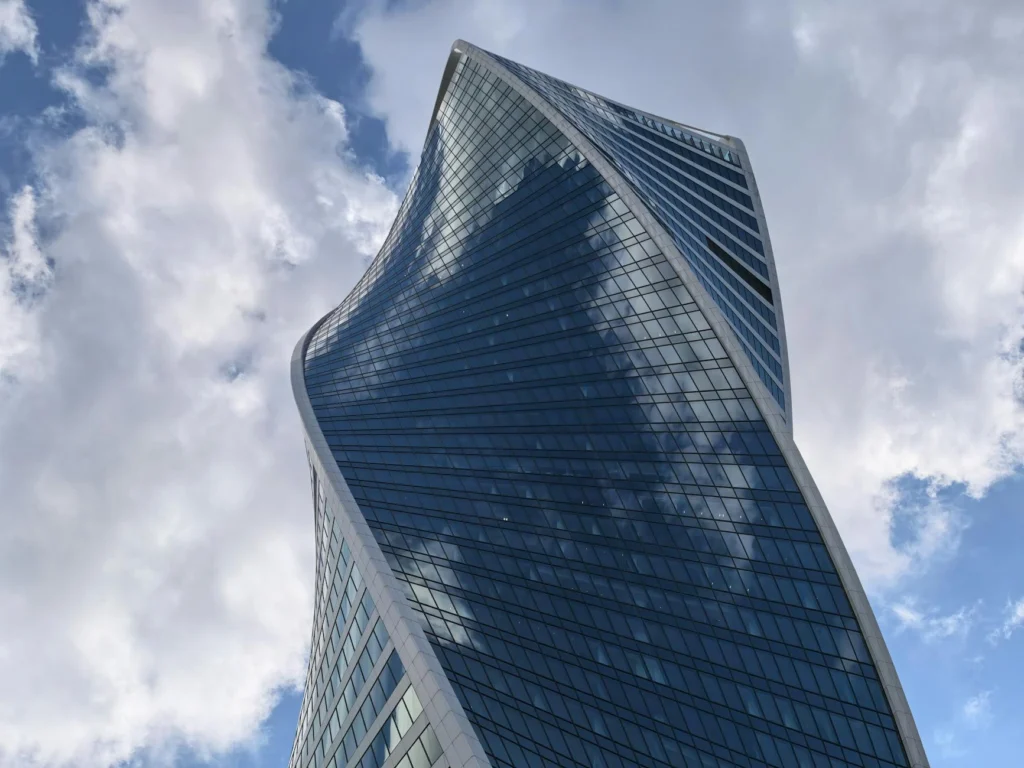
Some towers fight resonance by reshaping the wind itself. Shanghai Tower, China’s tallest building at 632 meters, twists 120 degrees from base to top. Engineers tested over 12 different rotation patterns in wind tunnels before selecting the final design, which reduced wind loads by 24 percent[s].
New York’s 432 Park Avenue takes a different approach. The 426-meter residential tower has floors with no walls at five locations throughout its height. Wind passes through these openings, breaking up the organized patterns of air pressure that would otherwise cause resonance[s].
Separating Buildings from the Shaking Ground
For earthquake protection, some buildings are completely separated from the ground using base isolation. Lead rubber bearings, developed in the 1970s, consist of layers of rubber and steel with a lead core[s]. During an earthquake, the ground can move 300 millimeters or more, but the building above the bearings barely moves at all. The rubber flexes to absorb the motion, and the lead core dissipates the energy as heat[s].
The Paradox That Keeps Cities Standing
The buildings we trust to stand firm are engineered to do the opposite. They sway, flex, and absorb punishment that would shatter anything truly rigid. This understanding of building resonance physics transformed how engineers approach tall structures: not as monuments to immobility, but as carefully tuned instruments designed to dance with the forces that threaten them.
The building resonance physics governing tall structure design operates on principles that appear counterintuitive: maximum structural safety requires engineered flexibility. Modern supertall buildings are designed as dynamic systems with natural frequencies calibrated to avoid resonance with wind vortex shedding and seismic ground motion.
Natural Frequency and Dynamic Response
Every structure possesses a natural frequency determined by its mass and stiffness distribution. For a simple mass-spring system, natural frequency f = (1/2π)√(k/m), where k represents stiffness and m represents mass[s]. Low-rise buildings exhibit high natural frequencies while tall flexible structures characteristically display low natural frequencies.
Resonance occurs when an excitation frequency approaches a structure’s natural frequency. If the period of ground motion matches the natural resonance of a building, it undergoes maximum oscillation amplitude and suffers greatest structural stress[s]. This explains why building resonance physics demands careful modal analysis during the design phase.
The Tacoma Narrows Failure: Aeroelastic Flutter
The 1940 Tacoma Narrows Bridge collapse demonstrated catastrophic resonance in a 42 mph wind, far below design specifications. The primary explanation involves torsional flutter: a self-induced harmonic vibration pattern that grows to destructive amplitude[s].
Post-collapse analysis identified the fundamental weakness as excessive flexibility, with a deck-width-to-span ratio of 1:72 providing minimal torsional resistance[s]. The 8-foot shallow deck created a 1:350 depth-to-span ratio, producing aerodynamic lift characteristics that amplified wind-induced oscillation rather than damping it.
Building Resonance Physics in Lateral Excitation
The Millennium Bridge incident of 2000 revealed a previously underappreciated resonance mode. With approximately 2,000 pedestrians crossing simultaneously, the bridge exhibited large lateral oscillations at frequencies between 0.49 Hz and 1.05 Hz[s].
Research quantified pedestrian-induced lateral force as F = K × V, where F represents average sideways force, K is a constant, and V is lateral bridge velocity[s]. The effect can occur on any bridge with lateral frequency below approximately 1.3 Hz, the upper limit of normal pedestrian pacing frequency. This finding generalized beyond the Millennium Bridge’s specific cable-stayed design to any structure meeting the frequency criterion.
Tuned Mass Damper Engineering
TMDs operate by introducing a secondary oscillating mass tuned to the structure’s fundamental frequency. When the building moves in one direction, the TMD mass lags due to inertia, creating a restoring force that opposes building motion[s].
Taipei 101’s pendulum-style TMD consists of a 730-ton (660 metric ton) steel sphere suspended from cables anchored at the 92nd floor and stabilized by hydraulic dampers[s]. During the magnitude 7.4 earthquake of April 2024, the system demonstrated design performance: the building swayed visibly while sustaining zero structural damage, with the TMD reducing displacement by up to 40 percent[s].
Research in the International Journal of Civil Engineering confirms TMD effectiveness: buildings equipped with tuned mass dampers showed displacement reductions of up to 32 percent under combined wind and seismic loading compared to undamped structures[s].
Aerodynamic Shape Optimization
Wind tunnel testing enables optimization of building geometry to reduce crosswind excitation. As wind passes a building, vortex shedding generates oscillating lateral forces perpendicular to wind direction. When vortex shedding frequency matches building natural frequency, resonant amplification occurs[s].
Shanghai Tower’s twisted facade disrupts coherent vortex formation across its 632-meter height. Wind tunnel testing of 12 rotation configurations determined that the final 120-degree twist reduced wind loads by 24 percent[s]. This aerodynamic efficiency reduced structural material requirements, offsetting the complexity cost of the twisted form.
For 432 Park Avenue in Manhattan, engineers introduced floor-height apertures at five evenly spaced locations. These openings allow wind to pass through the structure, breaking up the organized vortex patterns that would otherwise generate resonant loading. Combined with two 600-ton tuned mass dampers, this approach achieved acceptable building resonance physics parameters despite the tower’s 15:1 aspect ratio[s].
Base Isolation Systems
Seismic base isolation decouples superstructure response from ground motion. Lead rubber bearings, developed in the 1970s, incorporate layered rubber for horizontal flexibility, steel shims for vertical stiffness, and lead cores for energy dissipation[s].
During seismic events, ground displacement can exceed 300 millimeters relative to the superstructure[s]. The isolator bearings accommodate this differential movement while the lead core converts kinetic energy to heat through plastic deformation. Unlike steel or concrete, lead recrystallizes at room temperature, restoring its energy dissipation capacity without permanent damage.
Design Limits and Occupant Comfort
Structural safety margins typically exceed occupant comfort thresholds. The accepted upper limit for lateral sway is 1/500 of building height; beyond this, occupants experience physical discomfort despite full structural integrity[s]. On breezy days, supertall buildings can sway up to three feet (approximately one meter) per side[s].
Wind poses particular hazard to tall buildings because their fundamental frequencies approach wind spectrum peaks as flexibility increases[s]. This frequency overlap, rather than absolute wind force, drives the engineering challenge of supertall building design.
Implications for Modern Engineering
The evolution of building resonance physics from the Tacoma Narrows disaster to contemporary supertall design reflects a fundamental shift in structural philosophy. Modern towers function as dynamic systems engineered to accommodate force through controlled deflection rather than resist it through rigidity. Tuned mass dampers, aerodynamic shaping, and base isolation represent complementary strategies unified by a common principle: structures survive by moving with the forces that would otherwise destroy them.