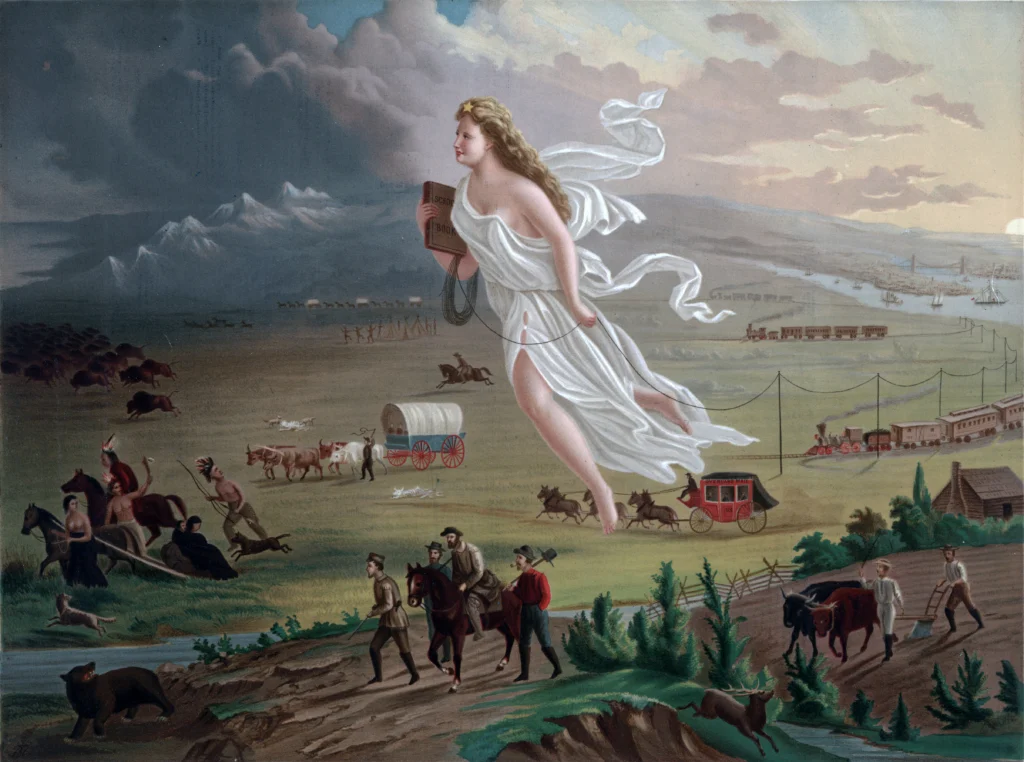
Two words published in an 1845 magazine essay helped justify the conquest of half a continent. The manifest destiny concept, as journalist John O’Sullivan called it, framed American expansion as inevitable, divinely ordained, and unstoppable[s]. Within three years of the phrase’s coining, the United States had annexed Texas, negotiated control of Oregon, and seized 525,000 square miles from Mexico through war[s]. The phrase did not cause this expansion, but it gave Americans a vocabulary to describe what they were already doing as righteous rather than aggressive.
Where the Phrase Came From
John Louis O’Sullivan was a New York editor who ran the United States Magazine and Democratic Review, a publication aligned with the Democratic Party. In the July 1845 issue, while arguing for Texas annexation, he complained about European interference with American growth. Foreign powers, he wrote, were “thwarting our policy and hampering our power, limiting our greatness and checking the fulfillment of our manifest destiny to overspread the continent allotted by Providence for the free development of our yearly multiplying millions”[s].
The phrase appeared buried in the third paragraph of a long essay[s]. O’Sullivan did not think his wording particularly memorable. Yet by December 1845, when he used similar language in the New York Morning News to discuss the Oregon boundary dispute, the phrase caught fire[s]. The manifest destiny concept spread because it captured something Americans already felt: that their westward movement was not mere land-grabbing but a sacred mission.
The Manifest Destiny Concept and Territorial Gains
The 1840s were the decade when the manifest destiny concept translated into massive territorial acquisition. President James K. Polk, elected in 1844 on an expansionist platform, accomplished what later historians identified as the greatest territorial expansion in American history to that point[s].
Texas came first. The republic had declared independence from Mexico in 1836, but the United States had hesitated to annex it for fear of war. President John Tyler pushed through a joint resolution of Congress on March 1, 1845, and Texas entered the Union that December[s].
Oregon followed through diplomacy. Britain and the United States both claimed the Pacific Northwest. Polk negotiated the Oregon Treaty in 1846, setting the border at the 49th parallel and securing what would become the states of Washington and Oregon[s].
California and the Southwest came through war. After skirmishes along the disputed Texas border in April 1846, the United States declared war on Mexico. The conflict ended with the Treaty of Guadalupe Hidalgo in February 1848. Mexico ceded approximately 525,000 square miles, representing 55 percent of its prewar territory, in exchange for $15 million and the assumption of debts owed to American citizens[s].
Who Was Left Out
The manifest destiny concept spoke of “yearly multiplying millions,” but it meant white Protestant settlers. Native Americans, African Americans, and Hispanic populations had no place in this vision of progress[s].
For Native peoples, westward expansion meant displacement and death. President Andrew Jackson had already signed nearly seventy removal treaties by the end of his presidency in 1837, forcibly relocating approximately 50,000 Indigenous people from their ancestral lands east of the Mississippi[s]. The Cherokee Nation’s forced march to Indian Territory became known as the Trail of Tears. Between 3,000 and 4,000 of the 15,000 to 16,000 Cherokees died from the brutal conditions[s].
O’Sullivan himself described “the irresistible army of Anglo-Saxon emigration” pouring into California, “armed with the plow and the rifle, and marking its trail with schools and colleges, courts and representative halls”[s]. The language made conquest sound like civilization. It erased the peoples already living there.
Opposition and Debate
Not everyone embraced the manifest destiny concept. The Whig Party sought to discredit the idea as “belligerent as well as pompous”[s]. Massachusetts Representative Robert Winthrop used the phrase to mock President Polk’s aggressive stance on Oregon[s].
Antislavery Whigs like John Quincy Adams and Joshua Giddings viewed the Mexican War as proof that Southern interests intended to expand slavery westward[s]. On August 8, 1846, Congressman David Wilmot introduced a proviso stipulating that “neither slavery nor involuntary servitude shall ever exist” in any territory acquired from Mexico[s]. Southern senators blocked it, but the Wilmot ProvisoAn 1846 congressional proposal to ban slavery in any territory acquired from Mexico. It passed the House but failed in the Senate, intensifying the national debate over slavery's extension westward. ignited a political firestorm that would burn until the Civil War.
Why the Phrase Still Matters
O’Sullivan died in obscurity in 1895, fifty years after coining the phrase. Historian Julius W. Pratt identified him as the originator in a 1927 article in The American Historical Review[s].
The manifest destiny concept outlived both its creator and its era. After the Civil War, the purchase of Alaska briefly revived the rhetoric. In the 1890s, it returned in force when the United States went to war with Spain, annexed Hawaii, and began planning a canal across Central America[s].
The specific words “manifest destiny” may have faded from common use, but the underlying belief persists. The idea that America has a unique, divinely sanctioned role in the world remains central to much U.S. foreign policy and political debate[s]. Understanding where this belief came from, and what it cost, matters for understanding where it might lead.
The manifest destiny concept entered American political discourse through John O’Sullivan’s July 1845 essay in the United States Magazine and Democratic Review. O’Sullivan, arguing for Texas annexation, complained that European powers were “checking the fulfillment of our manifest destiny to overspread the continent allotted by Providence for the free development of our yearly multiplying millions”[s]. The phrase was not a policy prescription but a rhetorical flourish. Within three years, however, it had become shorthand for territorial acquisitions including the Texas annexation, the Oregon settlement, and the Mexican Cession, the last of which alone added approximately 525,000 square miles to the United States[s].
Origins and Ideological Precedents of the Manifest Destiny Concept
O’Sullivan’s 1845 formulation drew on earlier American exceptionalist rhetoric. As early as 1839, he had written: “We are the nation of human progress, and who will, what can, set limits to our onward march? Providence is with us, and no earthly power can”[s]. This proto-manifest destiny language echoed John Winthrop’s 1630 “City upon a Hill” sermon and Thomas Paine’s revolutionary rhetoric about America’s continental significance[s].
The manifest destiny concept functioned more as zeitgeistA German word meaning the spirit of the times, referring to the dominant mood or beliefs of a particular era. Here it describes how manifest destiny reflected widespread popular feeling rather than formal government policy. than official foreign policy strategy[s]. Its appeal cut across regional, party, and class lines, though Northerners and Southerners advocated expansion for different reasons. The possibility of new Western lands forced the federal government to confront questions that had been somewhat mollified since the Missouri Compromise of 1820: Would new states permit slavery? How would Congress maintain sectional balance?
Textual Analysis: O’Sullivan’s Annexation Essay
The original 1845 text reveals the manifest destiny concept’s specific argumentative function. O’Sullivan was not calling for conquest but complaining about foreign interference. Britain and France, he argued, were “thwarting our policy and hampering our power”[s]. The phrase “manifest destiny” appeared buried in the third paragraph of a lengthy essay, suggesting O’Sullivan did not consider it particularly significant[s].
O’Sullivan’s rhetoric about California is particularly revealing. He described “the irresistible army of Anglo-Saxon emigration” arriving “armed with the plow and the rifle, and marking its trail with schools and colleges, courts and representative halls, mills and meeting-houses”[s]. This language framed violent displacement as organic progress. Mexican sovereignty over California, O’Sullivan wrote, was merely “a military dominion, which is no government in the legitimate sense of the term.”
The Manifest Destiny Concept and Federal Policy
President James K. Polk’s administration (1845-1849) represented the manifest destiny concept’s translation into territorial fact. Polk accomplished what historians identify as three of his four primary goals during the first session of the 29th Congress: lowering the tariff, creating an independent treasury, and acquiring Oregon through diplomacy[s]. California required war.
The Mexican War’s origins remain contested. After Texas annexation, Polk ordered troops into disputed territory between the Nueces and Rio Grande rivers. When skirmishes occurred in April 1846, Polk declared that Mexico had “shed American blood on American soil.” Congress declared war on May 13, 1846, though the vote disguised substantial reservations. Senator Thomas Hart Benton told Polk that “19th Century war should not be declared without full discussion and much more consideration”[s].
The Treaty of Guadalupe Hidalgo (February 2, 1848) formalized the conquest. Mexico ceded approximately 525,000 square miles, representing 55 percent of its prewar territory, for $15 million and assumption of debts[s].
Indigenous Displacement and the Ideology of Erasure
The manifest destiny concept’s exclusions were explicit. It “rested upon the sidelining or eradication (both real-world and fictional) of American Indian peoples; there was little place for African Americans (free or enslaved) within the trope; Asian and Hispanic immigrants did not figure in the ideal America it conjured”[s].
The Removal Act of 1830 had already established the legal mechanism for Indigenous displacement. By the end of Andrew Jackson’s presidency, nearly seventy removal treaties had relocated approximately 50,000 Native Americans west of the Mississippi[s]. The Cherokee Nation challenged Georgia laws restricting tribal freedoms. In Cherokee Nation v. Georgia (1831), Chief Justice John Marshall declared tribes “domestic dependent nations.” The following year, the Supreme Court ruled tribes sovereign and immune from Georgia laws. Jackson refused to enforce the ruling. The resulting forced march, the Trail of Tears, killed between 3,000 and 4,000 of the 15,000 to 16,000 Cherokees[s].
Political Opposition and Sectional Conflict
The Whig Party positioned itself against the manifest destiny concept’s territorial implications. Representative Robert Winthrop of Massachusetts used the phrase sarcastically to mock Polk’s Oregon policy[s]. Antislavery Whigs including John Quincy Adams and Joshua Giddings interpreted the Mexican War as evidence of a slaveholder conspiracy[s].
The Wilmot ProvisoAn 1846 congressional proposal to ban slavery in any territory acquired from Mexico. It passed the House but failed in the Senate, intensifying the national debate over slavery's extension westward. (August 8, 1846) crystallized the connection between expansion and slavery. Congressman David Wilmot’s proposed ban on slavery in territories acquired from Mexico failed in the Senate but politicized the question of slavery’s extension[s]. The sectional conflict ignited by manifest destiny expansion would smolder until 1861.
Historiographical Recovery and Continuing Significance
O’Sullivan died in 1895, largely forgotten. His authorship of the phrase was established definitively by Julius W. Pratt in a 1927 American Historical Review article[s]. Subsequent scholarship has examined the manifest destiny concept’s relationship to American exceptionalismThe belief that the United States is fundamentally different from other nations due to its founding ideals and perceived providential mission. The concept underpins many historical arguments for American expansionism., settler colonialismA form of colonialism in which an outside group permanently displaces the indigenous population rather than merely extracting resources. Scholars use the term to analyze how American expansion erased Native peoples and their sovereignty., and imperial ideology.
The concept’s applications extended beyond the antebellumLatin for before the war, used by historians to refer to the period in American history before the Civil War, roughly 1812 to 1861. It describes a distinct era of politics, society, and territorial expansion. period. The Alaska Purchase (1867) briefly revived the rhetoric. In the 1890s, the Spanish-American War, Hawaiian annexation, and Central American canal planning marked the manifest destiny concept’s transformation into overseas imperialism[s].
Contemporary relevance persists. The belief that America possesses a unique, providentially sanctioned world role remains central to political discourse[s]. The manifest destiny concept’s 19th-century formulation provides essential context for understanding the longer trajectory of American expansion and its justifications.