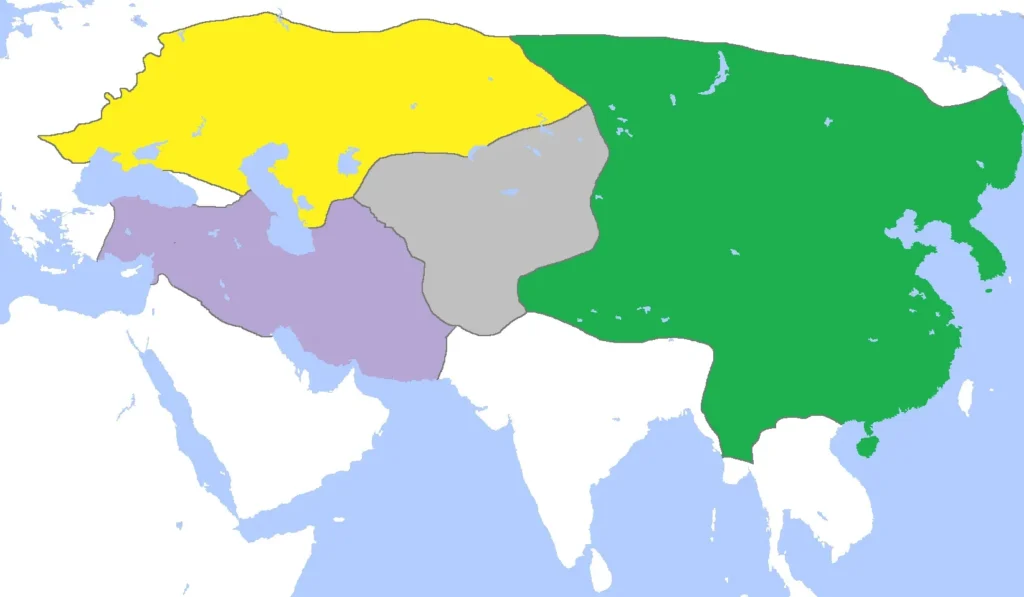
At its peak, the Mongol Empire covered 23 million square kilometers[s], stretching from the Pacific Ocean to the Danube River, the largest contiguous land empire in world history. Yet within a single generation of its greatest extent, it shattered into four warring fragments. The cause was not a foreign invasion or a natural disaster. It was a problem baked into the empire’s foundation: Mongol Empire succession had no fixed rules, and every transfer of power became a potential civil war.
Mongol Empire Succession: A System Designed to Fail
Genghis Khan unified the Mongol tribes in 1206 and built an empire through brilliant military organization and ruthless conquest. But for all his strategic genius, he left behind a fatal structural weakness. He decreed that any future great khan could be chosen only by a kurultai[s], an assembly of Mongol nobles and military leaders, rather than through automatic inheritance. The idea was meritocratic: the most capable leader would rise to the top. In practice, it meant that every time a khan died, the empire held its breath.
Genghis also divided his territories among his four sons by his primary wife Borte. He chose his third son Ogedei as successor[s], most likely because Ogedei had an even temperament and often made peace when his older brothers fought. Jochi, the eldest, received the western lands; Chagatai got Central Asia; Ogedei received western Mongolia; and Tolui inherited the Mongol heartland. This appanage system was meant to ensure stability, but it created competing power bases that would tear the empire apart.
The First Cracks: From Ogedei to Mongke
Genghis Khan died in 1227. Despite his designation of Ogedei, a two-year regency under Tolui preceded Ogedei’s formal election as great khan in 1229[s]. Under Ogedei, the empire continued to expand, conquering the Jin dynasty in northern China and sending armies deep into Europe. But Ogedei was a heavy drinker[s], and when he died in December 1241, the Mongol Empire succession crisis began in earnest.
Mongol armies that had reached Hungary turned back. No agreement could be reached[s] on a new khan. Ogedei’s widow Toregene served as regent for four years, maneuvering to install her son Guyuk. But Batu Khan, grandson of Genghis through Jochi, believed he had a better claim. Guyuk was elected in 1246, yet the two rivals prepared for war against each other. Only Guyuk’s premature death in 1248 prevented open conflict between the houses.
What followed was another regency and more backroom dealing. Sorqoqtani Beki, widow of Tolui, plotted with Batu[s] to seat her eldest son Mongke on the throne at the 1251 kurultai, bypassing the house of Ogedei entirely. The Ogedeids were furious. Mongke responded with a purge of his opponents, executing those who had conspired against him. The succession of the great khanate had now shifted from Ogedei’s line to Tolui’s, a transfer accomplished not through consensus but through political scheming and violence.
The Breaking Point: 1259
Mongke Khan proved an effective ruler who launched ambitious campaigns in China and the Middle East. His brother Hulegu destroyed the Abbasid Caliphate in Baghdad in 1258. But in August 1259, Mongke died during the siege of a provincial town in Sichuan[s], leaving no declared successor. This death triggered the crisis that would permanently fracture the empire.
Two of Mongke’s brothers claimed the throne simultaneously. Kublai, who was campaigning in China, proclaimed himself khan[s], while Ariq Boke, based in the traditional Mongol capital of Karakorum, did the same. Ariq Boke represented the traditionalist steppe faction; Kublai had adopted Chinese ways. The flawed Mongol Empire succession system had produced its most destructive crisis yet. The resulting Toluid Civil War lasted four years. Kublai prevailed in 1264, leveraging the agricultural wealth of China to outlast his brother. But many considered his status as Great Khan suspect[s] since he was never formally confirmed in a proper kurultai.
4 Khanates, 4 Destinies
The Mongol Empire succession dispute between Kublai and Ariq Boke was only the beginning. Berke Khan of the Golden Horde, a convert to Islam, broke with Hulegu[s] over the destruction of Baghdad, allying with the Mamluks of Egypt against his own cousin. For the first time in history, a Mongol ruler allied with a foreign power against another Mongol. Meanwhile, Kaidu, a grandson of Ogedei, waged a decades-long war against Kublai from Central Asia, refusing to accept Toluid supremacy.
The empire fractured into four effectively independent states: the Yuan dynasty in China under Kublai, the Golden Horde in Russia, the Chagatai Khanate in Central Asia, and the Ilkhanate in Persia. While some regional khans still nominally acknowledged Kublai, the diversity of the subjugated countries made itself more and more felt[s], and military cooperation between the four khanates never occurred again.
How Each Khanate Fell
Without a unified Mongol Empire succession system to hold them together, each khanate followed its own trajectory of decline. The Ilkhanate collapsed first in 1335[s] when Abu Said died childless, plunging Persia into civil war. The Chagatai Khanate splintered into small warring states[s] by the mid-fourteenth century. The Yuan dynasty fell in 1368[s], overthrown by the Chinese rebel leader Zhu Yuanzhang, who established the Ming dynasty. The Golden Horde proved most enduring but broke apart into smaller territories in the fifteenth century[s].
In every case, the same pattern repeated: succession disputes weakened central authority, ambitious generals and relatives carved out autonomous domains, and eventually the center could not hold. The problem Genghis Khan never solved, how to transfer power peacefully in a system built on conquest, outlived every one of his descendants.
The structural weakness of Mongol Empire succession is best understood through the tension between two incompatible principles. The kurultai system, which Genghis Khan established as the sole legitimate mechanism[s] for selecting a great khan, was rooted in steppe tradition: the most capable member of the ruling family would be chosen by consensus of the Mongol nobility. But Genghis simultaneously created an appanage system, dividing his empire among his four sons by Borte, each receiving lands, subjects, and military forces. These two systems worked at cross-purposes. The kurultai assumed a single, unified polity choosing one leader; the appanages created four autonomous power bases with divergent interests.
Genghis chose Ogedei as successor[s] precisely because of his conciliatory temperament, yet even this explicit designation required formal confirmation. After Genghis died in 1227, a kurultai convoked to elect the new great khan[s] passed over Chagatai, the oldest surviving son, in favor of Ogedei (reigned 1229-1241). The two-year interregnum before Ogedei’s formal election established a pattern: every transition of Mongol Empire succession would involve delay, regency, and political maneuvering.
Succession as Structural Crisis
The post-Ogedei period exposed the system’s fragility. Ogedei’s death in December 1241 halted the European campaign, which had reached Hungary and penetrated into Poland and Silesia[s]. The election proved difficult because no agreement could be reached[s]. Toregene’s regency (1242-1246) was consumed by factional politics. Her success in installing Guyuk (reigned 1246-1248) over Batu’s objections only deepened the rift between the houses of Ogedei and Jochi.
The 1251 kurultai represented a decisive break. Sorqoqtani Beki’s alliance with Batu[s] transferred supreme authority from Ogedei’s line to Tolui’s, a shift the Ogedeids never accepted. Mongke’s subsequent purge of opponents established a precedent: Mongol Empire succession was now settled by political conspiracy backed by force, not by the meritocratic deliberation Genghis Khan had envisioned.
The crisis of 1259 was the point of no return. Due to the lack of a clear principle of succession[s] other than descent from Genghis Khan, warfare between rival claimants was frequent. When Mongke died in August 1259 during the siege of a town in Sichuan[s], both Kublai and Ariq Boke held rival kurultais and proclaimed themselves great khan. The Toluid Civil War (1260-1264) was not merely a fraternal dispute; it was a contest between two visions of Mongol identity. Ariq Boke represented steppe traditionalism; Kublai, who aspired to govern as a Chinese emperor[s], represented cultural adaptation. Kublai’s victory, achieved through China’s agricultural surplus, came at the cost of legitimacy: many Mongol leaders never accepted his authority. The question of Mongol Empire succession had become unanswerable.
Fragmentation and the Berke-Hulegu Rupture
The simultaneous Berke-Hulegu war (1262-1265) compounded the damage. Berke’s adoption of Islam and his outrage at Hulegu’s destruction of Baghdad[s] produced the first instance of a Mongol ruler allying with a foreign power, the Mamluk Sultanate, against another branch of the Genghisid family. Religious conversion, which helped Mongol rulers govern diverse populations, simultaneously created irreconcilable differences between the khanates.
Kaidu’s rebellion from Central Asia (roughly 1268-1301) kept the wound open for another generation. While other princes nominally accepted Kublai as khan, his influence dwindled outside Mongolia and China[s]. The formal severing came under Ghazan Khan of the Ilkhanate (reigned 1295-1304), who declared himself formally independent of the court in Beijing, dropping all reference to the great khans[s] from official documents and coins.
The Khanates’ Divergent Collapses
Each successor state’s collapse followed the same structural flaw. The Ilkhanate ceased to exist as a political unity in 1335[s] when Abu Said died without an heir, triggering yet another Mongol Empire succession crisis in miniature. The Chagatai Khanate splintered into warring states[s] by the mid-fourteenth century. After Kublai’s death in 1294, disputes over succession weakened the central government in China[s], and the Yuan dynasty fell to Zhu Yuanzhang’s rebellion in 1368. The Golden Horde broke apart in the fifteenth century[s] after the Black Death and internal assassination destabilized its leadership.
The pattern is unmistakable across all four khanates: without an institutionalized, peaceful mechanism for transferring power, every generation reproduced the same destructive cycle. Genghis Khan conquered the world but could not solve the oldest problem in political organization: how to make power survive the man who holds it.