The word “propaganda” began as a Catholic project. On January 6, 1622, Pope Gregory XV founded the Sacred Congregation de Propaganda Fide to spread Christianity to non-believers[s]. Government propaganda would take centuries to reach the same level of institutional sophistication, but when it did, the results would reshape how nations wage war, conduct politics, and control their populations.
Ancient Roots of Government Propaganda
Long before the Vatican coined the term, rulers understood the power of shaping public belief. In ancient Athens, the Greeks used theater, religious festivals, and oratory to promote political and social ideas[s]. Playwrights embedded political messages in their dramas. Orators swayed assemblies with carefully crafted speeches. The tools were primitive by modern standards, but the underlying logic was identical: control the narrative, control the people.
By the time of the Spanish Armada in 1588, European powers had begun using propaganda in recognizable form. Both Philip II of Spain and Queen Elizabeth of England organized campaigns to influence public opinion, distributing pamphlets and reports that bore little resemblance to battlefield reality[s].
World War I: The First Modern Propaganda War
The Great War transformed government propaganda from an ad hoc activity into a systematic science. In Britain, the government established a secret War Propaganda Bureau in 1914, headquartered at Wellington House in London. David Lloyd George appointed Charles Masterman to run it, with a primary objective: convincing the United States to enter the war[s].
The operation’s secrecy was remarkable. By February 1916, Wellington House had published seven million copies of pamphlets, books, and other materials in seventeen languages[s]. Sir Gilbert Parker, heading the American department, maintained a mailing list that grew from 13,000 to 160,000 names and supplied 512 newspapers with propaganda material, all without revealing any government connection[s]. Until the war’s end, only a handful of people knew Britain had a propaganda apparatus operating in the United States.
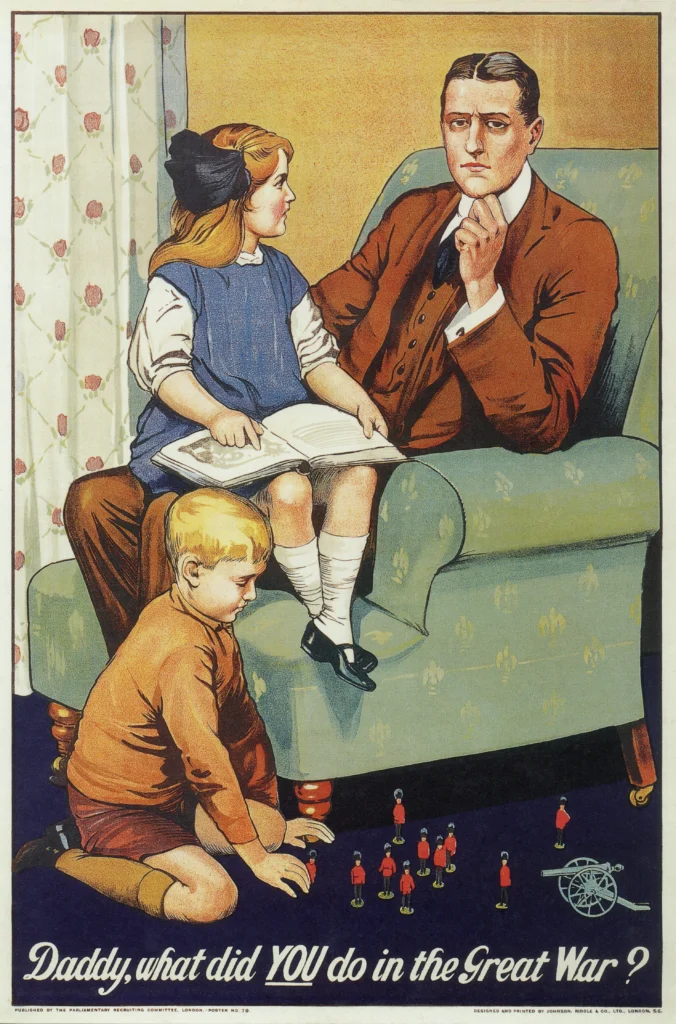
America built its own machine. President Woodrow Wilson created the Committee on Public Information in 1917, headed by journalist George Creel[s]. The CPI pioneered techniques still used today: the “Four-Minute Men,” 75,000 volunteers who delivered short patriotic speeches in movie theaters and public gatherings[s], and sophisticated poster campaigns that turned abstract war aims into visceral emotional appeals.
Edward Bernays and the Birth of Public Relations
The war’s end didn’t retire government propaganda techniques. Edward Bernays, who had worked for the CPI, saw peacetime applications everywhere. In 1928, he published Propaganda, arguing that mass manipulation wasn’t just acceptable but necessary: “The conscious and intelligent manipulation of the organized habits and opinions of the masses is an important element in democratic society”[s].
Bernays rebranded the practice. Since “propaganda” had acquired negative associations, he called it “public relations”[s]. Drawing on his uncle Sigmund Freud’s psychological theories, he developed what he called “the engineering of consent,” providing leaders the means to “control and regiment the masses according to our will without their knowing about it”[s].
Nazi Germany: Total Control
Joseph Goebbels read Bernays’ work with admiration[s]. When Hitler appointed him Reich Minister for Propaganda and Public Enlightenment in 1933, Goebbels built something unprecedented: a peacetime ministry dedicated entirely to controlling public thought[s]. Previous government propaganda efforts had been temporary wartime measures. Goebbels made it permanent.
The ministry’s reach was total. Under the Editors Law of October 4, 1933, the regime kept registries of “racially pure” journalists, excluding Jews from the profession[s]. Daily directives specified what stories could be reported and how. Goebbels, himself a former journalist, wrote in his diary: “Any man who still has a residue of honor will be very careful not to become a journalist”[s].
The Allied Response
World War II made government propaganda an essential industry. As the U.S. National Archives describes it, “Words, posters, and films waged a constant battle for the hearts and minds of the American citizenry just as surely as military weapons engaged the enemy. Persuading the American public became a wartime industry, almost as important as the manufacturing of bullets and planes”[s].
The U.S. government recruited leading intellectuals, artists, and filmmakers[s]. Norman Rockwell’s “Four Freedoms” paintings, illustrating Roosevelt’s January 1941 speech[s], became iconic. “Rosie the Riveter” redefined femininity to serve war production. Every poster, every radio broadcast, every film served the persuasion machine.
The Cold War: Radio Waves and Jazz
After 1945, government propaganda adapted to new fronts. Voice of America, established in 1942, expanded its operations to fight communism[s]. In 1947, VOA began broadcasting to Soviet citizens; by April 24, 1949, the Soviets had begun jamming the signals[s].
Some of the most effective Cold War propaganda came through culture. Willis Conover hosted the Voice of America Jazz Hour from 1955 to 2003, reaching 30 million listeners at its peak[s]. Jazz became a weapon, demonstrating American freedom and creativity to audiences behind the Iron Curtain. The music said what speeches couldn’t.
The Permanent Campaign
Today’s governments command tools their predecessors couldn’t imagine: social media algorithms, targeted advertising, synthetic media, coordinated influence operations. The techniques pioneered by Masterman, Creel, Bernays, and Goebbels have been refined across 404 years of experimentation. Government propaganda no longer requires printing presses or radio transmitters. It lives in the devices we carry, the feeds we scroll, the information environment we inhabit.
Understanding this history matters because the techniques still work. The emotional appeals that sold war bonds in 1943 function identically in 2026. The only difference is scale, speed, and the difficulty of identifying who’s behind the message. The art of mass persuasion, perfected across four centuries, shows no sign of retiring.
The etymology of “propaganda” traces to January 6, 1622, when Pope Gregory XV established the Sacra Congregatio de Propaganda Fide, a commission of thirteen cardinals charged with spreading Catholic faith and regulating church affairs in non-Christian territories[s]. The term derives from the Latin propagare, to propagate. Within a century, it had escaped ecclesiastical confines. By the 1700s, “propaganda” appeared in English texts, and by the late 18th century it described any systematic dissemination of doctrine[s]. Government propaganda, however, would require industrialized mass communication to reach its mature form.
Ancient Precedents and Early Modern Developments
The American Historical Association’s 1944 analysis notes that in ancient Athens, “the Greeks who made up the citizen class were conscious of their interests as a group and were well informed on the problems and affairs of the city-state to which they belonged. Differences on religious and political matters gave rise to propaganda and counterpropaganda”[s]. The Greeks deployed games, theater, assembly debates, law courts, and religious festivals as persuasive instruments. Oratory, in which the Greeks excelled, served as a primary vector for shaping public belief.
The early modern period saw recognizable government propaganda campaigns. During the Spanish Armada conflict of 1588, both the Spanish and English crowns organized systematic efforts to shape opinion across Europe[s]. Sir Walter Raleigh complained of Spanish “false and slanderous pamphlets” claiming victories that never occurred, spreading “in sundry languages, in print” across France, Italy, and beyond.
The First World War: Institutionalization
World War I transformed government propaganda from episodic practice to permanent institution. The British government established its War Propaganda Bureau in 1914, operating from Wellington House in Buckingham Gate, London. Chancellor of the Exchequer David Lloyd George appointed Charles Masterman as director, with explicit instructions to encourage American entry into the war on the Allied side[s].
The operation’s scale was industrial. By June 1915, Wellington House had published 2.5 million copies of materials in seventeen languages. By February 1916, output had reached seven million copies, excluding leaflets[s]. Critically, the Bureau concealed government involvement. Materials flowed through ostensibly private channels: voluntary organizations, British embassies and consulates, barbershops, waiting rooms, and libraries. Sir Gilbert Parker’s American department supplied 512 newspapers with propaganda content without attribution[s]. The Bureau’s existence remained secret until the war’s final months.
The United States created its parallel institution through Executive Order 2594 on April 13, 1917. The Committee on Public Information, chaired by journalist George Creel, comprised the Secretaries of State, War, and Navy[s]. The CPI’s innovations included the Four-Minute Men program: 75,000 volunteers delivering standardized patriotic speeches at public gatherings, particularly movie theaters during reel changes[s]. The CPI operated for 26 months, pioneering techniques that would define 20th-century government propaganda.
Theoretical Developments: Bernays and the Engineering of Consent
CPI veteran Edward Bernays codified wartime lessons for peacetime application. His 1928 work Propaganda argued for systematic opinion management: “The conscious and intelligent manipulation of the organized habits and opinions of the masses is an important element in democratic society. Those who manipulate this unseen mechanism of society constitute an invisible government which is the true ruling power of our country”[s].
Bernays, nephew of Sigmund Freud, drew on psychoanalytic theory to develop “the engineering of consent,” methods enabling leaders to “control and regiment the masses according to our will without their knowing about it”[s]. He rebranded the practice as “public relations” to escape propaganda’s increasingly pejorative associations[s]. Supreme Court Justice Felix Frankfurter warned President Roosevelt against employing Bernays during World War II, describing him and his colleagues as “professional poisoners of the public mind, exploiters of foolishness, fanaticism, and self-interest”[s].
Soviet Agitprop: The Marxist Variant
The Soviet Union developed its own theoretical framework. Marxist theorist Georgy Plekhanov distinguished between propaganda (promulgating multiple ideas to individuals or small groups) and agitation (promulgating a single idea to large masses)[s]. Lenin elaborated in What Is to Be Done? (1902): “the propagandist, whose primary medium is print, explains the causes of social inequities such as unemployment or hunger, while the agitator, whose primary medium is speech, seizes on the emotional aspects of these issues to arouse his audience to indignation or action”[s].
This framework became institutional. The Agitation and Propaganda Section of the Central Committee Secretariat, established in the early 1920s, “was responsible for determining the content of all official information, overseeing political education in schools, watching over all forms of mass communication, and mobilizing public support for party programs”[s]. Every Communist Party unit from republic to locality maintained an agitprop section, with trained agitators serving as primary contacts between party and public.
Nazi Germany: The Peacetime Propaganda State
Joseph Goebbels studied Bernays’ writings with enthusiasm[s]. His Reich Ministry of Public Enlightenment and Propaganda, established March 1933, represented a structural innovation: “Creating a Propaganda Ministry was a novel idea for a country at peace. Governmental propaganda organizations had tended to be temporary committees necessitated by war or disguised as ministries of information”[s].
The Ministry’s control mechanisms were comprehensive. The Editors Law of October 4, 1933 required registries of “racially pure” editors and journalists, excluding Jews and those married to Jews from the profession[s]. Daily conferences issued detailed guidelines on permissible content. Violations meant dismissal or concentration camp. Goebbels’ diary entry captures the result: “Any man who still has a residue of honor will be very careful not to become a journalist”[s].
World War II Allied Propaganda
The Allied response matched the threat’s scale. The U.S. National Archives characterizes wartime persuasion as “almost as important as the manufacturing of bullets and planes”[s]. The government “launched an aggressive propaganda campaign with clearly articulated goals and strategies to galvanize public support, and it recruited some of the nation’s foremost intellectuals, artists, and filmmakers to wage the war on that front”[s].
Visual propaganda proved particularly effective. Norman Rockwell’s “Four Freedoms” series, translating Roosevelt’s January 6, 1941 address into domestic imagery[s], became a centerpiece of war bond drives. Government manuals analyzed poster effectiveness systematically, finding that “images of women and children in danger were effective emotional devices.”
Cold War: Technological and Cultural Dimensions
Post-1945 government propaganda exploited new transmission technologies. Voice of America, established February 1, 1942, “initially served as an anti-propaganda tool against Axis misinformation but expanded to include other forms of content like American music programs for cultural diplomacy”[s]. In 1947, VOA began Russian-language broadcasts to Soviet citizens; the Soviets initiated electronic jamming on April 24, 1949[s].
Cultural programming proved unexpectedly effective. Willis Conover’s Voice of America Jazz Hour, broadcasting from 1955 to 2003, reached 30 million listeners at its peak[s]. Jazz demonstrated American creative freedom to audiences living under information control, achieving what direct political messaging could not.
Historiographic Significance
Across 404 years, government propaganda evolved from pamphlets distributed through barbershops to algorithmic content curation. The institutional innovations, from Wellington House’s concealed operations to Goebbels’ permanent ministry to VOA’s cultural diplomacy, created templates subsequent governments adapted and refined. The techniques Bernays systematized remain operational: appeal to emotion rather than reason, target the unconscious, maintain plausible deniability about the source. Understanding this lineage illuminates both historical events and contemporary information environments.