When the Soviet Union collapsed in 1991, one institution had outlasted nearly every rival, reform, and purge thrown at it across seven decades: its secret police. The KGB surveillance state did not emerge overnight. It was engineered, directorate by directorate, informant by informant, into what scholars now recognize as the most pervasive domestic intelligence apparatus of the Cold War era[s]. Understanding how the KGB actually worked, not as a Hollywood villain but as a bureaucratic machine, reveals something uncomfortable about the architecture of authoritarian control itself.
From the Cheka to the KGB Surveillance State
The KGB’s roots stretch back to December 1917, when Lenin authorized the creation of the All-Russian Extraordinary Commission for Combating Counter-Revolution and Sabotage, known as the Cheka. Led by Feliks Dzerzhinsky, the Cheka operated with no judicial oversight and reported directly to the highest Bolshevik leadership[s]. By 1921, it had grown to a staff of more than 250,000 and was responsible for the execution of more than 140,000 people[s].
The organization changed names repeatedly: GPU in 1922, OGPU in 1923, NKVD in 1934, NKGB in 1941, MGB in 1946. Each renaming brought cosmetic reform and real expansion. Under the NKVD, Stalin’s Great Purge executed at least 681,692 people between 1937 and 1938[s]. By 1953, some 2,750,000 Soviet citizens were in jail or forced labor camps, with approximately the same number in internal exile[s].
On March 13, 1954, the Committee for State Security, the KGB, was formally established with Ivan Serov as its first chairman[s]. This time the intent was different: the KGB was designed to be controlled by senior Communist Party officials, a “sword and shield of the Communist Party” rather than a personal instrument of any single dictator[s].
How the Machine Was Built: Directorates and Departments
The KGB surveillance state operated through a system of chief directorates, each responsible for a distinct domain of control. By 1988, the KGB had five chief directorates and several smaller directorates, plus a network of administrative, technical, and support departments[s].
The First Chief Directorate handled all foreign operations and intelligence gathering. It contained geographic departments covering every region of the globe, from the United States (1st Department) to French-speaking Africa (10th Department). It also ran Directorate S, which trained and deployed “illegal” agents under false identities in foreign countries[s].
The Second Chief Directorate was responsible for internal political control of Soviet citizens and foreigners residing within the USSR, including diplomats and tourists[s]. The Third Chief Directorate dealt with military counterintelligence, stationing KGB officers at every echelon of the Soviet armed forces down to the company level[s].
The Fifth Chief Directorate, created in 1967 under Chairman Yuri Andropov, targeted what the regime called “ideological subversion“: religious dissent, national minorities, the intelligentsia, and the artistic community[s]. The Seventh Directorate provided the physical surveillance teams, personnel and technical equipment to follow and monitor the activities of foreigners and suspect Soviet citizens in cities like Moscow and Leningrad[s].
5 Million Eyes: The Informant Network
The reach of the KGB surveillance state extended far beyond its official personnel. Western estimates of KGB manpower ranged from 490,000 in 1973 to 700,000 in 1986[s]. But the uniformed corps was only the visible fraction. According to KGB insiders, over half of KGB personnel, roughly 220,000 case officers, were involved in operative activities with secret informers, each controlling approximately 20 informants. That arithmetic yields a minimum of 4.5 to 5 million secret informers, constituting 3 to 4 percent of the adult population of the Soviet Union[s].
These informants were not just spies in the traditional sense. Students reported on other students. Workers watched coworkers. Hairdressers denounced customers. The KGB also maintained a broad network of special departments in all major government institutions, enterprises, and factories, each staffed by one or more KGB representatives whose purpose was to ensure the observance of security regulations and to monitor political sentiments among employees[s].
Tools of Suppression: From Arrest to Psychiatric Ward
The KGB was empowered by law to arrest and investigate individuals for political crimes including treason, espionage, terrorism, sabotage, and anti-Soviet agitation and propaganda[s]. But when formal charges were inconvenient, the KGB frequently enlisted the MVD and the Procuracy to instigate proceedings against political nonconformists on charges like hooliganism or drug abuse[s].
One of the KGB surveillance state’s most disturbing instruments was punitive psychiatry. Approximately one-third of political prisoners in the Soviet Union were locked up in psychiatric hospitals rather than conventional prisons[s]. The diagnosis of “sluggish schizophrenia,” developed by the Moscow School of Psychiatry under Professor Andrei Snezhnevsky, provided the framework: its symptoms could include “reform delusions,” “struggle for the truth,” and “perseverance”[s]. Prominent dissidents like Andrei Sakharov and Aleksandr Solzhenitsyn endured surveillance, internal exile, and periods of detention[s].
What the Archives Revealed
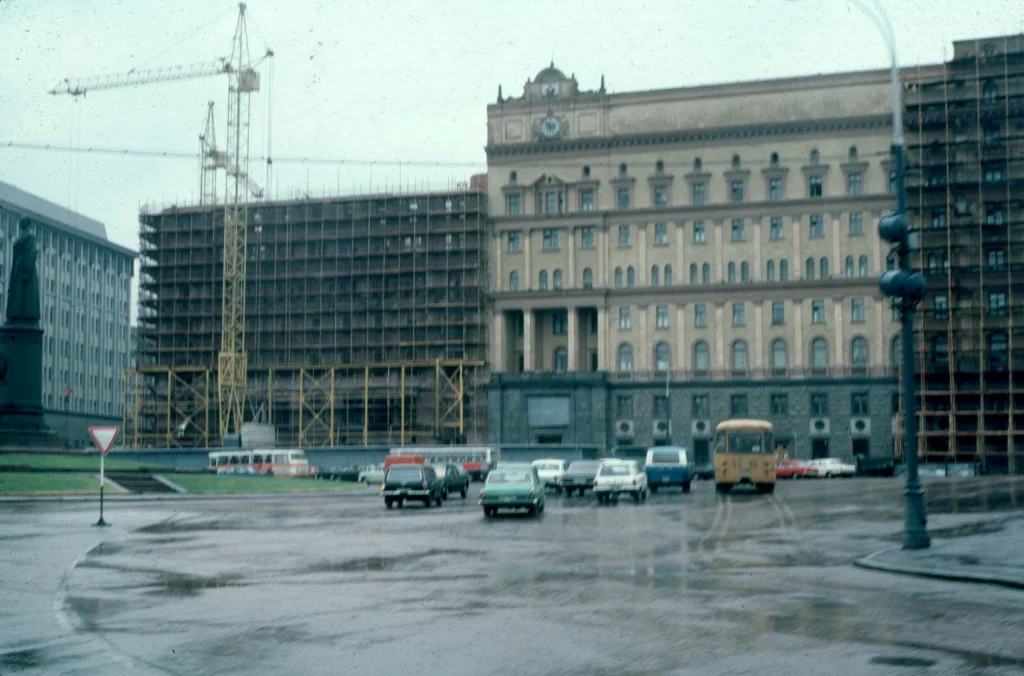
Much of what we now know about how the KGB surveillance state actually functioned comes from defectors and opened archives. Vasili Mitrokhin, a KGB archivist who supervised the transfer of the First Chief Directorate’s archives from the Lubyanka to Yasenevo in the 1970s, secretly copied documents by hand for over a decade. When he defected to the United Kingdom in 1992, he brought six trunks of notes[s]. His materials revealed the KGB’s deep involvement in Afghanistan, its “false flag” guerrilla operations, and the scope of its penetration into Western intelligence agencies.
When Soviet archives were opened in the 1990s, researchers with access to Communist Party records put the number of KGB personnel at more than 480,000, including 200,000 soldiers in the Border Guards[s]. Scholars now generally agree that the KGB and its predecessor agencies were responsible for the deaths of tens of millions of people[s].
Legacy: The Machine Endures
When the Soviet Union dissolved in 1991, the KGB formally disbanded. Its foreign intelligence wing became the SVR; domestic security passed to the FSK, which evolved into the FSB in 1995[s]. But the personnel, archives, and internal structures remained largely intact.
In 1998, Vladimir Putin, a former KGB officer stationed in East Germany, became FSB director. Within two years he was president[s]. Under his administration, former intelligence officers filled key positions across the judiciary, media, and business. The KGB surveillance state did not vanish; it adapted. The filing cabinets gave way to digital surveillance, but the logic of the system, the assumption that the state’s security requires the permanent monitoring of its own citizens, survived the Cold War that created it.
The KGB surveillance state represents perhaps the most extensively documented case study in how authoritarian regimes construct institutional control over their own populations. The Committee for State Security, formally established on March 13, 1954, was not a rupture with the past but the culmination of nearly four decades of iterative institutional design stretching back to the Cheka of 1917[s]. Its organizational architecture, informant networks, and methods of suppression offer essential primary material for understanding how surveillance states function at scale.
Institutional Lineage: The KGB Surveillance State and Its Predecessors
The Cheka, established in December 1917 under Feliks Dzerzhinsky, operated with no judicial oversight and assumed responsibility for arresting, imprisoning, and executing “enemies of the state,” including the former nobility, the bourgeoisie, and the clergy[s]. By 1921, it had grown to more than 250,000 staff and was responsible for over 140,000 executions. When Soviet archives opened in the 1990s, these figures were confirmed from internal records[s].
The institutional succession moved through the GPU (1922), OGPU (1923), NKVD (1934), NKGB (1941), and MGB (1946). Each iteration expanded operational scope. The OGPU directed a vast army of informers in factories, government offices, and the Red Army by the early 1930s[s]. The NKVD carried out the Great Purge: internal records document at least 681,692 executions under Order No. 00447 between 1936 and 1938[s]. The NKVD’s Polish Operation of 1937-1938 alone resulted in over 111,000 executions[s].
By 1953, approximately 2,750,000 Soviet citizens were in jail or forced labor camps, with roughly the same number in internal exile[s]. The KGB’s 1954 establishment was partly a response to the dangers of unchecked security power: the new agency was designed to be controlled by senior Communist Party officials through the Politburo, unlike the personal fiefdoms that Beria and Yezhov had built[s].
Organizational Architecture: The Directorate System
The KGB operated as a union-republic state committee with ministerial status, controlling corresponding committees in the fourteen non-Russian republics. Below the republic level, KGB administrations (upravleniia) existed in the kraia and oblasts. At lower levels, autonomous districts, cities, and raiony had KGB departments or sections[s]. The KGB was directed by a chairman, one or two first deputy chairmen, and typically four to six deputy chairmen. Key decisions were made by the KGB Collegium, a collective leadership body[s].
Unlike local branches of most union-republic agencies such as the MVD, which were subject to dual subordination, regional KGB branches were subordinated only to the KGB hierarchy, not to local soviets[s]. This centralization was a defining feature of the KGB surveillance state.
By 1988, the KGB contained the following principal directorates[s]:
- First Chief Directorate (Foreign Operations): Responsible for all foreign intelligence, divided into geographic departments (11 by the late 1980s), functional services (Directorate S for illegals, Directorate T for scientific and technical intelligence), and specialized units including Department A (disinformation) and Department V (“wet affairs,” i.e., assassinations and sabotage)[s].
- Second Chief Directorate: Internal political control of Soviet citizens and foreigners within the USSR[s].
- Third Chief Directorate (Armed Forces): Military counterintelligence, divided into twelve departments overseeing all military and paramilitary formations. Officers stationed at every echelon down to company level, in each military district, with every naval group, at each military front, reporting through their own chain of command to KGB headquarters[s].
- Fourth Directorate (Transportation Security): Created by Andropov in September 1981. Responsible for security of civil aviation, railroads, automobile, sea and river transport, and urban subways. Also conducted surveillance and recruitment through Soviet international transport organizations like Morflot and Aeroflot[s].
- Fifth Chief Directorate (Ideological Counterintelligence): Established in 1967 under Andropov to combat “ideological subversion.” Contained special departments for religious dissent, national minorities, the intelligentsia, artistic community, and censorship of literature[s].
- Sixth Directorate (Economic Counterintelligence): Created by Andropov in October 1982. By 1983, it covered practically all economic ministries, about 6,000 enterprises and scientific centers, and tens of thousands of Soviet scientists and specialists[s].
- Seventh Directorate (Surveillance): Physical surveillance of foreigners and suspect Soviet citizens, concentrated in Moscow and Leningrad. Also contained the Alpha counterterrorist group, formed in 1974[s].
- Eighth Chief Directorate (Communications): Monitoring foreign communications, maintaining KGB cryptological systems, and developing secure communications equipment[s].
- Ninth Directorate (Guards): A 40,000-person uniformed guard force providing bodyguard services to CPSU leaders and families, and securing major government facilities including nuclear weapons stocks[s].
- Border Troops Directorate: Protection of Soviet land and sea borders, comprising approximately 200,000 soldiers[s].
The Operations and Technology Directorate encompassed laboratories and research centers for creating surveillance devices, including Laboratory 12, which developed poisons and manufactured psychotropic substances[s].
The Informant Architecture: Scale and Method
The informant network was the true engine of the KGB surveillance state. Western estimates of KGB manpower ranged from 490,000 in 1973 to 700,000 in 1986[s]. According to the last KGB Chairman, Vladimir Kryuchkov, the total number of KGB servicemen by August 1991 amounted to 490,000, including 220,000 Border Troops and 60,000 Government Communication Troops[s].
Critically, Kryuchkov omitted the non-uniformed apparatus. According to KGB insiders, over half of KGB personnel (approximately 220,000) were case officers involved in operative activities with secret informers, each controlling roughly 20 agents. This yields a minimum estimate of 4.5 to 5 million secret informers, representing 3 to 4 percent of the adult population[s]. Researchers with access to Communist Party archives broadly corroborated these figures, placing informer numbers “in the millions”[s].
The KGB maintained a broad network of special departments (osobye otdely) in all major government institutions, enterprises, and factories. These departments recruited informers to monitor political sentiments among employees[s]. A separate, extensive network of special departments existed within the armed forces and defense-related institutions. The KGB’s statute, unlike those of most ministerial agencies, was never published[s].
Mechanisms of Repression
The KGB was empowered to investigate political crimes including treason, espionage, terrorism, sabotage, anti-Soviet agitation and propaganda, divulgence of state secrets, smuggling, and illegal exit abroad. The Procuracy was formally charged with ensuring KGB compliance with the Code of Criminal Procedure, but in practice it had little authority, and the KGB circumvented regulations whenever politically expedient[s].
When formal political charges were inconvenient, the KGB arranged for dissidents to be charged with ordinary crimes such as hooliganism or drug abuse[s].
The systematic abuse of psychiatry constituted one of the KGB surveillance state’s most internationally condemned practices. Approximately one-third of Soviet political prisoners were confined in psychiatric hospitals[s]. The diagnostic framework rested on “sluggish schizophrenia,” a concept developed by Professor Andrei Snezhnevsky and the Moscow School of Psychiatry. Its purported symptoms included “reform delusions,” “struggle for the truth,” and “perseverance,” making virtually any form of political dissent diagnosable as mental illness[s]. The practice was so extensive that the Soviet psychiatric establishment was forced to withdraw from the World Psychiatric Association in 1983[s].
Foreign Operations and the Intelligence War
The First Chief Directorate made the KGB the world’s largest foreign intelligence service[s]. During World War II, Soviet intelligence networks like the “Red Orchestra” comprised several hundred agents and informers, including agents in the German ministries of foreign affairs, labor, propaganda, and economics. Declassified documents indicate the Soviet Union had placed at least five agents in the U.S. nuclear weapons program and possibly as many as 300 agents in the U.S. government by 1945[s].
Department V of the First Chief Directorate handled “wet affairs” (mokrie dela): murders, kidnappings, and sabotage. Previously known as the Thirteenth Department, it was enlarged and redesignated in 1969 and tasked with sabotaging critical infrastructure to immobilize Western countries during future crises[s].
The Mitrokhin Archive, compiled by KGB archivist Vasili Mitrokhin between 1972 and 1984 during his supervision of the archive transfer from the Lubyanka to Yasenevo, provided unprecedented insight into these foreign operations when he defected to Britain in 1992. His materials revealed, among other things, that the KGB ran 86 armed “false flag” guerrilla units in Afghanistan by January 1983[s].
Dissolution and Continuity
After the failed August 1991 coup, in which KGB Chairman Vladimir Kryuchkov played a key role, the KGB was systematically stripped of its military units and many domestic security functions[s]. The foreign intelligence wing became the SVR; domestic security passed to the FSK, later the FSB. But as Britannica’s assessment notes, “the KGB and its leaders were never held accountable for crimes against the Soviet people”[s].
Scholars broadly agree that the KGB and its predecessors were responsible for the deaths of tens of millions of people[s]. The KGB surveillance state, as a bureaucratic model, was not dismantled so much as reorganized. Its institutional DNA, the assumption that state security requires the permanent, systematic monitoring of the citizenry, persists in the successor agencies of Russia and several former Soviet republics. The filing systems changed; the logic did not.