In April 2025, tariffs between the United States and China climbed to peak levels that read like a clerical error: 145 percent on Chinese goods entering America, and 125 percent on American goods crossing the other way.[s] The figures were extreme. The sequence that produced them was anything but. Strip away the container ships and the semiconductor controls, and the trade war escalation of the 2020s runs along a groove cut in 1651, when an English shipping statute aimed squarely at the Dutch Republic helped touch off a recognizably modern commercial conflict. The 367 years between that law and Washington’s 2018 tariffs change the technology and the stakes, never the choreography.
Across five centuries, the same four steps keep arriving in order. A government raises a barrier to shield a favored industry. The targeted nation protests and asks for relief. The request is refused. Retaliation follows, aimed not at random but at the initiator’s most prized exports, and the spiral continues until trade shrinks, both sides are poorer, and in the worst cases the dispute slips its commercial banks and turns military.
The Anatomy of Trade War Escalation
Economists describe a trade war as an escalatory sequence: a country imposes tariffs or quotas to protect domestic industries, “often leading to retaliatory measures from trading partners,” disrupting supply chains and raising costs for consumers and producers alike.[s] Adam Smith had a blunter name for the opening move. He called protectionism a “beggar-thy-neighbour” policy and observed how readily it provokes a tit-for-tat response that “devolves into an all-out trade war.”[s]
What makes the pattern worth studying is not that nations quarrel over trade; they always have. It is that the quarrels follow a grammar. The trigger is almost always domestic, a legislature or a leader answering to a wronged industry at home. The retaliation is almost always strategic, the injured party hunting for the goods the initiator can least afford to lose. And the outcome almost always disappoints the side that moved first, because the shrinking of trade falls on everyone. Naming the stages makes the modern conflict legible, and it shows how little about trade war escalation is genuinely new.
1651: An Early Trade War Escalation
By the middle of the seventeenth century the Dutch Republic owned the sea. Amsterdam was the financial center of Europe, and Holland had more merchant ships than the rest of the continent’s navies combined. English traders watched the Dutch carry English woolens abroad and resell them at a profit, and they resented it. In October 1651 the Rump Parliament answered with the Navigation Act, a law requiring that all imports into England arrive in English ships or in ships of the country that produced the goods. Because the Dutch lived by carrying other nations’ cargo, the statute was a dagger pointed at their economy.[s]
The effect was immediate. The act “crippled Dutch trade and shipping, and within two months Holland sent a delegation to Parliament to ask that the Navigation Act be repealed.”[s] The Dutch offered no concessions; Parliament granted no repeal. Where the Dutch had long preached mare liberum, the freedom of the open sea, England now asserted mare clausum, a closed and private sea over which it claimed the right to stop and search any passing ship.
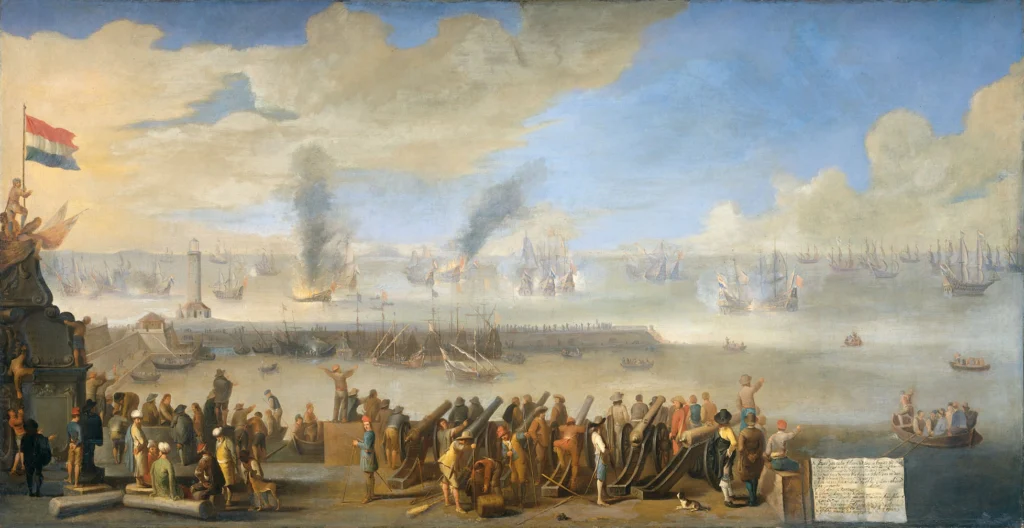
Protest having failed, the seizures began. Between October 1651 and July 1652, English privateers captured more than 100 Dutch merchant vessels on the pretext that their cargo was contraband.[s] On May 29, 1652, the Dutch admiral Maarten Tromp brought a fleet into the Straits of Dover and refused to dip his flag in salute to Robert Blake’s English warships. The two fleets traded fire for five hours, and England declared war that June. It was the first of four Anglo-Dutch wars fought across the 132 years between 1652 and 1784, and a peer-reviewed survey of trade conflict still ranks this seventeenth-century rivalry, waged with tariffs and naval blockades, among the earliest examples of a trade war.[s] For this pattern, it serves as the opening chapter of trade war escalation across five calendar centuries.
The Eighteenth Century: Mercantilism and the Fourth Dutch War
The Anglo-Dutch quarrel did not end in the 1650s; it hardened into the century that followed. The 1700s were the high noon of mercantilism, the doctrine that a nation grew rich by running trade surpluses and hoarding gold. The closest modern cousin to balancing trade flows country by country, one analysis notes, is precisely “the mercantilist policies that flourished in Europe in the 17th and 18th centuries, during which countries tried to balance trade flows while hoarding gold, ensuring that global trade was repressed.”[s] Under that logic a rival’s gain was your loss, and trade was a weapon by definition.
The Fourth Anglo-Dutch War, fought from 1780 to 1784, shows the pattern surviving into a new century with a fresh trigger. This time the spark was neutrality. As the American Revolution drained British strength, the Dutch colony of Sint Eustatius in the Caribbean became a clearing house for arms bound for the rebels, and the Dutch joined a Russian-led League of Armed Neutrality to shield their merchant ships from British boarding parties.[s] Britain read neutral commerce as hostile commerce and went to war to stop it. The grievance was new; the move, a great power punishing a smaller trading rival for commerce it could not control, was the one Parliament had first made in 1651.
1846: The Off-Ramp Britain Took
Not every trade conflict escalates. The most instructive nineteenth-century episode is the one where a great power chose the exit. Britain’s Corn Laws had taxed imported grain for centuries to guarantee high prices for landowners, and by the 1820s the sliding scale of duties had become an article of aristocratic faith. The economists despised it. Adam Smith had argued for free trade as early as 1776, and David Ricardo “had specifically applied such doctrines to agricultural protection some fifty years later,” contending that the Corn Laws raised food prices, protected inefficient farmers, and strangled Britain’s export trade.[s]
What turned theory into repeal was organization and catastrophe. The Anti-Corn Law League, led by the Manchester manufacturers Richard Cobden and John Bright, built a propaganda machine on a scale British politics had not seen. When the Irish potato harvest failed in 1845, Prime Minister Sir Robert Peel concluded that famine made the duties indefensible, and in 1846 he carried repeal, splitting his own Tory Party to do it; the Commons passed it on May 15 and the Lords followed on June 15. Repeal “was the first step in the conversion of British tariff policy to one of free trade instead of protectionism,” and that policy “persisted as dogma for more than eighty years.”[s] Britain’s unilateral surrender of protection was a rare act of strategic restraint, the road a nation takes when it decides a barrier costs more than it earns.
The same Britain practiced no such restraint abroad. While it dismantled tariffs at home, it forced foreign markets open by gunfire: the Opium Wars against Qing China turned a lopsided trade in one drug into a military rout that ended in unequal treaties and ceded territory. Free trade for oneself and coerced trade for others were two faces of the same century, a reminder that the absence of a tariff war is not the absence of trade coercion.
1930: Trade War Escalation Goes Global
The twentieth century industrialized the pattern. American agriculture had overexpanded during the First World War, and when European farms recovered and crop prices collapsed, indebted farmers demanded protection even though the United States exported more food than it imported. What began as a narrow farm tariff became, in the depths of the Great Depression, “a free-for-all, with nearly every industry demanding greater protection.”[s] The Smoot-Hawley Tariff Act, signed in June 1930, produced some of the highest duties in American history.
Then came the answer. Trading partners protested, and many went further. Using a new dataset covering 99 countries, the economists Kris James Mitchener, Kirsten Wandschneider, and Kevin Hjortshøj O’Rourke found that American exports to countries that merely protested fell by between 15 and 22 percent, while exports to countries that retaliated fell by 28 to 33 percent.[s] The retaliation was not blunt. Partners hunted the goods America could least afford to lose: retaliators “significantly reduced their purchases of key U.S. exports, especially automobiles, after Smoot-Hawley passed.”[s] The surgical instinct that led English privateers to seize Dutch cargo later led Canada and Europe to choke off American cars.
The aggregate result was trade war escalation at planetary scale. Smoot-Hawley “set off a classic trade war of reciprocal increases in tariffs,” and “world trade plummeted by two thirds as national markets closed, exacerbating the effects of the Depression.”[s] The damage outlived the decade: many economists and historians point to the tariff as not only deepening the global slump but “contributing to the rise in extremism that culminated in World War II.”[s] Congress drew the lesson, and in 1934 it handed tariff-setting power to the president through the Reciprocal Trade Agreements Act, beginning a long retreat from the brink.
1962: When Trade War Escalation Jumped Sectors
If 1930 showed the pattern’s scale, the Chicken War showed its strangest feature: escalation rarely stays in its lane. After the Second World War, American industrial farming made chicken cheap, and frozen American poultry flooded West Germany. European farmers complained, and in 1962 the new European Economic Community “imposed new tariffs and price regulations on imported chicken,” pricing American birds out of the market.[s] Washington called it protectionism; Brussels called it defending its farmers.
In 1963 President Lyndon Johnson retaliated, and here the dispute jumped the fence. Among the goods he taxed was a 25 percent duty on imported light trucks, aimed at the Volkswagen vans then selling well in America. The poultry quarrel faded; the truck tariff, nicknamed the “chicken tax,” never did, and it still shapes which vehicles Americans buy more than sixty years later.[s] The deeper lesson is one a peer-reviewed survey draws out plainly: a fight over one commodity readily becomes “a series of retaliatory measures affecting various other industries.”[s] A grievance about chicken became a permanent fixture of the car market.
2018: The Same Trade War Escalation, New Weapons
The current conflict began, as the others did, with a domestic grievance dressed as policy. The trade war “started in 2018 when the U.S.-China trade deficit hit its highest point: more than $377 billion,” and Washington imposed tariffs on hundreds of billions of dollars of Chinese goods.[s] Beijing protested, then retaliated, and the duties climbed in lockstep. As one trade scholar summarizes the first round, “Trump imposed tariffs on Chinese goods, then China imposed tariffs on U.S. goods. Duties spiraled up, and trade spiraled down until the two sides called a ceasefire and preserved rates at their then-elevated levels.”[s]
The strategic targeting was textbook. China aimed its tariffs at American soybeans, one of the few goods the United States sold it in bulk, the twenty-first-century equivalent of the automobiles that retaliators throttled in 1930. By April 2025 the second-term escalation had driven tariffs to a peak of 145 percent on Chinese goods and 125 percent on American goods. CFR, citing research by the Peterson Institute for International Economics, says United States imports and exports with China fell more than 25 percent by the end of 2025; by late November 2025, the two governments had reduced tariff rates to 30 percent and 10 percent, respectively.[s]
What is new is the arsenal, not the logic. The weapons now include export controls on rare-earth minerals and advanced semiconductors, tools that can choke a rival’s factories without a single tariff. By June 2026 CFR described the two governments as maintaining a fragile truce after a May summit in Beijing, but said high tariffs, rare-earth restrictions, and tech export controls remained major sticking points, with the bulk of trade-war tariffs still in place.[s] Like every initiator before them, both sides learned that starting a trade war is easier than ending one, and that an aggressor can set off an escalation they cannot contain.
Why Trade War Escalation Keeps Repeating
Three structural facts explain why trade war escalation recurs with such regularity. The first is that the trigger is always domestic. Tariffs are written by legislators and leaders answering to specific wronged industries: Midwestern farmers in 1930, French poultry growers in 1962, Rust Belt workers in 2018. The political reward is immediate and concentrated; the cost is diffuse and arrives later. The second is that retaliation is intelligent. A rival does not match a tariff dollar for dollar; it finds the export the initiator cannot replace and strikes there, whether that export is English woolens, American automobiles, or American soybeans. The third is that the outcome betrays the intent. The policy is sold as protection, but because it shrinks the total volume of trade, “the economic pie tends to shrink for everyone involved.”[s]
History also records the exits. A nation can defuse the spiral on its own terms, as Britain did when it repealed the Corn Laws, and as Washington and Tokyo did in the 1980s, when they capped the flood of Japanese cars through negotiated voluntary export restraints rather than trading tariff for tariff.[s] Or it can bind itself to rules, as the world did after 1930 by building the institutions, from the Reciprocal Trade Agreements Act to the GATT and the World Trade Organization, designed to convert tariff fights into arbitration. Those guardrails are precisely what the current trade war escalation has strained, as the major powers reach again for the tariff, the embargo, and the export ban.
The script is old enough now to read as prophecy. A barrier goes up, a protest is filed and ignored, the injured party retaliates where it hurts most, and the damage outruns everyone’s plan. Nearly four centuries after an English shipping law set Dutch and English fleets firing in the Channel, the choreography of trade war escalation has not changed. The only open question, as it was in 1651, is whether anyone will choose the off-ramp before the spiral chooses for them.