In the spring of 1839, a Chinese official named Lin Zexu stood on the banks of a trench near the port of Canton and watched as workers dissolved more than 20,000 chests of opium in lime and salt water before flushing the toxic slurry into the sea. It was one of the largest drug seizures in history, some 1,400 tons of the substance[s] confiscated from British merchants. The act was meant to end a crisis. Instead, it started a war. The opium wars china suffered between 1839 and 1860 would break open an empire, redraw the map of Asia, and establish a template for Western imperialism that endured for generations.
The Trade Imbalance That Started It All
For centuries, European merchants craved Chinese goods: silk, porcelain, and above all, tea. By the early 1800s, tea had become a staple of daily British life, and the East India Company was importing vast quantities[s]. The problem was that China wanted almost nothing in return. As the Qianlong Emperor had famously told a British trade delegation: “Our celestial empire possesses all things in abundance and lacks no product within its borders.”[s]
Britain was hemorrhaging silver to pay for its tea habit. The trade imbalance left Western powers scrambling[s] to find something, anything, that China would buy. The East India Company found its answer in the poppy fields of Bengal.
Opium Wars China: Weaponizing Addiction
Britain started growing opium in its Indian colonies and exporting it to China[s], where it spread through the population with devastating speed. The operation was a masterpiece of cynical commerce: the Company grew the poppies, auctioned the raw opium in Calcutta, and then private traders smuggled it into China aboard British ships. British exports of opium to China grew from an estimated 15 long tons in 1730 to 75 long tons in 1773[s], and the trajectory only steepened.
China banned opium imports in 1799, but enforcement was nearly impossible across a vast coastline. By the early 19th century, the British were smuggling in over 1,000 tonnes per year[s]. The silver drain reversed: now it was China losing its currency reserves to pay for a drug its own laws prohibited. By 1838, the number of Chinese opium addicts had grown to between 4 and 12 million[s].
Lin Zexu’s Stand
The Daoguang Emperor had seen enough. In late 1838, he appointed Lin Zexu as Special Imperial Commissioner with extraordinary powers to crush the trade. Lin was a leading scholar-official[s] with a reputation for integrity, and he attacked the problem from every angle: arresting Chinese dealers, blockading foreign merchants in their Canton warehouses, and demanding they surrender their opium stocks.
Before resorting to seizure, Lin tried diplomacy. He wrote a remarkable letter to Queen Victoria, a document that reads as both a moral appeal and a legal argument. “I have heard that the smoking of opium is very strictly forbidden by your country; that is because the harm caused by opium is clearly understood,”[s] Lin wrote. “Since it is not permitted to do harm to your own country, then even less should you let it be passed on to the harm of other countries, how much less to China!”[s]
Lin also made a pointed observation about the asymmetry of trade: “Of all that China exports to foreign countries, there is not a single thing which is not beneficial to people.”[s] Britain, by contrast, was sending poison. The letter went unanswered. Britain chose war.
The First Opium War (1839-1842)
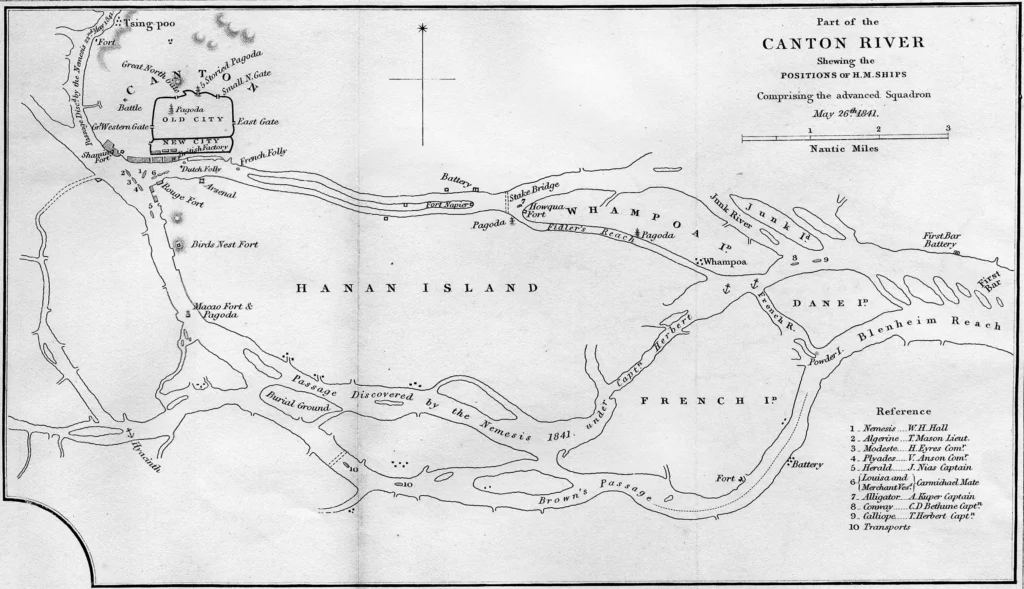
The military mismatch was stark. Britain’s Royal Navy, the most powerful fleet on earth, faced a Qing navy that had barely modernized since the 17th century. British warships destroyed a Chinese blockade of the Pearl River estuary at Hong Kong[s], and an expeditionary force arrived in June 1840. Over two years, the British seized port after port along the Chinese coast, pushing north until they captured Nanjing in August 1842.
The resulting Treaty of Nanjing was the first of what the Chinese would call the “unequal treaties.” China was forced to pay a large indemnity, cede Hong Kong Island to the British, and open five treaty ports[s] to Western trade. A supplementary treaty granted British citizens extraterritoriality, meaning they could not be tried under Chinese law. The opium wars china was forced to accept were not just military defeats; they were a fundamental assault on Chinese sovereignty.
The Second Opium War and the Burning of the Summer Palace
The peace did not last. By the mid-1850s, Britain wanted more: legalization of opium, access to the Chinese interior, and a diplomatic presence in Beijing. A pretext arrived in 1856 when Chinese officials boarded the Arrow, a British-registered ship, and arrested its crew. Britain, now joined by France, launched a second war.
The treaties of Tianjin, signed in June 1858, provided residence in Beijing for foreign envoys, the opening of several new ports, the right of foreign travel in the interior of China, and freedom of movement for Christian missionaries.[s] The importation of opium was legalized. When the Qing court resisted ratification, Anglo-French forces marched on Beijing itself.
In October 1860, they committed an act of cultural destruction that still reverberates. European troops looted and demolished the Summer Palace[s], an 18th-century imperial retreat of extraordinary beauty and cultural significance. The forces plundered and then burned the Yuanming Garden[s], destroying thousands of irreplaceable artworks, manuscripts, and architectural treasures. The Convention of Beijing that followed forced China to pay 8 million taels to Britain and France[s], cede Kowloon to Britain, and formally legalize the opium trade.
Why the Opium Wars China Endured Still Matter
The treaties that ended the opium wars china suffered were not negotiated between equals. They were dictated at gunpoint, and their consequences cascaded across more than a century. The “unequal treaties” gave foreigners privileged status and extracted concessions from the Chinese[s], establishing a system of foreign control that other Western powers and Japan were quick to exploit.
In the wake of the settlement, China legalized the trade and consumption of opium, setting the stage for the spread of opium smoking throughout the population.[s] The human cost was staggering. What had begun as a commercial strategy to balance Britain’s tea imports became a public health catastrophe affecting millions of Chinese families for generations.
The period from 1839 to 1949, which Chinese historians call the “Century of Humiliation,” began with the opium wars china was forced into. The Qing dynasty never recovered. The military humiliation fueled internal rebellions, most devastatingly the Taiping Rebellion, which killed an estimated 20 million people[s]. The dynasty finally collapsed in 1912, and the trauma of foreign domination shaped Chinese politics, nationalism, and foreign policy throughout the 20th century and into the 21st.
The pernicious influence of opium in Chinese society and the increasing outflow of silver[s] were problems the Qing dynasty identified clearly and tried to solve through law, diplomacy, and finally force. They lost not because their cause was unjust, but because industrialized military power overwhelmed them. The opium wars china endured remain one of the starkest examples in modern history of a nation being compelled, by violence, to accept its own destruction.
The opium wars china fought against Britain and France between 1839 and 1860 occupy a central position in modern historiography, not only as the opening chapter of what Chinese scholars term the “Century of Humiliation” (bainian guochi), but as a case study in the intersection of free trade ideology, imperial violence, and narcotic commerce. When Commissioner Lin Zexu destroyed more than 20,000 chests of opium, some 1,400 tons[s], at Humen in June 1839, he triggered a sequence of events that would fundamentally reshape China’s relationship with the outside world.
The Political Economy of Opium Wars China
The structural origins of the conflict lie in the 18th-century Sino-British trade relationship. Western traders had long sought a variety of Chinese products, including furniture, silk and tea, but found there were few products that China wanted from the West.[s] The Qianlong Emperor’s dismissal of the Macartney Embassy in 1793 is often cited as emblematic of Chinese insularity, but the economic logic was straightforward: China ran a trade surplus because its goods were in demand and European manufactures were not.
The East India Company’s solution was to cultivate opium in Bengal and Malwa, auction it in Calcutta, and channel it to China through private “country traders” who operated outside the Company’s official monopoly. British exports of opium to China grew from an estimated 15 long tons in 1730 to 75 long tons in 1773[s], and by the 1830s the trade had exploded to over 1,000 tonnes annually. The pernicious influence of opium in Chinese society and the increasing outflow of silver alarmed the Qing dynasty[s], which saw both a public health crisis and a fiscal emergency: silver was flowing out to pay for a commodity that was destroying its population.
Lin Zexu and the Moral Argument
The Daoguang Emperor’s appointment of Lin Zexu in late 1838 represented the triumph of the suppression faction at court over those who advocated legalization and taxation. Lin was a proponent of the revitalization of traditional Chinese thought and institutions[s], and he brought both administrative competence and moral conviction to Canton.
His letter to Queen Victoria, preserved in translation by Teng and Fairbank in China’s Response to the West (Harvard, 1954), remains a primary source of exceptional clarity. Lin’s central argument was one of reciprocity: “I have heard that the smoking of opium is very strictly forbidden by your country; that is because the harm caused by opium is clearly understood. Since it is not permitted to do harm to your own country, then even less should you let it be passed on to the harm of other countries.”[s]
Lin further argued that the trade was fundamentally asymmetric. China exported tea, silk, porcelain: “not a single thing which is not beneficial to people.”[s] Britain exported a substance that destroyed them. The letter also threatened enforcement: anyone bringing opium to China would face “decapitation or strangulation.” Whether Victoria ever read it remains debated among historians.
Military Dimensions of the Opium Wars China Lost
The military disparity between Britain and the Qing empire reflected the broader divergence between an industrializing maritime power and a continental agrarian state. British warships destroyed a Chinese blockade of the Pearl River estuary[s] in November 1839, and the expeditionary force that arrived in 1840 systematically captured coastal positions, exploiting superior naval gunnery, steam-powered vessels, and disciplined infantry tactics.
The Treaty of Nanjing (August 29, 1842) imposed five treaty ports (Canton, Amoy, Fuzhou, Ningbo, Shanghai), a large indemnity, and the cession of Hong Kong Island[s]. The supplementary Treaty of the Bogue (1843) added extraterritoriality and most-favored-nation clauses. As the U.S. Office of the Historian notes, these agreements “gave foreigners privileged status and extracted concessions from the Chinese.”[s]
The Second Opium War (1856-1860) escalated the pattern. The Arrow Incident provided Britain a casus belli; France joined after the murder of a missionary. The treaties of Tianjin (1858) provided residence in Beijing for foreign envoys, new ports, the right of foreign travel in the interior, and freedom of movement for missionaries.[s] When the Qing resisted ratification, Anglo-French forces advanced on Beijing and, in October 1860, looted and demolished the Summer Palace[s], an act of calculated cultural violence.
The Convention of Beijing (1860) required 8 million taels in reparations[s], ceded Kowloon, and legalized opium. China legalized the trade and consumption of opium, setting the stage for the spread of opium smoking throughout the population.[s]
Historiographic Debates and Legacy
The historiography of the opium wars china endured has itself been contested terrain. As Miriam Kingsberg Kadia observes, there has been “a tendency to write opium out of the story entirely, thereby obscuring (and absolving) the central role of Western imperialism.”[s] Euphemistic labels like “Arrow War” or “Anglo-French expedition to China” sanitize what was, at its core, a narco-imperial project.
The estimated 4 to 12 million Chinese opium addicts by 1838[s] represented a public health disaster of staggering proportions, one that predated the wars and was massively amplified by the forced legalization that followed. The unequal treaty system that emerged from the opium wars china was subjected to persisted, in various forms, until 1943, when extraterritorial privileges were formally abolished.
The legacy is not merely historical. The “Century of Humiliation” narrative remains central to Chinese political identity. The opium wars china remembers are not distant events but foundational grievances, invoked by Chinese leaders from Sun Yat-sen to Xi Jinping to explain why sovereignty, territorial integrity, and resistance to foreign pressure remain non-negotiable principles of Chinese statecraft. Understanding these wars, in their full economic, military, and moral dimensions, is essential to understanding the world China navigates today.