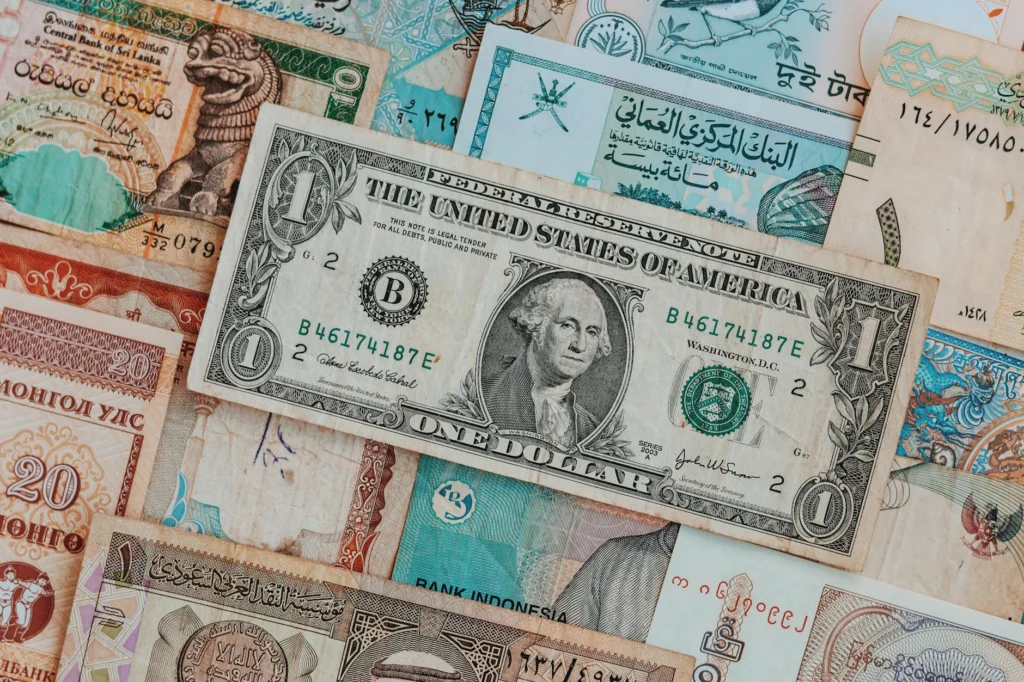
Every time a country buys oil on the global market, it almost certainly pays in US dollars. This arrangement, known as the petrodollar system, has quietly underwritten American economic power for over half a century. It is not the product of a formal treaty or international law. It grew out of a secret Cold War-era deal between Washington and Riyadh, and it has shaped everything from US government borrowing to the price of groceries worldwide.
Now, for the first time since the 1970s, the petrodollar system faces credible challenges from multiple directions: Saudi Arabia is diversifying its partnerships, China is building alternative payment infrastructure, and a growing number of countries are settling oil trades in currencies other than the dollar.
How the Petrodollar System Was Born
The story begins with a crisis. In 1971, President Richard Nixon closed the “gold window,” ending the ability of foreign governments to exchange US dollars for gold at the fixed rate of $35 per ounce that had anchored the global monetary system since 1944.[s] By the 1960s, military spending and foreign aid had flooded the world with more dollars than the United States had gold to back, and the system was buckling under its own contradictions.[s]
Two years later, in October 1973, Arab oil producers imposed an embargo on the United States in retaliation for Washington’s support of Israel during the Yom Kippur War. Oil prices quadrupled, from $2.90 a barrel to $11.65 by January 1974.[s] The American economy reeled. Gas stations ran dry. Inflation surged.
The Nixon administration saw an opportunity in the wreckage. Secretary of State Henry Kissinger negotiated a secret arrangement with Saudi Arabia: the kingdom would price its oil exclusively in US dollars and invest its enormous oil revenues in US Treasury bonds. In return, Washington would provide military equipment and guarantee Saudi security.[s] No formal treaty was ever signed; the arrangement was kept confidential for over four decades, until Bloomberg News reported on confidential diplomatic cables obtained from the US National Archives in 2016.[s][s]
Why It Matters to Everyone
The petrodollar system created a self-reinforcing cycle. Because oil, the most traded commodity on earth, was priced in dollars, every country needed dollars to buy it. That demand kept the currency strong. Oil exporters, flush with dollars they could not spend fast enough at home, recycled those revenues into US Treasury bonds, effectively lending money back to the American government at favorable rates. This allowed Washington to run large budget deficits without the punishing interest rates that would normally follow.
For ordinary Americans, the arrangement meant cheaper borrowing, lower import costs, and a stronger currency. For the rest of the world, it meant dependence on a financial architecture centered in Washington, with all the leverage that implies.
The scale of this dependence is staggering. Gulf Cooperation Council states currently require an estimated $800 billion in dollar reserves to maintain their currency pegs, and GCC sovereign wealth funds hold more than $2 trillion in US assets.[s]
Cracks in the Petrodollar System
The arrangement held for decades because no viable alternative existed. That is changing. In 2024, Saudi Arabia did not formally renew its commitment to pricing oil exclusively in dollars.[s] While the original deal was never a formal obligation, and Saudi Arabia still conducts the vast majority of its oil trade in dollars, the symbolic shift matters. In 2023, the kingdom signed a $7 billion currency swap agreement with China[s] and its finance minister publicly stated openness to settling trades in non-dollar currencies at the World Economic Forum.[s]
The dollar’s share of global reserves has fallen from 71% in 1999 to 56.3%, with central banks purchasing over 1,000 metric tons of gold annually for three consecutive years.[s] China has slashed its US Treasury holdings from $1.3 trillion in 2013 to $682 billion by November 2025.[s]
A JP Morgan banker estimated that roughly one-fifth of global oil was bought and sold in non-dollar currencies by 2023.[s] Russia and Iran, both under US sanctions, have shifted much of their oil trade to the Chinese yuan. China now accounts for 90% of Iran’s oil exports.[s]
What Comes Next
The petrodollar system is not collapsing overnight. The dollar still dominates cross-border trade: over 90% in the Americas, roughly 70% in the Asia-Pacific, and about 20% in Europe, according to Deutsche Bank.[s] As economist Fadhel Kaboub of Denison University put it, “I’m not going to say that the petrodollar is dead, because that’s wrong. It still overwhelmingly dominates international transactions.”[s]
But the monopoly is over. The question is whether the erosion remains gradual, measured in percentage points per decade, or whether a geopolitical shock accelerates the timeline. The Asia Society Policy Institute concluded in a January 2025 report that “complete de-dollarization of the oil trade is highly unlikely over the next five years,” but warned of “gradual erosion of the dollar’s use in oil trade settlement.”[s]
For 52 years, the petrodollar system operated as the hidden architecture of American financial power. Its slow unraveling may prove to be one of the defining economic stories of this decade.
The petrodollar system, the informal arrangement by which global oil trade is denominated and settled in US dollars, has functioned as a structural pillar of American monetary hegemony since 1974. It was never codified in a treaty. It emerged from crisis-driven diplomacy, survived through institutional inertia and genuine comparative advantage, and now faces its most serious challenge since inception. Understanding how it works, and why it persists even as alternatives emerge, requires examining the mechanics rather than the mythology.
Origins: From Bretton Woods to the Petrodollar System
The Bretton Woods system, established in 1944, pegged the dollar to gold at $35 per ounce and fixed other currencies to the dollar.[s] It worked as long as US gold reserves could credibly back the dollars in global circulation. By the 1960s, that credibility was eroding: military expenditures in Vietnam, foreign aid commitments, and capital outflows had produced more foreign-held dollars than the United States had gold to redeem.[s] The structural flaw was what economist Robert Triffin had identified years earlier: a country issuing a global reserve currency must run persistent current account deficits to supply the world with liquidity, but those deficits eventually undermine confidence in the currency itself.[s]
Nixon’s August 15, 1971, suspension of gold convertibility addressed the immediate gold-run problem but created a new one: without the gold anchor, what would sustain global demand for dollars? The answer arrived through crisis. By March 1973, the G-10 had abandoned fixed exchange rates entirely.[s] Then came the October 1973 OAPEC embargo, which quadrupled oil prices from $2.90 to $11.65 per barrel.[s]
The embargo devastated the US economy, but it also created the conditions for a new monetary anchor. Kissinger’s subsequent negotiations with Riyadh produced the core bargain: Saudi Arabia would price oil in dollars and recycle its surging revenues into US Treasuries; Washington would provide military protection and equipment.[s] The arrangement was kept secret, and its details remained classified until Bloomberg News reported on confidential diplomatic cables obtained from the US National Archives in 2016.[s][s] Importantly, no formal treaty was ever signed; the American Institute of Economic Research confirmed that “the use of U.S. dollars in oil trade had never been dictated by a formal treaty.”[s]
The Mechanics of Petrodollar Recycling
The petrodollar system operates through a feedback loop with three components. First, oil exporters price their commodity in dollars, guaranteeing baseline global demand for the currency. Second, exporters accumulate dollar surpluses they cannot absorb domestically, particularly given the scale of the revenue shift: Saudi oil export earnings increased 40-fold between 1965 and 1975, from $655 million to nearly $27 billion.[s] Third, those surpluses flow back into US financial assets, primarily Treasuries, financing American fiscal deficits and depressing borrowing costs.
This recycling mechanism was facilitated through the US-Saudi Arabian Joint Commission on Economic Cooperation, established in 1974.[s] The downstream effects extend far beyond oil. As former Ecuadorian central bank director Andrés Arauz explained, the petrodollar system created “a dollar-denominated value chain with global and international repercussions,” encompassing derivatives, petrochemicals, and the upstream technology required for extraction.[s]
The system also locked in structural dependence. GCC states maintain an estimated $800 billion in dollar reserves to support their currency pegs, and their sovereign wealth funds hold over $2 trillion in US assets.[s] Economist Fadhel Kaboub of Denison University described this as an “exorbitant privilege” that “created a locked-in system that gives the US dollar a privilege as the dominant payment system and gives the opportunity to weaponise this system.”[s]
Causation Runs Both Ways
A persistent analytical error in petrodollar discourse conflates correlation with causation. Historian David Wight, author of Oil Money: Middle East Petrodollars and the Transformation of US Empire, 1967-1988, argues that the causal arrow often points the wrong direction: “Saving oil in dollars is not fundamentally what makes the dollar powerful in global trade. The power of the dollar in global trade is why most oil is sold for dollars.”[s]
This distinction matters for assessing the system’s resilience. The dollar’s reserve status rests on multiple foundations: the depth and liquidity of US capital markets, the rule of law protecting property rights, the size of the US economy (still roughly 25% of global GDP[s]), and the absence of a comparably liquid alternative. Oil pricing reinforces these advantages but did not single-handedly create them.
De-dollarization Vectors
The petrodollar system’s erosion is proceeding along several distinct channels.
Sanctions blowback. Washington’s increasing use of financial sanctions has provided the strongest incentive for diversification. Russia, after Western sanctions following its 2014 annexation of Crimea, executed a currency swap with China worth 150 billion yuan (approximately $25 billion).[s] Iran, under comprehensive US sanctions, has shifted to yuan-denominated oil sales; China now purchases 90% of Iran’s exported oil.[s] Former central banker Arauz identified the “weaponisation of the hegemonic banking system” as the primary accelerant of diversification efforts.[s]
Saudi rebalancing. China displaced the United States as Saudi Arabia’s largest oil customer, and Riyadh has responded accordingly. In 2023, the kingdom signed a $7 billion currency swap with Beijing[s] and its finance minister signaled openness to non-dollar settlements at the World Economic Forum.[s] In 2024, Saudi Arabia did not formally renew its commitment to exclusive dollar pricing.[s]
Alternative infrastructure. China launched the Shanghai International Energy Exchange in 2018, providing a yuan-denominated oil futures market.[s] The Saudi central bank participates in the mBridge digital payment platform, which enables direct currency exchanges via blockchain.[s] ECB President Christine Lagarde identified the current moment as a potential “global euro moment” in May 2025.[s]
Reserve diversification. The dollar’s share of global foreign exchange reserves has declined from 71% in 1999 to 56.3%.[s] Central banks have purchased over 1,000 metric tons of gold annually for three consecutive years. China has reduced its US Treasury holdings from $1.3 trillion in 2013 to $682 billion by November 2025.[s]
Constraints on the Petroyuan
Despite these trends, structural barriers limit the yuan’s ability to replace the dollar in oil markets. The renminbi is not fully convertible; Beijing maintains capital controls that make holding large yuan reserves risky for foreign governments. As Bloomberg’s Javier Blas has argued, China has historically sought to manipulate commodity prices when they rise too high, and oil exporters have little incentive to cede pricing power to Beijing after spending 60 years building OPEC’s price-management capacity.[s]
A JP Morgan estimate put the share of global oil traded in non-dollar currencies at roughly 20% in 2023[s], a meaningful increase but far from a tipping point. Dollar-based trade invoicing still exceeds 90% in the Americas and 70% in the Asia-Pacific region.[s]
Assessment: Erosion, Not Collapse
The Asia Society Policy Institute’s January 2025 report, authored by Enodo Economics chief economist Diana Choyleva, concluded that “complete de-dollarization of the oil trade is highly unlikely over the next five years” but projected “gradual erosion of the dollar’s use in oil trade settlement and the global recycling of oil revenues.”[s] The report identified three scenarios: managed evolution with incremental yuan-based settlements, external shock from geopolitical conflict or technological disruption, and a rapid strategic pivot by Gulf states toward Chinese systems.
The petrodollar system persists not because of the 1974 handshake but because the dollar still offers unmatched liquidity, convertibility, and institutional credibility. Those advantages are real, but they are not permanent. As the Atlantic Council’s Hung Tran observed, “how Saudi Arabia approaches the petrodollar remains an important harbinger of the financial future to come as its creation was fifty years prior.”[s]
The petrodollar system built over 52 years is not dying, but it is losing its monopoly position. For analysts, the relevant question is no longer whether alternatives will emerge, but how quickly the transition proceeds and whether it remains orderly.