Film noir history begins not in Hollywood, but in postwar Paris. In August 1946, French critic Nino Frank watched a batch of American crime films that had been banned during the Nazi occupation and noticed something strange: these were not ordinary detective stories[s]. The concern of these new films, Frank observed, “was less with the solution of a crime than with an exploration of the human frailties of the protagonists and the psychology driving their behaviour.”[s] He called them “films noirs,” meaning “dark films,” and a genre was christened.
What Makes Film Noir History Distinct
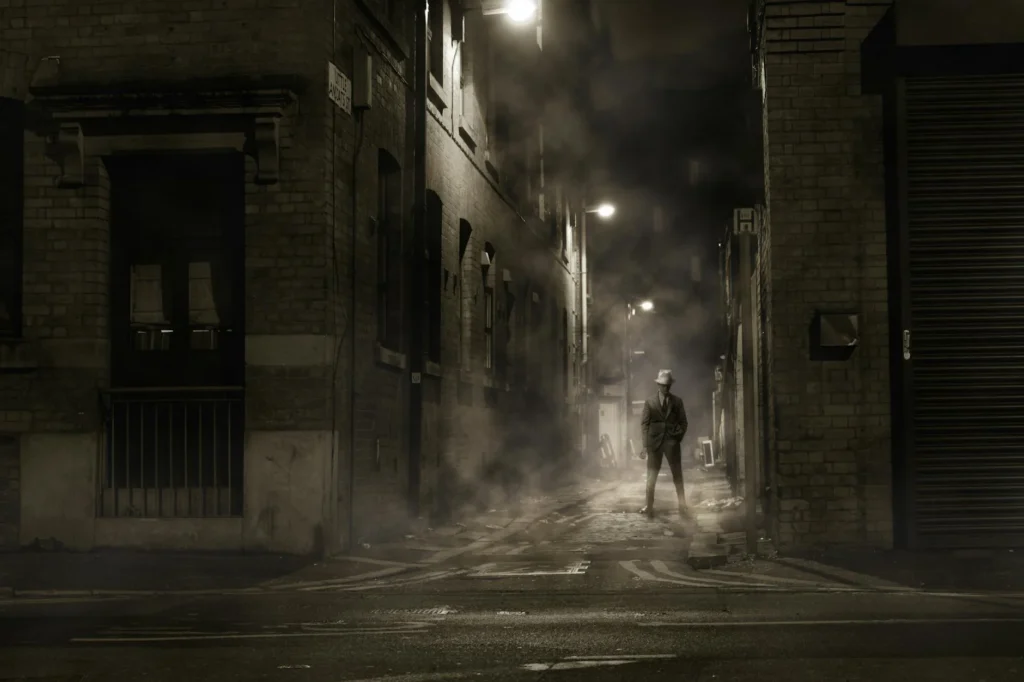
The style is instantly recognizable: cynical heroes, stark lighting, flashbacks, intricate plots, and an underlying existentialist philosophy[s]. But noir was never officially a genre to the people making it. Directors thought they were making crime films, thrillers, and romantic melodramas. The French saw the pattern first because they received the films all at once, stripped of the Hollywood marketing that obscured their connections.
Frank’s original 1946 article identified four founding films: The Maltese Falcon (1941), Laura (1944), Murder, My Sweet (1944), and Double Indemnity (1944)[s]. Three were adapted from hardboiled crime fiction (Hammett, Chandler, Cain); the fourth, Laura, came from Vera Caspary’s mystery novel. All featured morally compromised protagonists. All bathed their stories in shadows.
The Shadows of War
Film noir history cannot be separated from the trauma that produced it. The darkness of these films reflected the disenchantment of the times[s]. Pessimism and disillusionment had been growing in the American psyche since the Great Depression, and World War II intensified it. After the war, an unstable peacetime economy, McCarthyism, and the threat of atomic warfare created what Britannica describes as “a collective sense of uncertainty.”[s]
Several noir films tell the same story: a war veteran returns home to find that the way of life for which he has been fighting no longer exists[s]. Films like The Blue Dahlia (1946) and Dead Reckoning (1947) feature men adrift in a changed America, one that is “modernized, heartless, coldly efficient, and blasé about matters such as political corruption and organized crime.”[s]
The German Connection
The visual language central to film noir history came from Germany. The shadowy style can be traced to German Expressionist cinema of the silent era[s]. Robert Wiene’s The Cabinet of Dr. Caligari (1920) established the techniques: tilted cameras, distorted images, chiaroscuro lighting where only faces emerge from darkness[s].
When the Nazis rose to power, many of these filmmakers fled to Hollywood. Fritz Lang, who made Metropolis and M, escaped Germany in 1933 after Joseph Goebbels reportedly told him that Hitler wanted him to lead the Nazi film industry[s]. Lang chose exile instead. He and other émigrés brought their visual techniques with them: Robert Siodmak, Billy Wilder, Otto Preminger, Curtis Bernhardt[s]. These outsiders shaped American crime cinema into something darker and more psychologically complex than anything Hollywood had produced before.
The Femme Fatale and the Hardboiled Detective
Noir developed two central character types. The hardboiled detective, pioneered in pulp fiction by Carroll John Daly and popularized by Dashiell Hammett and Raymond Chandler, was a cynical antihero battling both organized crime and a corrupt legal system[s]. Sam Spade, Philip Marlowe, and their imitators were tough but doomed, wise to the world’s corruption but unable to escape it.
The femme fatale was more controversial. She was “a seductive and beautiful woman who brings disaster to anyone with whom she becomes romantically involved”[s]. Barbara Stanwyck’s Phyllis Dietrichson in Double Indemnity (1944) became the prototype: calculating, peroxide blonde, wearing dark sunglasses and a gold anklet, luring an insurance agent into murder[s].
Some scholars argue the femme fatale reflected anxieties about changing gender roles. During WWII, women entered the workforce in unprecedented numbers. Film noir’s dangerous women, according to ACMI, represented “an attempt to demonize the independent woman of the war years.”[s]
The Classic Period Ends
Film noir history’s classic period lasted roughly 17 years, from The Maltese Falcon (1941) to Touch of Evil (1958). Orson Welles’s border town thriller, with its famous unbroken opening shot, is now recognized as “one of the final gems of the classic film noir period”[s]. By then, television had changed audience habits, color film was becoming standard, and the postwar anxieties that fueled noir were giving way to different concerns.
But the style never truly died. Neo-noir films from Chinatown (1974) to L.A. Confidential (1997) to Drive (2011) continue to use noir’s visual vocabulary and moral ambiguity. The genre that French critics named in 1946 remains one of cinema’s most enduring contributions to visual storytelling.
Film noir history begins with a critical act of naming. On 28 August 1946, French critic Nino Frank published an article in L’Écran français titled “Un nouveau genre ‘policier’: L’aventure criminelle” that identified a new tendency in American crime cinema[s]. The term “films noirs” would not become commonplace in international critical circles until Raymond Borde and Étienne Chaumeton published Panorama du film noir américain in 1955[s]. American filmmakers of the era never used the term; they believed they were making crime films, thrillers, and melodramas.
The Phenomenology of Film Noir History
What Frank recognized was a shift in narrative emphasis. The concern of the new films, he wrote, “was less with the solution of a crime than with an exploration of the human frailties of the protagonists and the psychology driving their behaviour.”[s] The four films he analyzed, The Maltese Falcon, Laura, Murder My Sweet, and Double Indemnity, three of them adapted from hardboiled crime fiction by Hammett, Chandler, and Cain, with Laura drawn from Vera Caspary’s mystery novel[s], shared a style that Britannica would later codify as “cynical heroes, stark lighting effects, frequent use of flashbacks, intricate plots, and an underlying existentialist philosophy.”[s]
The debate over whether noir constitutes a genre, a style, or merely a critical category has never been resolved. Chris Fujiwara notes that the makers of these films “didn’t think of them as ‘films noir’; they thought they were making crime films, thrillers, mysteries, and romantic melodramas. The nonexistence of ‘noir’ as a production category during the supposed heyday of noir obviously problematizes the history of the genre.”[s]
Post-War Social Context
Film noir history is inseparable from its historical moment. The darkness reflected “the disenchantment of the times,” as pessimism grew during the Depression and intensified through the war[s]. Post-war factors including economic instability, McCarthyism, and nuclear anxiety “manifested themselves in a collective sense of uncertainty.”[s]
A recurring narrative structure in noir involves the returning veteran who discovers “the way of life for which he has been fighting no longer exists”[s]. Films like Cornered (1945), The Blue Dahlia (1946), Ride the Pink Horse (1947), and Dead Reckoning (1947) present an America that is “modernized, heartless, coldly efficient, and blasé about matters such as political corruption and organized crime.”[s]
The classic period of noir “features a cycle of pictures produced in Hollywood between the 1940s and 1950s. Dealing with the aftershocks of the Depression and World War II, these films were crime thrillers with a distinctive bleak tone and experimental look that distinguished them from Hollywood’s usual offerings.”[s]
German Expressionist Inheritance
The visual grammar of noir derives from German Expressionism. “The shadowy noir style can be traced to the German Expressionist cinema of the silent era”[s]. Robert Wiene’s Das Kabinett des Doktor Caligari (1920) established the foundational techniques: “tilted cameras to present skewed images and a dark atmosphere in which only the faces of the actors were visible.”[s]
German Expressionism “established narrative and visual conventions that would shape cinema forever, such as subjective points of view, non-linear narratives, twist endings, unchained camera movements, oblique filming angles, expressionistic set design, and chiaroscuro lighting.”[s]
The transmission mechanism was émigré filmmakers fleeing Nazi persecution. Fritz Lang escaped Germany in 1933 after Goebbels reportedly informed him that Hitler wanted him to create National Socialist cinema[s]. Hollywood absorbed “a growing milieu of European filmmakers who had fled the Nazis, including Billy Wilder, Henry Koster, Fred Zinnemann, and Robert Siodmak, as well as actors Hedy Lamarr, Conrad Viedt, and Peter Lorre.”[s] Key noir directors including “Robert Siodmak, Fritz Lang, Jacques Tourneur, Otto Preminger” brought expressionist sensibilities to American crime cinema[s].
Hardboiled Fiction as Source Material
The literary foundation of noir was the hardboiled detective story, “a literary genre that shares some of its characters and settings with crime fiction” featuring protagonists who “battle the violence of organized crime that flourished during Prohibition in the United States (1920-1933)”[s]. The style “was pioneered by Carroll John Daly in the mid-1920s, popularized by Dashiell Hammett over the course of the decade, and refined by James M. Cain and by Raymond Chandler beginning in the late 1930s.”[s]
These authors provided source material for canonical noir films. “Many of these stories, written by famous authors of the genre such as Raymond Chandler, Dashiell Hammett, James M. Cain, and Mickey Spillane, were made into movies after World War II.”[s]
The Femme Fatale as Cultural Symptom
The femme fatale archetype “appears throughout history in mythology, art, and literature and became a principal character in the hard-boiled detective novels and classic film noir of the 20th century.”[s] Barbara Stanwyck’s Phyllis Dietrichson in Double Indemnity (1944) is “often considered” the “prototypical film noir femme fatale”: “a calculating, dark sunglasses and gold anklet-wearing, peroxide blonde who lures an insurance agent into killing her husband.”[s]
The proliferation of femme fatales has been read as a response to wartime social change. “During WWII, women increasingly entered the labour market and discovered greater agency and independence. This is primarily expressed in film noir through the femme fatale trope, which ‘was an attempt to demonize the independent woman of the war years.'”[s]
Periodization and Legacy
The classic noir period spans approximately 17 years, conventionally dated from The Maltese Falcon (1941) to Touch of Evil (1958). Orson Welles’s final Hollywood studio film “was a box-office disappointment, but in later years it was recognized as one of the final gems of the classic film noir period of the 1940s and ’50s.”[s]
Film noir history continues through neo-noir revivals that deploy the style’s visual and thematic vocabulary in contemporary settings. The genre that French critics identified in 1946 established a cinematic language, born from Depression-era fiction and German Expressionism, filtered through post-war trauma, that continues to shape how cinema represents moral ambiguity and urban alienation.