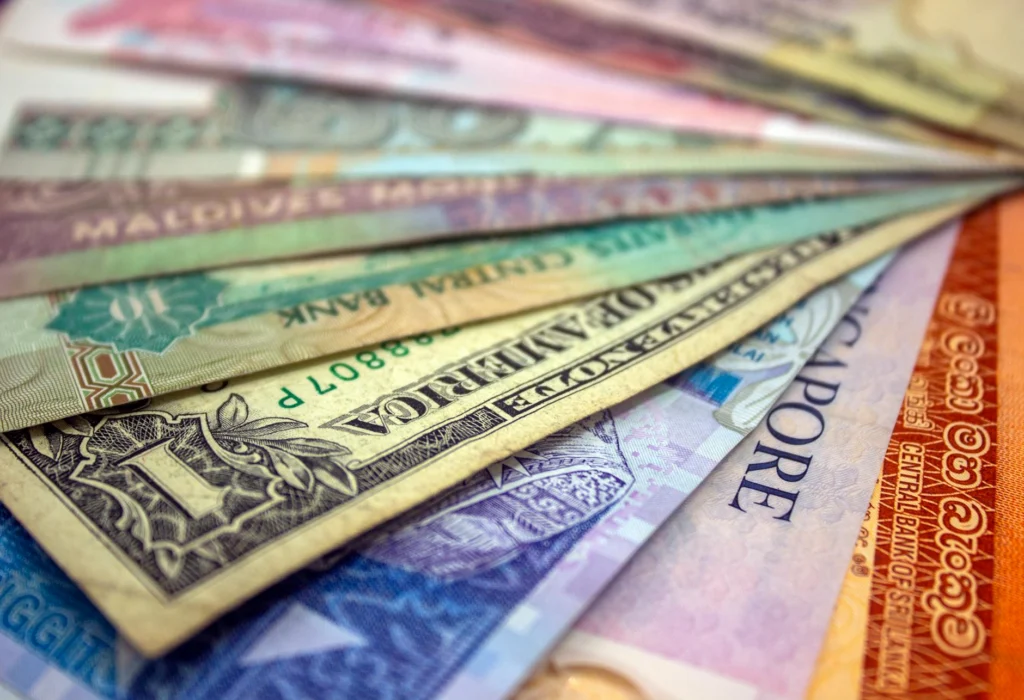
The de-dollarization myth has become one of the most persistent narratives in global finance. BRICS summits generate breathless headlines about the dollar’s imminent collapse. Politicians from Beijing to Brasília speak of breaking free from American financial hegemony. Yet the actual data tells a story of glacial change, mathematical illusions, and a fundamental absence of alternatives.
The dollar’s share of global foreign exchange reserves has declined. That much is true. According to IMF data, it dropped to 56.9% in the third quarter of 2025, down from 72% in 2001[s]. This represents the lowest share since 1994. Headlines scream about dollar dominance crumbling. But the de-dollarization myth falls apart the moment you examine what central banks are actually doing with their money.
The De-dollarization Myth Meets Hard Numbers
Foreign central banks hold $7.4 trillion in dollar-denominated assets. That figure has remained essentially flat since 2014[s]. Central banks are not dumping dollars. They are adding more assets denominated in other currencies, particularly smaller ones like the Australian and Canadian dollars, while their dollar holdings stay roughly constant. The percentage share declines because the denominator grows, not because central banks are fleeing the greenback.
The Federal Reserve’s own analysis confirms this pattern. The dollar’s share was 58% in 2024 and has been “basically unchanged since 2022, when it accounted for 58 percent of reserves, suggesting that U.S. sanctions on Russia following the invasion of Ukraine have not led to fears of dollar ‘weaponization’ causing a notable reallocation of reserves out of dollars”[s].
The 92% Illusion
The de-dollarization myth becomes even more fragile when you understand how reserve share calculations work. In the first half of 2025, the dollar index fell sharply amid tariff uncertainty and Federal Reserve policy confusion. The dollar’s reserve share dropped accordingly. But here is the critical detail most analysis ignores: 92% of the Q2 2025 decline in dollar reserve share was driven by exchange rate movements, not active central bank selling[s].
When the dollar weakens, non-dollar holdings automatically appear larger in dollar terms, even if no central bank changed a single position. That is not de-dollarization. That is arithmetic. The de-dollarization myth conflates valuation fluctuations with strategic realignment.
The Transaction Dominance Nobody Mentions
Reserve shares capture only part of dollar dominance. The Bank for International Settlements found the dollar involved in nearly 90% of global foreign exchange transactions in 2022, dominant across all FX instruments and counterparties[s]. The Federal Reserve, citing the same BIS Triennial Survey, notes the dollar share at “about 88 percent of global FX transactions” and adds that “this share has remained stable over the past 20 years”[s]. The Fed’s aggregate index of international currency usage has stayed in a narrow range between 65 and 70 since 2010[s].
U.S. Treasury markets remain the world’s largest and most liquid sovereign debt market by a distance no competitor approaches[s]. SWIFT data shows the dollar accounting for 50.49% of global payments as of December 2025, more than double the euro’s 21.9%[s].
BRICS: Loud Rhetoric, Empty Proposals
The de-dollarization myth finds its loudest champions in the BRICS bloc. Russia and China speak constantly of reducing dollar dependence. Yet a fundamental fact undermines the entire narrative: there has never been a formal proposal at BRICS for dedollarization[s]. The 2009 summit issued a vague statement about a “more diversified international monetary system.” That remains the high-water mark of concrete action.
India, one of BRICS’ largest members, explicitly rejects the entire premise. External Affairs Minister Subrahmanyam Jaishankar stated in March 2025 that “the dollar as the reserve currency is the source of international economic stability, and right now, what we want in the world is more economic stability, not less”[s]. Commerce Minister Piyush Goyal was more direct: “Imagine us having a currency shared with China. We have no plans. It is impossible to think of a BRICS currency”[s].
The Alternative That Does Not Exist
The de-dollarization myth requires a credible replacement, and none exists. The Chinese renminbi accounts for just 2.1% of global reserves, roughly where it stood in 2020[s]. Despite China’s economic scale, the yuan remains tightly controlled, not fully convertible, and deeply distrusted by reserve managers outside China’s political orbit.
The euro holds second place at about 20%, but a European Parliament study concluded that “a quick decline of the US dollar or a shift towards a multipolar currency system with similarly important reserve currencies is highly unlikely”[s]. The study noted that gold has surpassed the euro as the second most important reserve asset, “reflecting its immunity to sanctions and political dysfunction” and highlighting “the perception that the euro is not a credible alternative to the dollar”[s].
A GIS Reports analysis rated BRICS currency alternatives as the “least likely” scenario, noting that “except for the renminbi and the ruble, the record of the BRICS currencies in terms of liquidity and stability is far from stellar”[s].
Stagnation Disguised as Revolution
The de-dollarization myth persists because it serves political purposes. Russia and China have obvious incentives to talk up alternatives after Western sanctions. Nationalist politicians worldwide find anti-dollar rhetoric useful. Financial media needs drama. But the data reveals a different story: not collapse, but slow diversification into smaller currencies; not strategic realignment, but portfolio management; not a revolution, but arithmetic.
Steven Kamin, a senior fellow at the American Enterprise Institute, told Anadolu Agency that “a large part of the US dollar’s decline in reserves was due to reserve managers seeking to diversify with the addition of non-traditional currencies like the Canadian or the Australian dollar to their reserves”[s]. This is not de-dollarization. This is basic portfolio theory.
The dollar is not losing its reserve status. It is losing its monopoly, at the rate of roughly 0.6 percentage points per year since 2001[s]. At that pace, the dollar would still dominate global reserves for decades to come. The de-dollarization myth mistakes a gradual decline for a sudden shift, and mistakes rhetoric for reality. The numbers have always told a different story. Few bother to read them.