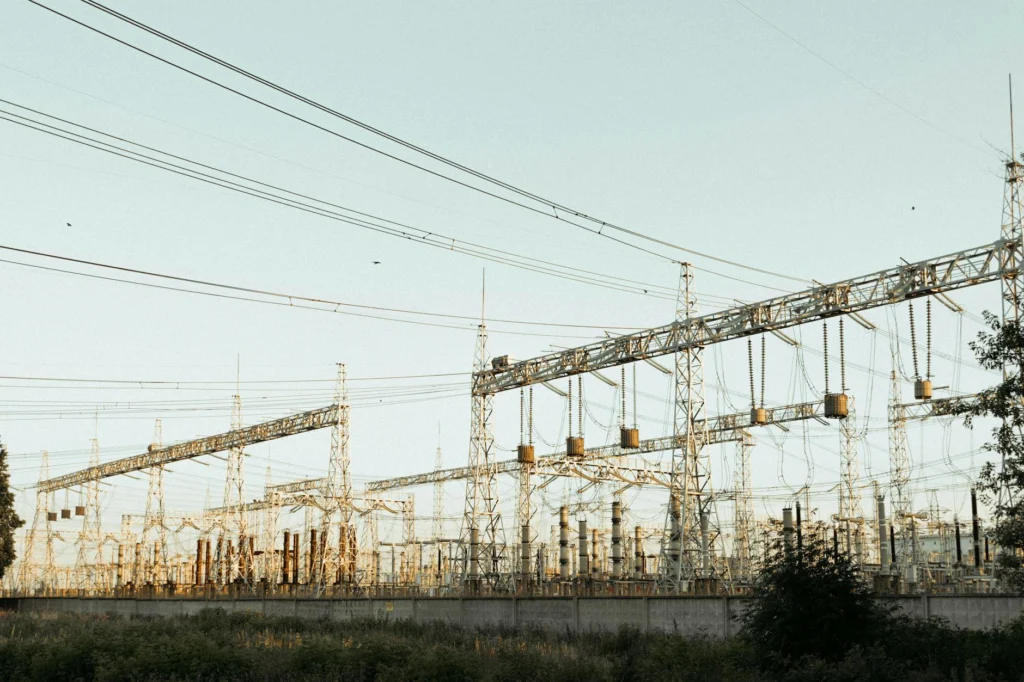
On July 10, 2024, a single lightning strike in Northern Virginia triggered something grid operators had never seen before: sixty data centers simultaneously disconnected from the power network, removing 1,500 megawatts of load in an instant[s]. The data center grid came within minutes of cascading failure that could have blacked out the region.
This near-miss exposed a fundamental problem: America’s electrical infrastructure was never designed for the concentrated, volatile loads that modern data centers impose. As AI drives explosive growth in computing demand, the gap between what data centers need and what the grid can reliably deliver is widening into a crisis that could reshape electricity costs and reliability for millions of households.
The Phantom Problem
Before a data center connects to the grid, developers must submit interconnection requests to utilities. In theory, this helps utilities plan for future demand. In practice, developers have flooded utilities with speculative requests, often submitting the same project to multiple utilities while shopping for the best electricity rates[s].
These “phantom data centers” or “vaporwatt” requests have made load planning extraordinarily difficult[s]. John Moura, director of reliability assessments at the North American Electric Reliability Corporation (NERC), confirmed that phantom data centers appearing in grid connection requests across the country make it difficult for utilities to forecast future demand conditions[s].
The scale is staggering. In Texas alone, more than 220 gigawatts of projects requested grid connections by late 2025, a 170% increase from January of that year[s]. If all those projects were built, they would require more power than 154 million Texas homes consume annually. The state has only 30 million residents.
When the Data Center Grid Goes Dark
The July 2024 Virginia incident revealed what happens when concentrated data center grid loads suddenly disappear. When a lightning arrestor failed on a 230kV transmission line, it caused six rapid voltage drops as automated systems tried to compensate[s]. Data centers are extremely sensitive to voltage fluctuations because even brief disturbances can damage expensive equipment. All sixty facilities automatically switched to their internal backup power systems.
The grid operators at PJM Interconnection, which manages electricity for 67 million people across 13 states, had to quickly reduce power flowing into the network from power plants to prevent a dangerous surge. The data centers remained offline for hours because reconnecting to the grid requires manual intervention[s].
“As these data centers get bigger and consume more energy, the grid is not designed to withstand the loss of 1,500MW data centers,” Moura told Reuters. “At some level it becomes too large to withstand unless more grid resources are added.”[s]
The Coming Shortfall
For the first time ever, PJM’s most recent capacity auction failed to secure enough promised power to meet the grid’s reliability target[s]. Energy consultant Abe Silverman of Johns Hopkins University described it as “a long-term structural deficit where the amount of power is way less than the amount of electricity we’re trying to provide to customers, and that is particularly driven by the data centers.”
The shortfall equals roughly the electricity used by a city the size of Philadelphia. Starting June 2027, the mid-Atlantic region faces “elevated risk” for blackouts[s].
In Texas, NERC warned that data centers’ constant energy consumption will make it more difficult to maintain sufficient electricity supply during extreme winter weather like the catastrophic Winter Storm Uri in 2021, which killed at least 210 people[s].
Who Pays
The data center grid expansion is already hitting consumers’ wallets. Utilities requested more than $29 billion in rate increases in the first half of 2025 alone, double the amount requested in the same period of 2024[s]. Average U.S. electricity prices reached 19 cents per kilowatt-hour by end of 2025, about 27% higher than in 2019.
In Virginia, home to the world’s largest concentration of data centers, electricity prices have increased by up to 267% over five years[s]. In the PJM electricity market, data centers accounted for an estimated $9.3 billion price increase in the 2025-26 capacity market, translating to $18 per month more on average residential bills in western Maryland and $16 more in Ohio[s].
By 2028, data centers could consume up to 12% of total U.S. electricity, up from 4.4% in 2023[s]. That growth, equivalent to adding eight New York Cities to the national grid, shows no signs of slowing. The question is whether the infrastructure can keep pace, or whether consumers will continue paying for a grid strained beyond its design limits.
On July 10, 2024, at approximately 19:00 EST, a lightning arrestor failure on the Ox-Possum 230kV transmission line near Fairfax, Virginia, initiated a sequence of events that nearly collapsed the data center grid serving Northern Virginia. The failure caused six rapid voltage sags as protection systems attempted to clear the fault, triggering automatic transfer switches at approximately sixty data center facilities. Within seconds, 1,500 MW of load disconnected from PJM Interconnection[s].
The sudden load loss drove grid-wide frequency to 60.047 Hz, well above NERC’s target band of 60 Hz ± 0.036 Hz[s]. Unlike generation loss events, where frequency drops and operators deploy reserves, load loss requires rapid reduction of generation output. Operators had limited tools: while batteries respond bidirectionally within milliseconds, PJM has only approximately 400 MW of installed battery capacity compared to nearly 8 GW in ERCOT and 12 GW in CAISO.
Data Center Grid Load Characteristics
Modern AI-focused data centers present unique challenges for grid stability. While traditional server racks operate at 7-10 kW, AI computing racks demand 30-100+ kW per rack[s]. NVIDIA’s GB200 NVL72 servers draw approximately 120 kW per rack. Hyperscale facilities now routinely exceed 100 MW capacity, with some campuses planned at gigawatt scale.
The variability compounds the challenge. Large-scale GPU clusters produce power fluctuations of hundreds of megawatts within seconds[s]. These loads interface with the grid through power electronics, exhibiting low inertia, fast response dynamics, and harmonic distortion characteristics fundamentally different from electromechanical loads.
Geographic concentration amplifies local grid stress. In 2023, data centers consumed 26% of Virginia’s total electricity supply, with North Dakota at 15%, Nebraska at 12%, and Iowa and Oregon each at 11%[s].
The Phantom Load Problem
Interconnection queue distortion has become a systemic data center grid planning failure. Developers submit speculative requests to multiple utilities simultaneously, seeking optimal rate structures[s]. These phantom loads inflate demand forecasts and resource planning models while consuming limited utility study resources and delaying legitimate projects in the queue.
ERCOT’s queue illustrates the magnitude: 220 GW of projects requested connection by late 2025, with 73% from data centers[s]. The approved connection capacity stands at only 7.5 GW. The ratio suggests most requests will never materialize, yet utilities must study each one, extending already lengthy queue timelines.
Capacity Market Mechanics
PJM’s January 2026 capacity auction for delivery year 2027-2028 cleared below target reserve margins for the first time system-wide[s]. The auction secured commitments totaling 14.8% above projected peak demand, versus the target 20% buffer. Data centers drove nearly all of the 5,250 MW increase in projected peak load year-over-year.
The capacity market price mechanism demonstrates the stress: data centers accounted for $9.3 billion of the 2025-26 capacity cost increase[s]. Governor Shapiro’s administrative price cap of $333/MW-day prevented auction prices from reaching the estimated $530/MW-day that would have cleared without intervention.
Reliability Implications
Lawrence Berkeley National Laboratory’s December 2024 report projects U.S. data center electricity consumption will reach 325-580 TWh by 2028, representing 6.7-12% of total national consumption, up from 4.4% in 2023[s]. This trajectory creates a structural data center grid supply-demand imbalance.
NERC’s winter reliability assessment identified data center loads as contributing to elevated blackout risk during extreme weather in Texas. Unlike demand response resources that can curtail during emergencies, data centers require constant power for server operation. Battery storage resources face state-of-charge limitations during extended high-load events[s].
The July 2024 event revealed a specific vulnerability in data center grid operations: while UPS systems activate automatically during voltage disturbances, reconnection requires manual intervention. The affected data centers remained offline for hours[s]. At scale, manual reconnection of gigawatt-class loads creates sequencing and coordination challenges that grid operators have limited experience managing.
Economic Distribution
Rate case filings totaled $29 billion in the first half of 2025, double the prior year period[s]. Infrastructure investments to serve data center loads, including generation, transmission, and distribution upgrades, flow through to ratepayers absent specific cost allocation mechanisms.
Virginia’s 267% electricity price increase over five years[s] reflects both direct infrastructure costs and market dynamics from concentrated load growth. Some utilities and regulators are beginning to implement specialized large-load tariffs to isolate data center costs from residential ratepayers, but implementation lags the pace of development. The data center grid transformation is outpacing the regulatory frameworks designed to ensure equitable cost distribution.