Low frequency soundproofing is nearly impossible, and physics is the reason. When your neighbor’s subwoofer rattles your walls or a distant highway hums through your bedroom at 3 AM, you’re experiencing a fundamental limit built into how sound works. The bass gets through because its wavelengths are simply too large to stop with ordinary building materials[s].
Why Low Frequency Soundproofing Fails
Sound travels as waves, and the distance between wave peaks is called wavelength. Here’s the problem: low frequencies have enormous wavelengths. A 20 Hz bass tone has a wavelength of about 17 meters, roughly 56 feet[s]. A 50 Hz rumble stretches about 7 meters (23 feet). Compare that to a 1,000 Hz tone, which measures just 34 centimeters, about the width of a laptop screen.
This matters because sound interacts with barriers based on wavelength. When a wave hits a wall that’s much smaller than its wavelength, the wave largely ignores it. The wave bends around the obstacle through a process called diffraction[s]. Think of ocean waves flowing around a small rock versus crashing against a seawall. Bass waves treat your walls like that rock.
The Mass Law and Its Limits
The standard approach to low frequency soundproofing relies on mass. The “mass law” in acoustics states that doubling the weight of a barrier adds about 6 decibels of sound reduction[s]. More mass, less transmission. But this rule works far better for high frequencies than low ones[s].
At low frequencies, walls start to vibrate in sympathy with the sound waves[s]. Windows, floor assemblies, and ceiling joists all have natural resonance frequencies, typically in the bass range. When bass hits at just the right frequency, these structures actually amplify transmission rather than block it.
The Measurement Problem
Standard soundproofing ratings make the problem worse by hiding it. The Sound Transmission Class (STC) rating, used throughout the construction industry, only measures performance down to 125 Hz[s]. Most bass energy from music, traffic, and industrial equipment sits below this cutoff.
A wall with an impressive STC 48 rating might perform terribly at 50 Hz. Tests show that a 4-inch solid concrete wall (STC 47) can outperform a steel stud wall (STC 48) by 30 decibels at low frequencies[s]. The rating system misses exactly what matters most.
What Actually Works
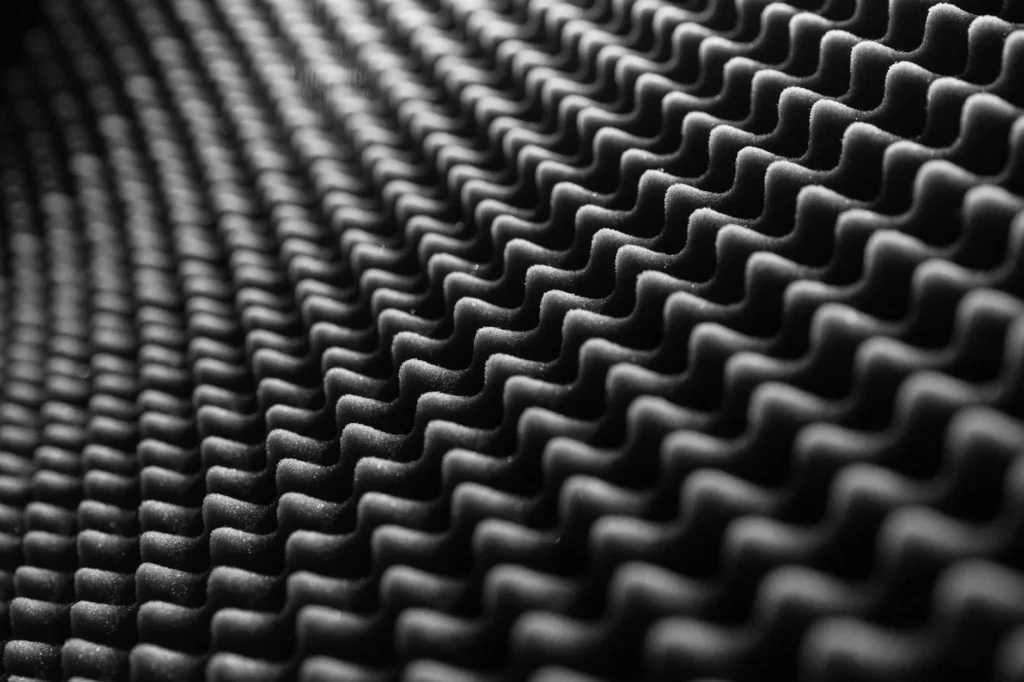
Low frequency soundproofing demands extreme measures. Absorbing a 30 Hz wave requires a porous absorber nearly 3 meters (9 feet) deep, following the quarter-wavelength rule[s]. That’s the minimum thickness where the material can fully absorb that frequency. Foam panels a few inches thick simply cannot touch bass.
Even massive construction struggles. Acoustic engineers have built rooms with two 8-inch concrete walls separated by a 6-inch air gap, totaling 22 inches of poured concrete and isolation, and still measured 30 Hz waves on the outside[s]. UK government research confirms that stopping infrasound “requires extremely heavy walls” that are “impracticable” in most settings[s].
Bass penetrates because physics allows it to. Treating the symptom without understanding the cause leads to expensive failures. The only reliable solutions involve addressing the source, massive construction, or accepting that some frequencies simply will not stop.
Low frequency soundproofing confronts a hard physical limit: wavelengths that exceed practical barrier dimensions. When bass frequencies propagate through building structures, they exploit the relationship between wavelength and transmission loss that renders standard isolation techniques ineffective. Understanding why requires examining wave physics, resonance mechanics, and the fundamental mismatch between acoustic wavelengths and architectural scales.
Wavelength and Diffraction in Low Frequency Soundproofing
The governing relationship is vw = fλ, where wave velocity equals frequency times wavelength[s]. At 343 m/s (speed of sound in air at 20°C), a 20 Hz wave measures 17.15 meters in wavelength, while a 20,000 Hz wave compresses to 1.7 centimeters[s]. The orders of magnitude difference in scale explains divergent transmission behavior.
Diffraction effects dominate when wavelength exceeds barrier dimensions. A standard interior wall at 10 cm thickness represents a negligible fraction of a 50 Hz wavelength (6.86 m). The wave effectively wraps around the obstacle[s]. This is why the bass from a party carries blocks away while speech attenuates rapidly.
Mass Law Limitations
The mass law predicts transmission loss as TL ≈ 20 log10(m), where m is surface mass density[s]. Doubling mass yields approximately 6 dB additional transmission loss[s]. However, this relationship holds most reliably at frequencies above the coincidence frequency of the panel.
At lower frequencies, the mass law’s predictive power degrades. Stiffness and resonance effects dominate[s]. Real panels exhibit frequency-dependent transmission that diverges significantly from mass law predictions in the sub-125 Hz range.
Resonance and the Mass-Air-Mass System
Decoupled construction (double-stud walls, resilient channel systems) introduces a mass-spring-mass resonance frequency. At this frequency, the system provides minimal isolation; performance degrades from the resonance point up to approximately 1.5× that frequency[s].
Decoupling actually reduces low frequency performance around resonance[s]. A system with 70 Hz resonance performs well at 150 Hz but offers little benefit below 100 Hz. Moving resonance lower requires adding mass, increasing cavity depth, or adding damping material. Each approach faces diminishing returns.
Building elements themselves resonate. Windows, floors, and ceilings have natural frequencies in the bass range. When incident sound matches these frequencies, the structure vibrates and re-radiates energy, effectively acting as a secondary source[s].
Absorption Constraints: The Quarter-Wavelength Rule
Porous absorbers require thickness related to wavelength. The quarter-wavelength rule states that effective absorption requires material depth of at least λ/4 for the target frequency[s]. For 30 Hz (λ ≈ 11.4 m), this means 2.86 m of absorber depth. For 100 Hz (λ = 3.43 m), approximately 86 cm[s].
Commercial “bass traps” claiming low frequency absorption in 4-inch depths violate this physics. A 24-inch foam wedge can only absorb meaningfully down to 90-100 Hz[s]. Below that, porous absorption is negligible without impractical depth. Only resonant absorbers (Helmholtz resonators, membrane absorbers, diaphragmatic absorbers) can achieve low frequency absorption in compact form, and these are narrow-band by nature.
Transmission Through Dense Materials
A counterintuitive factor complicates low frequency soundproofing: sound velocity increases in denser materials[s]. Steel transmits sound at approximately 5,960 m/s versus 343 m/s in air. Concrete conducts at roughly 3,700 m/s[s]. This elevated transmission speed through the barrier material reduces the impedance mismatch that would otherwise reflect energy.
Low frequencies also pass through where higher frequencies are reflected or absorbed[s]. Building material absorption coefficients drop precipitously at low frequencies. Brick reflects all sound, but drywall and timber reflect high frequencies while transmitting bass.
The STC Measurement Gap
Sound Transmission Class (STC) ratings test only 125 Hz to 4,000 Hz[s]. This systematically excludes the problematic range. A wall’s STC 48 rating reveals nothing about 50 Hz performance.
Comparative testing demonstrates the problem: a 4-inch concrete wall (STC 47) outperforms a steel stud assembly (STC 48) by 30 dB at frequencies the rating ignores[s]. Specifiers relying on STC alone consistently fail at low frequency soundproofing.
Practical Limits
UK government research found that stopping infrasound “requires extremely heavy walls” and absorption “requires a thickness of absorbing material which is impracticable”[s]. Field measurements confirm this: two 8-inch concrete walls separated by 6 inches of air (22 inches total construction) still showed measurable 30 Hz transmission[s].
Low frequencies in the 25-150 Hz range have wavelengths comparable to room dimensions, producing standing wave resonances that complicate both isolation and internal treatment[s]. This is why “low-frequency noise is difficult to abate, and it can penetrate through walls and structures”[s].
The physics constrains the solutions: source control, impractical mass, or acceptance. Low frequency soundproofing below 50 Hz remains beyond standard construction without extraordinary measures that exceed normal architectural budgets and space allowances.