Gray zone warfare looks clever on paper. Send fishing boats instead of warships. Harass instead of attack. Wear down opponents without triggering a shooting war. China deploys a record average of 241 maritime militia vessels daily in the South China Sea.[s] The Houthis attacked 178 commercial vessels over two years in the Red Sea.[s] Iran’s Revolutionary Guard boats regularly swarm American warships in the Persian Gulf. Yet for all this activity, gray zone warfare consistently fails to achieve lasting strategic gains.
The reason is simple: harassment is not power. Real naval power means the ability to control sea lanes, project force over distance, and deny an adversary the use of the ocean. Gray zone tactics can annoy, disrupt, and impose costs. They cannot conquer territory, defeat a navy, or secure the kind of dominance that shapes international order.
What Gray Zone Warfare Actually Looks Like
China’s maritime militia represents the most sophisticated gray zone naval force in the world. These vessels look like fishing boats but operate under military coordination.[s] They swarm disputed reefs, block resupply missions, and provide cover for coast guard operations. The militia played a key role in seizing Scarborough Shoal from the Philippines in 2012.
Since 2021, Chinese vessels have used force against Philippine resupply missions ten times, accounting for 26% of all missions.[s] In June 2024, coast guard personnel wielding axes and knives boarded Philippine boats, injuring eight sailors, including one who lost a finger.[s] Yet despite this escalating violence, Chinese forces have only succeeded in blocking supplies twice in that entire period.
The Houthi campaign in the Red Sea followed a similar pattern. Beginning in late 2023, the Iran-backed group used missiles, drones, and naval drones to attack commercial shipping. They sank four ships and killed nine sailors.[s] The attacks forced hundreds of vessels to reroute around Africa, disrupting global trade. The U.S. military response, which included the Prosperity Guardian escort mission and a subsequent strike campaign, cost over $750 million.[s]
Why Harassment Fails
Gray zone warfare exploits a specific vulnerability: the gap between what opponents see and what they are authorized to do about it. When civilian-flagged vessels conduct military maneuvers, decision-makers must pause to determine whether the activity constitutes routine presence or coercive aggression.[s] That pause transfers initiative to the aggressor.
But this advantage has limits. The hesitation only works when opponents treat gray zone provocations as genuinely ambiguous. Once the pattern becomes clear, the ambiguity disappears. China’s maritime militia is no longer a shadowy force; analysts track their movements via satellite, and the international community knows they are not legitimate fishers.[s] When cover is blown, the tactical advantage evaporates.
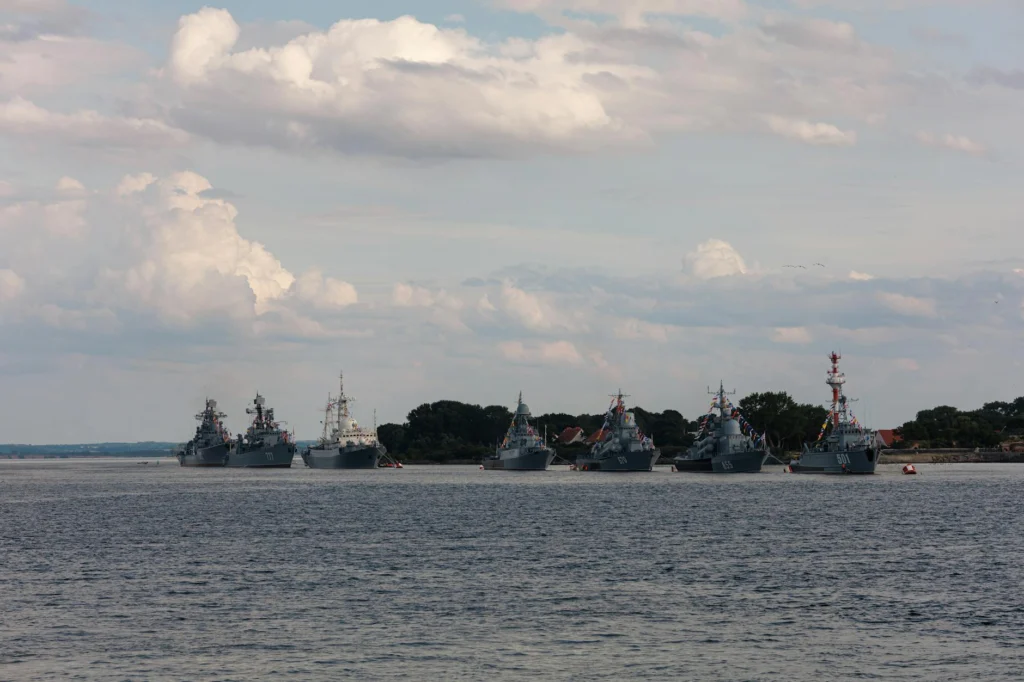
More fundamentally, gray zone warfare cannot substitute for the capabilities that actually determine maritime dominance. The U.S. Navy operates over 3.6 million tons of warships, nearly twice the combined tonnage of China’s navy and coast guard.[s] Those ships carry missiles that can strike targets hundreds of miles away, aircraft that can establish air superiority, and submarines that can choke off sea lanes. No number of fishing boats can replicate these capabilities.
The Backfire Effect
Gray zone warfare also generates strategic costs that practitioners rarely anticipate. China’s 335 consecutive days of coast guard presence around the Senkaku Islands, ending in October 2025, set a new record.[s] But this persistence has not changed the territorial status; Japan still administers the islands. What it has changed is regional perception: Japan now sees China as a direct threat and has committed to major defense spending increases.
Taiwan provides an even clearer example. China violated Taiwan’s air defense identification zone over 3,700 times in 2025,[s] erasing the median line that both sides had respected for decades.[s] The coercion has successfully worn down Taiwan’s military readiness, forcing expensive scrambles that divert resources from training. Yet Taiwan has not moved toward accepting unification. Instead, it has deepened security ties with the United States, Japan, and other regional partners.
The June 2024 Second Thomas Shoal incident triggered discussions about invoking the U.S.-Philippines Mutual Defense Treaty.[s] Australia, Canada, Germany, Japan, and other nations publicly condemned China’s actions. Every escalation that falls short of achieving its objective simply galvanizes opposition.
The Mahanian Reality
Naval strategist Alfred Thayer Mahan understood in 1900 what gray zone practitioners still struggle to accept: “The power, therefore, to insure these communications to one’s self, and to interrupt them for an adversary, affects the very root of a nation’s vigor.”[s] Sea power is about control, not harassment. It requires the ability to keep shipping lanes open for yourself while closing them to your enemy.
Gray zone warfare cannot accomplish this. The Houthis demonstrated that a determined adversary can impose significant costs on commercial shipping, but they could not actually close the Red Sea. When the U.S. and allies responded with military force, the Houthis eventually halted attacks as part of a diplomatic settlement. The underlying calculus had not changed: they lacked the naval power to sustain their campaign against serious opposition.
China faces a similar constraint in the South China Sea. Its militia can harass Philippine vessels and occupy disputed reefs, but it cannot prevent the U.S. Navy from transiting the region. The fundamental asymmetry remains: real navies can sink militia boats, but militia boats cannot sink real navies.
Gray zone warfare represents a deliberate strategy to achieve objectives below the threshold of armed conflict. In the maritime domain, this typically involves coast guard forces, maritime militia, and other quasi-civilian assets conducting operations that impose costs on adversaries while maintaining plausible deniability. China deploys a daily average of 241 militia vessels across the South China Sea, the highest figure ever recorded.[s] The Houthis conducted 178 attacks on commercial shipping over a two-year period in the Red Sea.[s] Despite the scale of these operations, both campaigns reveal the structural limitations of gray zone warfare as a substitute for conventional naval power.
Operational Characteristics of Gray Zone Naval Forces
China’s maritime militia operates as a third sea force alongside the People’s Liberation Army Navy (PLAN) and China Coast Guard (CCG). The Spratly Backbone Fishing Fleet comprises the numerical bulk of this force, with vessels typically measuring 45-65 meters in length.[s] These ships operate under military command while maintaining civilian registration, enabling what Beijing calls “rights protection” activities that fall short of armed attack.[s]
Operational patterns reveal deliberate coordination. At Second Thomas Shoal, Chinese forces employed increasing levels of force across ten documented incidents since 2021, representing 26% of Philippine resupply missions.[s] Tactics evolved from water cannons and laser dazzlers to physical boarding with edged weapons. The June 2024 incident saw CCG personnel armed with knives and axes disable Philippine Navy rigid-hull inflatable boats, injuring eight personnel.[s]
The Houthi campaign demonstrated different operational parameters. The group employed a mix of anti-ship ballistic missiles, cruise missiles, loitering munitions, and unmanned surface vessels. Weapons included the Toufan surface-to-surface missile with 1,800 km range and Samad-series UAVs capable of reaching Israeli territory.[s] Four vessels were sunk and nine sailors killed before diplomatic pressure halted the campaign.
The Authority-Tempo Gap
Gray zone warfare exploits a structural vulnerability in Western military decision-making: the divergence between situational awareness and authorization to act. When adversaries employ civilian-flagged vessels or ambiguous tactics, classification becomes contested, forcing decisions upward through command chains optimized for clear-cut scenarios.[s]
This creates what analysts term “weaponized hesitation.” Operators may possess complete operational pictures yet lack authority to respond because the situation resists categorization within existing escalation frameworks. Each layer of legal, political, and reputational consideration introduces latency. When this hesitation becomes predictable, it becomes exploitable terrain.
However, the authority-tempo gap is not permanent. As gray zone patterns become established, defenders can pre-delegate authorities and develop response protocols that compress decision cycles. The militia’s diminishing value stems partly from this adaptation: “the international community knows they are not legitimate fishers.”[s]
Tonnage Asymmetry and Power Projection
The fundamental limitation of gray zone warfare is capability mismatch. The U.S. Navy operates 3.6 million tons of warships against China’s combined naval and coast guard tonnage of approximately 2 million tons.[s] More critically, the composition differs: U.S. forces include 11 aircraft carriers displacing 1.1 million tons collectively, 73 destroyers, and 52 tactical submarines. These platforms possess power projection capabilities that no gray zone force can replicate.
Alfred Thayer Mahan’s formulation remains operative: “The power, therefore, to insure these communications to one’s self, and to interrupt them for an adversary, affects the very root of a nation’s vigor.”[s] Sea control requires the ability to establish and maintain maritime dominance through force if necessary. Coast guard vessels and fishing boats lack the sensors, weapons, and survivability to contest this domain against conventional naval forces.
Strategic Counterproductivity
Gray zone campaigns generate second-order effects that frequently undermine the practitioner’s strategic position. China’s 335 consecutive days of presence around the Senkaku Islands, ending in October 2025,[s] produced no change in territorial administration but catalyzed Japanese defense modernization and deeper alliance integration with the United States.
Taiwan’s experience illustrates the coercion-resilience paradox. Over 3,700 ADIZ violations in 2025[s] erased the median line and imposed significant costs on Taiwan’s air force through mandatory scramble responses.[s] Yet Brookings analysts assess that “while the United States and Taiwan have thus far deterred an attack against the island, they have failed to deter Chinese coercion below that threshold.” The coercion succeeds tactically while failing strategically; Taiwan has not moved toward political accommodation.
The June 2024 Second Thomas Shoal incident approached the threshold for invoking the U.S.-Philippines Mutual Defense Treaty.[s] Multiple nations condemned China’s actions. Each escalation that fails to achieve decisive results instead consolidates opposing coalitions.
The Limits of Asymmetric Cost Imposition
Gray zone warfare succeeds in imposing costs, but cost imposition is not equivalent to strategic victory. The Houthi campaign forced hundreds of commercial vessels to reroute around Africa, significantly disrupting global trade patterns. U.S. counter-operations cost over $750 million and seven MQ-9 Reaper drones.[s] Yet the campaign ended through diplomatic pressure backed by military force, not through Houthi achievement of stated objectives.
The underlying strategic logic remains Mahanian: naval power determines who controls the maritime commons. Gray zone warfare can harass, disrupt, and impose friction. It cannot achieve sea control, project power at distance, or sustain operations against a determined conventional response. States pursuing maritime ambitions through gray zone means are investing in capabilities that cannot deliver the outcomes they seek.