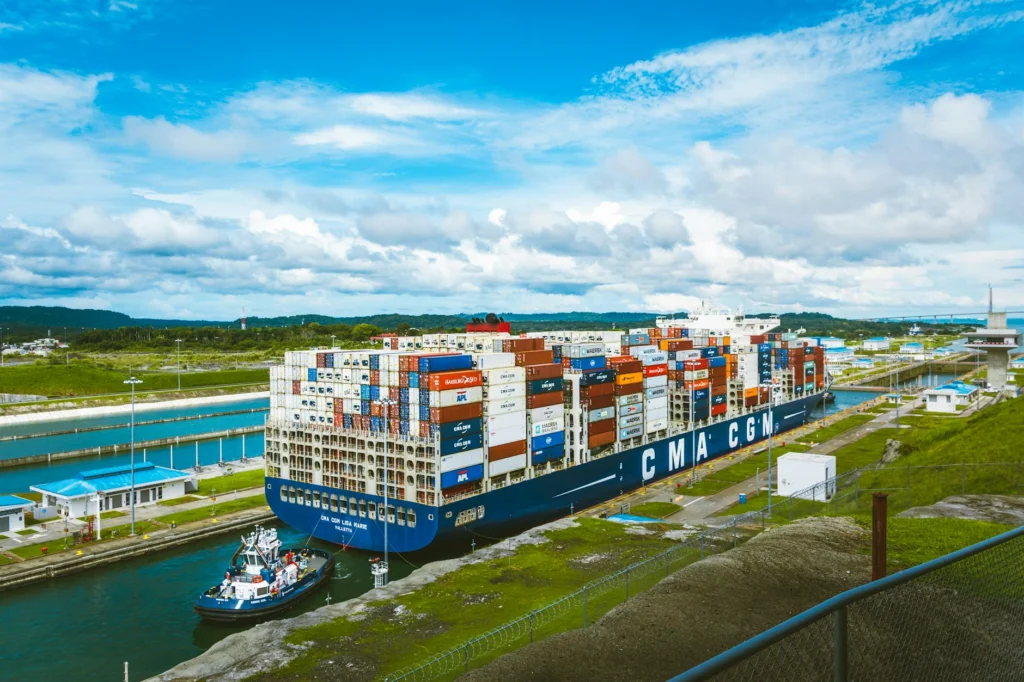
Maritime infrastructure fragility became impossible to ignore on March 23, 2021, when a single container ship, the Ever Given, ran aground in the Suez Canal and blocked one of the world’s most important trade routes for six days. The immediate story was dramatic enough: 432 vessels carrying cargo worth $92.7 billion sat idle while tugboats and dredgers fought to free a quarter-mile-long ship from a 265-meter-wide channel.[s] But the real damage was never about one stuck ship. It was about what that ship revealed.
Maritime Infrastructure Fragility and the $137 Billion Lesson
Researchers at the Beijing Institute of Technology and the University of Oxford estimated that the six-day Suez Canal blockage caused approximately $136.9 billion in global economic losses, far exceeding the $92.7 billion value of the cargo sitting in the water.[s] The gap between those two numbers is where the second-order effects live: factory shutdowns triggered by missing components, inventory buffers drawn down to zero, and production schedules thrown weeks off track across industries that had no direct connection to any ship in the canal.
India absorbed roughly 75% of the total losses, approximately $102 billion, because its manufacturing sector depends heavily on imported raw materials routed through the Suez Canal.[s] The concentration of damage in a single country that was not even geographically close to the blockage illustrates how maritime infrastructure fragility punishes economies at the end of long, lean supply chains.
Why One Missing Part Stops an Entire Factory
The auto industry’s just-in-time model, designed to minimize inventory costs, turned into a liability the moment ships stopped moving. A German manufacturer that could not receive parts from China stuck in the Gulf of Suez could not produce automotive components for export to American assembly plants, which in turn could not build vehicles.[s] One missing component shuts down an entire production line. This cascading failure hit an automotive sector already reeling from a global semiconductor shortage compounded by a winter storm that had shut down chip fabrication plants in Texas weeks earlier.[s]
The shipping company Maersk alone lost $89 million from the blockage. Of that, $76 million came from inventory holding costs, the expense of keeping containers full of goods that could not be delivered on schedule. Carbon emissions from Maersk’s rerouted and delayed fleet increased by 44,574 tonnes.[s]
The Same Lesson, Repeated Harder
The 2021 blockage was a warning. Beginning in late 2023, Houthi rebel attacks on commercial vessels in the Red Sea turned maritime infrastructure fragility from a theoretical risk into a sustained crisis. Average daily transit volume through the Suez Canal dropped from roughly 4.0 million metric tons to 1.7 million metric tons, a decrease of nearly 57.5%.[s]
This time, the disruption lasted not six days but months, and the manufacturing consequences were immediate. Tesla halted production at its Berlin plant for two weeks starting January 29, 2024, because Red Sea rerouting delayed the delivery of battery components from China. Volvo stopped production at its Ghent, Belgium plant for three days after gearbox shipments were delayed. Stellantis resorted to airfreighting components to keep lines running.[s]
Container prices surged from approximately $1,400 in December 2023 to nearly $3,800 by mid-January 2024, a more than 150% increase in weeks.[s]
The Chokepoint Problem at Scale
A 2025 study published in Nature Communications quantified the broader scope of maritime infrastructure fragility across 24 global chokepoints. Researchers estimated $192 billion in annual trade exposure to chokepoint disruptions, with economic losses of $10.7 billion per year from delays, rerouting, insurance premiums, and trade interruptions, plus an additional $3.4 billion per year from increased freight costs.[s] The Suez Canal and the nearby Bab el-Mandeb Strait drive the majority of those losses.
Around 15% of global maritime trade value passes through the Suez Canal. Maritime transport handles 80% of global trade volume.[s] Those two numbers together mean that a disruption at a single canal can ripple through supply chains serving billions of people.
How Manufacturers Are Responding
The repeated exposure of maritime infrastructure fragility has accelerated three shifts in global manufacturing strategy. The first is a move from just-in-time to just-in-case inventory management: holding larger buffer stocks to absorb shipping delays rather than relying on precise delivery windows that a single chokepoint disruption can destroy.
The second is geographic diversification. Companies are increasingly nearshoring or reshoring production to reduce dependence on long maritime routes. Many firms have concluded that the reliability of shorter supply chains outweighs the higher labor costs.[s]
The third is dual sourcing: qualifying multiple suppliers in different regions for the same component so that a disruption on one route does not halt production entirely.[s]
Each of these strategies costs money. Larger inventories tie up capital. Nearshoring raises labor expenses. Dual sourcing requires duplicated qualification processes. But the cost of doing nothing has been measured repeatedly: $137 billion from a six-day blockage, factory shutdowns across Europe from months of rerouting, and an annual chokepoint risk bill that runs into the tens of billions.
The Structural Problem Remains
Maritime infrastructure fragility is not a problem that reshoring alone can solve. Even as some production moves closer to end markets, the raw materials, energy commodities, and specialized components that feed those factories still travel by sea through the same vulnerable chokepoints. UNCTAD reported that by mid-2024, rerouting away from the Red Sea and Panama Canal had increased global container ship demand by 12%, straining capacity and driving up costs everywhere.[s]
Small island developing states and least developed countries face the sharpest consequences. They are, on average, ten times less connected to global shipping networks than other countries, and disruption-driven price increases hit their import-dependent economies hardest.[s]
The geometry of global trade has not changed. The world’s goods still pass through the same narrow waterways they did when the Ever Given ran aground. What has changed is that the cost of ignoring maritime infrastructure fragility is now measured in factory shutdowns, not just shipping delays.
Maritime infrastructure fragility entered the quantitative risk vocabulary of supply chain professionals on March 23, 2021, when the Ever Given, a 20,000-TEU container vessel, grounded in a single-lane section of the Suez Canal and blocked bidirectional traffic for six days. Researchers subsequently estimated that 432 vessels carrying cargo valued at $92.7 billion were delayed, triggering cascading production losses across multi-tier manufacturing networks.[s]
Quantifying Maritime Infrastructure Fragility: Beyond Direct Losses
An agent-based complex network model developed by Qu et al. (2024), integrating Automatic Identification System vessel data with the BACI trade database, estimated total global losses from the Suez Canal blockage at $136.9 billion (95% CI: $127.5 to $147.3 billion). This figure exceeds the $92.7 billion cargo value by $44.2 billion, a gap that represents cascading supply chain effects: production declines triggered when raw material delays exceeded inventory holding periods, propagating through trade linkages to countries and sectors with no direct exposure to the blocked vessels.[s]
India absorbed approximately 75% of total losses ($102 billion, equivalent to 3.8% of GDP), driven by its manufacturing sector’s dependence on imported intermediate goods routed through the canal. The nonlinear relationship between blockage duration and losses is particularly significant: the model showed losses escalating rapidly after the fifth day, suggesting that even modest extensions to disruption duration produce disproportionate economic damage.[s]
Firm-Level Cost Structure of Disruption
A European research collaboration analyzing Maersk Line’s fleet data (69 affected vessels representing one-third of all commercial ships disrupted) calculated firm-level losses of $89 million. The cost decomposition reveals the mechanics of maritime infrastructure fragility at the operational level: inventory holding costs dominated at $76 million, followed by ship capital, operational, container, and fuel costs, with environmental externalities calculated at $100 per tonne of CO2 per European Commission standards. The blockage increased Maersk’s fleet emissions by 44,574 tonnes from extended voyages and waiting time.[s]
The dominance of inventory holding costs (85% of total firm losses) over vessel operating costs underscores a structural vulnerability in lean manufacturing: the financial exposure is concentrated not in transportation assets but in the goods those assets carry, goods whose value compounds with every day of delay.
Cascading Failures in Just-in-Time Networks
The blockage struck manufacturing supply chains already weakened by pandemic-era disruptions and a semiconductor shortage. The cascading failure mechanism operates through component interdependency: a European Tier 1 automotive supplier unable to receive intermediate goods from East Asia cannot produce components for export to North American assembly plants, which in turn cannot build finished vehicles regardless of their own inventory status.[s] Approximately 52 vessels transited the canal daily before the blockage, carrying goods across sectors from petrochemicals to consumer electronics.[s]
From Acute Event to Chronic Disruption: The Red Sea Crisis
Beginning in November 2023, Houthi attacks on commercial vessels transformed the Suez corridor from a site of acute maritime infrastructure fragility to one of chronic disruption. Average daily transit volume through the canal fell from 4.0 million metric tons to 1.7 million metric tons, a 57.5% reduction.[s] The duration of disruption, measured in months rather than days, exposed a different failure mode from the Ever Given incident: sustained rerouting via the Cape of Good Hope added 10 to 14 days to Asia-Europe transit times, fundamentally breaking just-in-time scheduling assumptions.
Manufacturing consequences materialized rapidly. Tesla suspended Model Y production at its Berlin-Brandenburg facility from January 29 to February 11, 2024, citing delayed battery component deliveries from China. Volvo halted its Ghent plant for three days due to gearbox supply delays. Stellantis shifted to air freight for critical components.[s] Container spot rates spiked from $1,400 to $3,800 within weeks, a more than 150% increase reflecting both capacity constraints and risk premiums.[s]
Systemic Risk Quantification Across 24 Chokepoints
A comprehensive risk assessment published in Nature Communications in 2025 modeled maritime infrastructure fragility across all 24 global maritime chokepoints, incorporating natural hazards (cyclones, droughts, earthquakes) and human-induced hazards (piracy, blockages, armed conflict, terrorism, interstate conflict). The expected value of trade disrupted (EVTD) across all chokepoints and hazards totals $192 billion annually. Associated economic losses, covering rerouting costs, delays, insurance premiums, toll revenue losses, and production interruptions, amount to $10.7 billion per year, with an additional $3.4 billion from container price spikes caused by capacity reduction during rerouting.[s]
Geopolitical risk at the Taiwan Strait and Suez Canal drives the largest share of EVTD, while the Bab el-Mandeb Strait faces the most diverse hazard profile. The Suez Canal handles approximately 15% of global maritime trade value; maritime transport overall facilitates 80% of trade volume and 50% of trade value.[s]
Strategic Responses and Their Limitations
The repeated demonstration of maritime infrastructure fragility has driven three structural shifts in manufacturing strategy. Just-in-case inventory management replaces just-in-time for critical components, accepting higher carrying costs to buffer against transit uncertainty. Geographic diversification through nearshoring and reshoring reduces exposure to long maritime routes; firms increasingly accept higher labor costs in exchange for supply chain reliability.[s] Dual sourcing across geographically diverse suppliers creates redundancy at the component level.[s]
These strategies mitigate but do not eliminate chokepoint risk. Rerouting during the Red Sea crisis increased global container ship demand by 12% and overall vessel demand by 3%, straining capacity even for firms with diversified supply chains.[s] SIDS economies, on average ten times less connected to global shipping networks than non-SIDS countries, face disproportionate cost pass-through from disruption-driven freight rate increases.[s]
The fundamental constraint is geometric: raw materials, energy commodities, and specialized components still transit through narrow waterways whose capacity cannot be rapidly expanded. Maritime infrastructure fragility is now a quantifiable input to manufacturing strategy, not an externality to be absorbed after the fact.