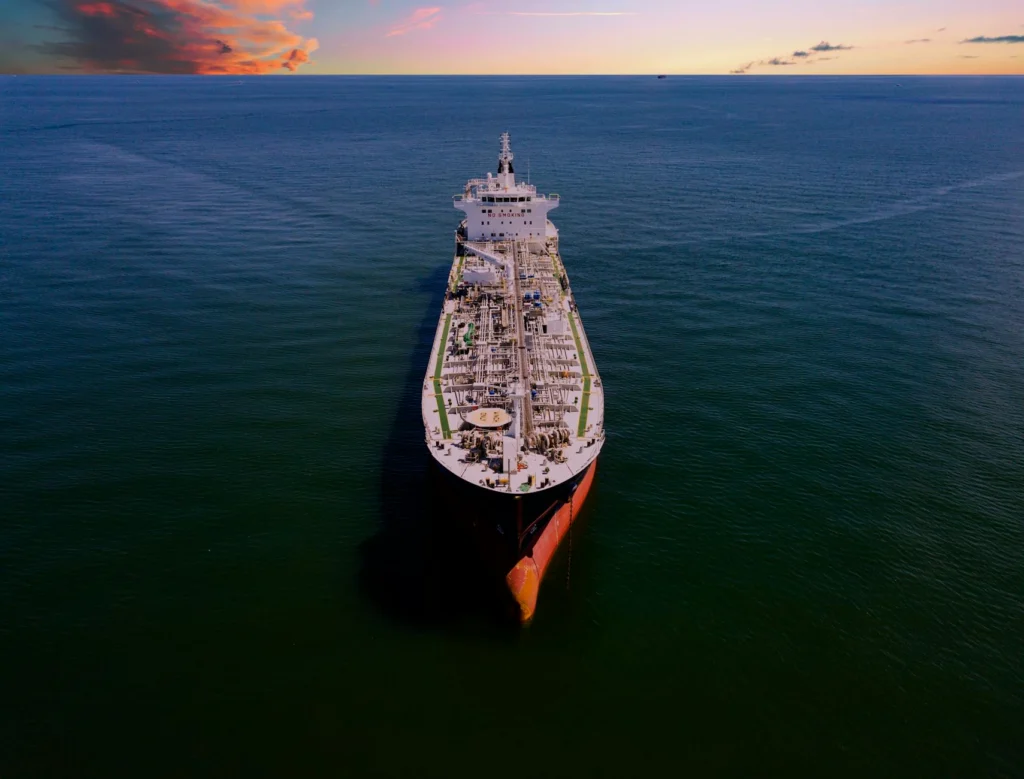
The ceasefire was announced on Tuesday. By Wednesday, four ships had made it through. More than 400 oil tankers remain anchored on either side of the Strait of Hormuz, their captains unwilling to risk the passage.[s] Over 800 vessels of all types are trapped in the Persian Gulf, along with an estimated 20,000 civilian seafarers stuck on board.[s] The bombs may have stopped falling, but the Hormuz chokepoint power that Iran built over the past six weeks has not evaporated with a handshake.
Our editor flagged this angle, and it deserves the attention: the weapon that matters most right now isn’t getting bombed at all.
Hormuz Chokepoint Power: What the IRGC Actually Controls
The United States and Israel have largely destroyed Iran’s conventional navy since February 28. The U.S. military reported sinking 60 Iranian vessels; satellite imagery confirms most of the fleet is gone.[s] But the threat to global shipping has not diminished. That is because Iran has two navies, and the one that matters for Hormuz chokepoint power is the one that is still very much intact: the Islamic Revolutionary Guard Corps Navy.
The IRGC Navy fields roughly 20,000 sailors and specializes in a doctrine built around fast-attack boats, shore-based anti-ship missiles, naval mines, midget submarines, and unmanned surface vessels configured as floating bombs.[s] This is asymmetric warfare by design. After the U.S. Navy destroyed half of Iran’s conventional fleet in a single day during Operation Praying Mantis in 1988, Tehran concluded that symmetrical naval warfare against a superpower was a losing proposition and pivoted to tools that exploit geography rather than try to match firepower.[s]
The result: you do not need to sink a tanker to shut down a strait. You just need ship captains to believe you might. “As long as there’s a threat of an attack, that’s enough. You don’t actually need the attack,” said Nikos Petrakakos of maritime investment firm Tufton.[s]
The Toll Booth at the Edge of the World
Iran has not simply closed the strait. It has reorganized it. While most of the world’s shipping sits frozen, the IRGC established a controlled corridor north of Larak Island, near the Iranian coast, where its forces vet each vessel before granting passage.[s] Ships flying the flags of China, India, Iraq, Pakistan, Russia, Thailand, Turkey, and Malaysia have transited the strait under bilateral deals with Tehran.[s] Everyone else waits.
“Iran’s IRGC has imposed a de facto toll booth regime in the Strait of Hormuz,” said maritime research firm Lloyd’s List Intelligence.[s] Iran’s parliament passed a bill to formalize toll collection on transiting vessels, with at least two ships already paying fees settled in Chinese yuan.[s] Under Iran’s rejected 10-point proposal, the toll could reach $2 million per vessel, split with Oman, with Iran’s share earmarked for reconstruction of infrastructure destroyed by U.S. and Israeli strikes.[s]
This is Hormuz chokepoint power converted into a revenue stream and a diplomatic tool simultaneously.
Why Captains Stay Anchored
The ceasefire has changed the political atmosphere. It has not changed the risk calculus for ship operators. Hapag-Lloyd, one of the world’s largest shipping firms, said it is “currently refraining” from transiting the strait. Maersk said the truce “does not yet provide full maritime certainty.”[s] Matt Smith of Kpler estimated only 10 to 15 vessels per day would attempt passage,[s] compared to a pre-war average of around 135.[s]
“For now, most of them are rightfully thinking, ‘I don’t care how much the bonus is, it’s not worth risking my life,'” Petrakakos told CNBC, referring to ship captains.[s] War risk insurance premiums, undefined transit conditions, and the legal framework for passage all remain unresolved.
The IRGC’s Real Card
The IRGC is not just a military organization. It controls a sprawling business empire spanning oil, banking, telecommunications, agriculture, and real estate, with affiliated foundations estimated in 2013 to account for more than half of Iran’s GDP.[s] It operates Iran’s ballistic missile arsenal, oversees the Quds Force, and plays a central role in the nuclear program.[s] Western sanctions intended to rein in that nuclear program actually strengthened the IRGC’s economic grip, as the corps expanded under the banner of “economic resistance.”[s]
Bombing Iran’s military bases and nuclear facilities hits the IRGC’s hardware. Hormuz chokepoint power hits the global economy. Only one of these gives Iran leverage at the negotiating table in Islamabad this Saturday.
“Iran has already demonstrated the power of its card,” said Liu Jia, a research fellow at the Middle East Institute of the National University of Singapore.[s] The IRGC Navy declared on April 6 that the strait will “never return to its former state.”[s]
What Happens Next
If the ceasefire holds, traffic will restart slowly. But Hormuz chokepoint power does not disappear when ships start moving. The infrastructure of control, the Larak corridor, the vetting system, the bilateral deals, remains in place. Iran is laying the “foundation” for “strengthening its control over the strait in the long term,” according to Andrea Ghiselli, a lecturer at the University of Exeter.[s]
The lesson of the past six weeks is straightforward: the weapon that paralyzed the global economy was not a missile, a centrifuge, or a warhead. It was a few hundred fast boats in a narrow strait, and the willingness to use them.
As of April 9, MarineTraffic data shows more than 400 oil-laden tankers and dozens of LNG and LPG carriers anchored on either side of the Strait of Hormuz, with only four transits recorded on the first full day of the ceasefire.[s] In total, over 800 vessels remain trapped in the Persian Gulf: 426 tankers hauling crude and clean fuels, 34 LPG carriers, 19 LNG vessels, plus dry bulk and container ships, with some 20,000 civilian seafarers stuck on board.[s] The boss called this one right: the most consequential weapon in this war is not getting bombed.
Hormuz Chokepoint Power: Asymmetric Doctrine in Practice
U.S. Central Command reported sinking 60 Iranian vessels and destroying the bulk of Iran’s conventional naval fleet, including both Mowj-class warships, the Alvand-class frigate Sabalan, and the forward-basing ship Makran.[s] In a historic first, a U.S. submarine torpedoed the IRIS Dena in the Indian Ocean near Sri Lanka on March 4, marking the first confirmed wartime submarine sinking of a surface warship since Britain sank the Argentine cruiser General Belgrano in 1982.[s]
None of this has reduced the threat to commercial shipping. The IRGC Navy, a parallel force with roughly 20,000 sailors, remains operationally intact.[s] “While I think the Iranian Navy is largely combat ineffective at this point, the IRGC navy remains able to harass shipping,” said Sascha Bruchmann, a military analyst at the International Institute for Strategic Studies. “That maintains a specter of danger that most civilian shipping lines and insurers will find unacceptable.”[s]
The doctrinal roots of this Hormuz chokepoint power trace to April 18, 1988, when the U.S. Navy sank half of Iran’s conventional fleet in a single day during Operation Praying Mantis. Tehran’s takeaway was unambiguous: symmetrical naval warfare against a superpower is suicide. What followed was a decades-long pivot toward fast-attack boats, shore-based anti-ship missiles, naval mines, midget submarines, and unmanned surface vessels configured as floating bombs.[s] Iran institutionalized this split by maintaining two separate navies: a conventional fleet for prestige, and the IRGC Navy purpose-built for harassment and denial operations in the Persian Gulf’s shallow, island-cluttered waters where geography compresses distances and partly neutralizes the advantages of a superior conventional force.[s]
Mohammad Farsi, a former Iranian naval officer, told RFE/RL that the focus on mines misses the point: “Any vessel can do it, even the IRGC speedboats currently in the Persian Gulf. The reason ships aren’t passing through is that companies know the probability of being hit is extremely high.”[s]
The Larak Corridor: Hormuz Chokepoint Power Monetized
The IRGC has not merely closed the strait; it has restructured transit through it. A de facto safe-shipping corridor now runs north of Larak Island, near the coast of Bandar Abbas, where IRGC and port authorities vet each ship before granting passage. All 57 transits logged since March 13 have taken this Larak detour.[s] Lloyd’s List Intelligence characterized it as “a de facto toll booth regime.”[s]
The vetting process requires vessel operators to submit IMO numbers, crew names, and final destinations through IRGC-linked intermediaries. If approved, the IRGC issues a clearance code and routing instructions; an Iranian boat then escorts the vessel through territorial waters. Ships that fail the screening are turned away.[s]
Countries with bilateral deals, including China, India, Iraq, Malaysia, Pakistan, Russia, Thailand, and Turkey, have secured passage for their flagged vessels.[s] Iran’s parliament passed a bill to formalize toll collection, and at least two vessels have paid fees in Chinese yuan, one brokered by a Chinese maritime services company acting as intermediary.[s] Iran’s rejected 10-point proposal set the toll at up to $2 million per vessel, split with Oman, with Tehran’s share designated for post-war reconstruction.[s]
The Economic Shockwave
The Federal Reserve Bank of Dallas modeled the closure as removing close to 20% of global oil supplies from the market, three to five times larger than the 1973, 1979, or 1990 oil shocks. Their model projects a WTI oil price of $98 per barrel and a reduction in global real GDP growth of 2.9 annualized percentage points in Q2 2026.[s] If the closure extends to two quarters, WTI rises to $115; three quarters, $132.[s]
The IRGC made the stakes explicit. On March 11, a spokesperson for the IRGC’s Khatam al-Anbiya Headquarters declared that not “a litre of oil” would pass through, that any vessel linked to the U.S., Israel, or their allies “will be considered a legitimate target,” and that the world should “expect oil at $200 per barrel.”[s]
The ceasefire has not resolved these dynamics. Oil analyst Matt Smith of Kpler estimated only 10 to 15 vessels per day would attempt passage, with the IRGC still vetting who goes through.[s] Hapag-Lloyd said it is “currently refraining” from transit; Maersk said the truce “does not yet provide full maritime certainty.”[s]
The IRGC’s Economic Empire and Strategic Leverage
Understanding why Hormuz chokepoint power is the IRGC’s trump card requires understanding what the IRGC actually is. It is not merely a military organization. The corps controls a diversified business empire spanning oil, transportation, banking, telecommunications, agriculture, medicine, and real estate. IRGC-affiliated foundations were estimated by the Clingendael Institute in 2013 to account for more than half of Iran’s GDP.[s] The IRGC operates Iran’s ballistic missile arsenal, oversees the Quds Force, and plays a central role in the nuclear program.[s]
Western sanctions designed to curb that nuclear program paradoxically strengthened the IRGC’s grip. As Fortune reported, “the IRGC used it as an opportunity to expand under the guise of ‘economic resistance’ and ‘self-reliance.'”[s] The entity that controls the nuclear program, the missile arsenal, and the economy also controls the strait. The U.S. can bomb the first two. The third is the one that brings the world to the table.
The Negotiating Table
The first round of ceasefire negotiations is set for Saturday in Islamabad.[s] The White House insists the strait must open “without limitation, including tolls.”[s] Iran’s position is that passage remains “subject to coordination with Iran’s Armed Forces and with due consideration to technical limitations.”[s] The IRGC Navy declared on April 6 that the strait will “never return to its former state.”[s]
Andrea Ghiselli, a lecturer at the University of Exeter and head of research at the ChinaMed Project, told Time that Iran is laying the “foundation” for “strengthening its control over the strait in the long term.”[s] The bilateral deals with China, India, and others “undermine U.S. leverage,” he said, because Iran is demonstrating its ability to manage the strait without U.S. involvement.[s]
Windward, the maritime research firm, put it plainly in a note on Wednesday: “All signs point to the Islamic Republic refusing to give up its leverage during the two-week period.”[s]
The U.S. has dropped thousands of bombs on Iran since February 28. It has destroyed the conventional navy, struck nuclear sites, and degraded missile infrastructure. Iran, in return, paralyzed 20% of global oil supply with speedboats, drones, and the credible threat of more. The Hormuz chokepoint power that the IRGC built is not a military tactic; it is a negotiating position. And as of today, with 400 tankers still at anchor, it is working.