Iran’s new supreme leader, Mojtaba Khamenei, declared on March 12 that the Strait of Hormuz would remain closed. It was his first public statement since being appointed supreme leader on March 9, following the killing of his father in US-Israeli airstrikes on February 28.
Here is what that means. The Strait of Hormuz is a narrow waterway connecting the Persian Gulf to the open ocean. It is the only sea route for oil exported from Saudi Arabia, Iraq, the UAE, Kuwait, and Qatar. According to the US Energy Information Administration[s], about 20 million barrels of oil pass through it every day, roughly 20% of global petroleum consumption. About a fifth of global liquefied natural gas trade also transits the strait, primarily from Qatar.
Why Iran Can Do This
The strait is only about 33 kilometers wide at its narrowest point. Iran sits on the northern shore, with missile batteries, radar installations, and fast-boat bases on islands inside the waterway, operated by the Islamic Revolutionary Guard Corps (IRGC). The geography gives Iran the ability to threaten any vessel passing through.
Iran has threatened to close the strait before, during disputes in 2012 and 2019, but never followed through. This time is different. Since early March, maritime traffic has been “reduced to a trickle,” according to the International Energy Agency. Insurance companies have pulled war risk coverage for ships in the area. Without insurance, commercial tankers do not sail. A Thai cargo ship was attacked on March 11[s].
Iran does not need to defeat the US Navy. It needs to make the cost of sending a tanker through prohibitively high. That threshold has already been crossed.
Why Pipelines Are Not Enough
Saudi Arabia and the UAE have oil pipelines that bypass the strait. But according to EIA estimates[s], only about 2.6 million barrels per day of spare pipeline capacity is available for bypass, against 20 million barrels per day of normal strait flow. There is no overland alternative for Qatar’s natural gas exports. The oil price shock is already cascading through global markets.
What Comes Next
The US Navy has two aircraft carrier groups in the region and is working to clear Iranian mines. But military analysts say restoring normal commercial shipping could take weeks to months. Mine clearance cannot proceed under fire; Iran’s coastal defenses would need to be neutralized first.
Khamenei’s statement[s] went beyond the strait, calling for all US bases in the region to be “immediately closed or will be attacked.” Whether the strait reopens depends on the wider military campaign, the willingness of Gulf states to provide alternatives, and how long major oil-importing nations, particularly China, India, South Korea, and Japan (which together receive about 69% of Hormuz crude[s]), can tolerate the disruption.
The 33-kilometer channel that carries a fifth of the world’s oil is closed. The consequences are not hypothetical. They are arriving.
Iran’s new supreme leader, Mojtaba Khamenei, declared on March 12 that “the vital global artery of the Strait of Hormuz would continue to be closed to pressure Iran’s enemies.” It was his first public statement since being appointed supreme leader on March 9, following the killing of his father in US-Israeli airstrikes on February 28. The statement was not delivered by Khamenei himself. It was read by a news anchor on Press TV.
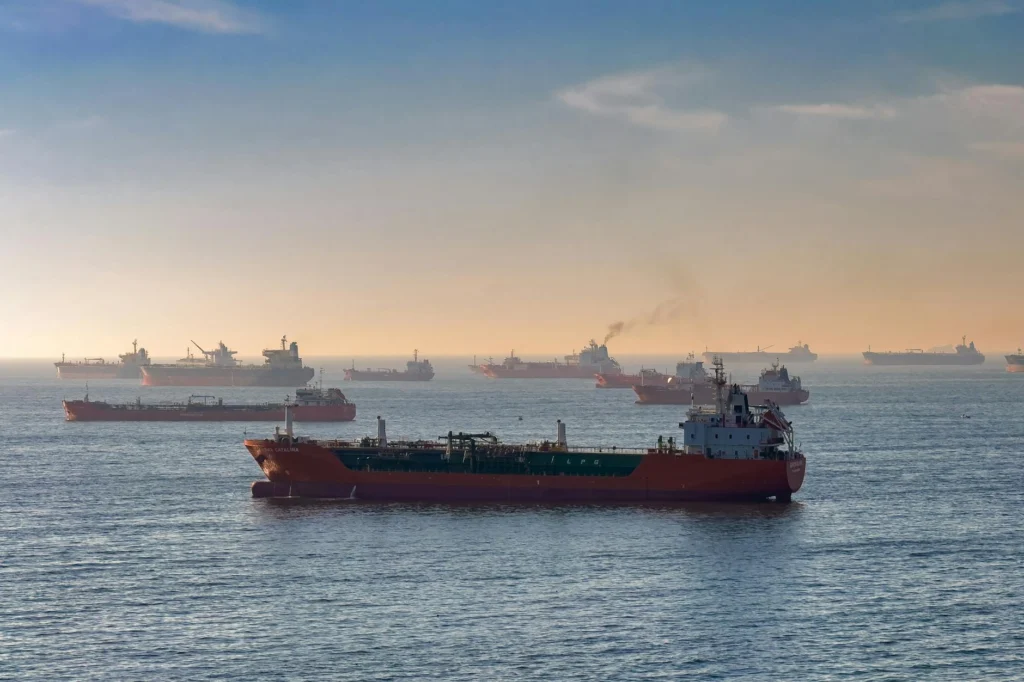
The Strait of Hormuz carries roughly 20 million barrels of oil per day, approximately 20% of global petroleum consumption, according to the US Energy Information Administration[s]. It is 167 kilometers long and, at its narrowest point, just 33 kilometers wide. An inbound and an outbound shipping lane, each about 3 kilometers across, are separated by a buffer zone. On a normal day, well over a hundred vessels transit the strait. There is no normal day right now.
Why the Strait of Hormuz Matters More Than Any Other Waterway
The Strait of Hormuz connects the Persian Gulf to the Gulf of Oman and, from there, to the open ocean. It is the only maritime exit for oil produced in Saudi Arabia, Iraq, the UAE, Kuwait, and Qatar. Iran sits on the northern shore. Oman and the UAE occupy the southern side.
The numbers are difficult to overstate. According to EIA data[s], Saudi Arabia alone accounts for roughly 38% of all crude oil transiting the strait (about 5.5 million barrels per day). Iraq and the UAE together make up most of the remainder. Three countries, nearly three quarters of total flow. On the receiving end, China, India, South Korea, and Japan together absorb about 69% of all Hormuz crude, with China as the single largest destination. Four Asian economies, the majority of everything that passes through.
The strait also handles roughly a fifth of global liquefied natural gas (LNG) trade, primarily from Qatar, one of the world’s largest LNG exporters. A disruption to the Strait of Hormuz is not a regional energy problem. It is a global one.
The Geography That Makes a Blockade Possible
A chokepoint is only as dangerous as its geography allows. The Strait of Hormuz is dangerously narrow.
The internationally recognized Traffic Separation Scheme (TSS) routes commercial shipping through lanes that pass close to Iranian territorial waters and the Iranian-controlled islands of Abu Musa, Greater Tunb, and Lesser Tunb. Iran has fortified these islands with anti-ship missile batteries, radar installations, and small-boat bases operated by the Islamic Revolutionary Guard Corps (IRGC) Navy.
The southern side of the strait, near the Musandam Peninsula belonging to Oman, offers alternative navigable water. But rerouting commercial traffic through an inshore zone while under threat of missile, drone, and mine attack is not a simple logistical adjustment. It requires naval escort, mine clearance, and air superiority, all sustained over weeks or months.
A History of Threats, and One Unprecedented Action
Iran has threatened to close the Strait of Hormuz before. It never followed through until now.
During the Iran-Iraq War (1980-1988), both sides attacked commercial shipping in what became known as the Tanker War. Over eight years, hundreds of ships were attacked, including 239 petroleum tankers[s]. Iran laid mines in the Persian Gulf, including in the strait itself. The US Navy intervened directly, reflagging Kuwaiti tankers and escorting them through the waterway in Operation Earnest Will. In April 1988, the US Navy sank or damaged half of Iran’s operational fleet in a single day during Operation Praying Mantis. Despite the escalation, Iran never closed the strait. It depended on the same sea lanes for its own oil exports.
In 2012, as Western sanctions tightened over Iran’s nuclear program, Iranian officials repeatedly threatened closure. General Martin Dempsey, then Chairman of the US Joint Chiefs of Staff, acknowledged that Iran “has invested in capabilities that could, in fact, for a period of time block the Strait of Hormuz.” The threat was taken seriously. It was not carried out.
In June 2019, two oil tankers were attacked near the strait in the Gulf of Oman. The US attributed the attacks to Iran, which denied involvement. Iran again threatened closure. Again, nothing happened.
On March 2, 2026, a senior IRGC official confirmed that the strait was closed and threatened any vessel attempting to transit. This time, the threat was not rhetorical. Maritime traffic through the strait has, according to the International Energy Agency, been “reduced to a trickle.” Insurance underwriters have pulled war risk coverage for vessels in the area. The Thai bulk carrier Mayuree Naree was attacked on March 11[s]. As of this writing, the strait remains effectively shut.
What the US 5th Fleet Actually Has in the Water
The US Fifth Fleet, headquartered in Bahrain, is responsible for naval operations across 2.5 million square miles of water, including the Strait of Hormuz. Its current deployment reflects the scale of the crisis.
Two carrier strike groups are operating in the theater. The USS Abraham Lincoln Carrier Strike Group is in the Arabian Sea, south of Iran, conducting flight operations and maritime security. The USS Gerald R. Ford was en route to join it as of mid-February, creating an uncommon two-carrier presence. Each carrier strike group includes guided-missile cruisers and destroyers equipped with the Aegis Combat System, and embarked air wings flying F-35C fighters and EA-18G electronic warfare aircraft.
For mine countermeasures, at least three Littoral Combat Ships (LCS) equipped with mine-sweeping mission packages are deployed from Bahrain: the USS Canberra, USS Tulsa, and USS Santa Barbara. US Central Command has released video[s] showing the destruction of 16 Iranian minelaying vessels. The Navy describes the mine threat as one it is taking “seriously,” which, in Pentagon vocabulary, means it is not under control.
Can Iran Actually Block the Strait?
The short answer: Iran cannot permanently close the Strait of Hormuz against a determined US response. The longer answer is that permanent closure is not the relevant metric.
Iran’s arsenal for disrupting the strait includes thousands of naval mines (both contact and magnetic varieties that can be deployed from virtually any vessel), anti-ship cruise missiles fired from coastal batteries and the fortified islands, explosive-laden fast attack boats operated by the IRGC Navy, armed drones, and submarines. The IRGC has trained extensively for asymmetric warfare in confined waters. It does not need to sink a carrier. It needs to make the insurance premium for a tanker transit prohibitively expensive.
That threshold has already been crossed. Maritime insurers have cancelled war risk coverage for the strait. Without insurance, commercial tankers do not sail. The physical blockade and the financial blockade are producing the same result.
Even a full US military effort to reopen the strait faces challenges. Nick Childs of the International Institute for Strategic Studies told NPR[s] that “if Iran was able to lay a large amount of mines, these could take weeks or months to clear.” Mine clearance cannot proceed under enemy fire. The IRGC’s coastal missile batteries must be neutralized first. The fortified islands must be suppressed. This is a campaign, not an operation.
Military analysts broadly agree on the timeline. Creating conditions for some ships to pass could take days to weeks. Restoring sustained, commercially viable transit could take months.
What Cannot Go Around the Strait
Saudi Arabia and the UAE have pipelines that bypass the Strait of Hormuz. According to the EIA[s], Saudi Aramco operates the East-West Pipeline running from the Abqaiq processing center on the Persian Gulf coast to the Red Sea port of Yanbu, with a capacity of about 7 million barrels per day. The UAE operates a 1.8 million barrel-per-day pipeline linking onshore fields to the Fujairah terminal on the Gulf of Oman, outside the strait.
Combined, these pipelines have a theoretical capacity of 8.8 million barrels per day. However, much of that capacity is already in use for normal operations. The EIA estimates that only about 2.6 million barrels per day of spare capacity from both pipelines could actually be redirected to bypass the strait. Against 20 million barrels per day of normal Hormuz flow, even the theoretical maximum replaces less than half. The realistic spare capacity replaces roughly one eighth. And neither pipeline does anything for Qatar’s LNG exports, which have no overland alternative.
The oil price shock is already cascading through global markets. Oil crossed $100 per barrel this week for the first time since 2022. Every day the strait remains closed widens the gap between what the world consumes and what the world can deliver.
What Comes Next
Mojtaba Khamenei’s statement[s] did not stop at the strait. He called for “all US bases in the region” to be “immediately closed or will be attacked.” He referenced “studies” into “the opening of other fronts in which the enemy has little experience and is highly vulnerable.” This is escalation rhetoric from a leader who has held power for less than two weeks, appointed mid-war, backed by an IRGC that has spent decades preparing for exactly this scenario.
The Strait of Hormuz has always been Iran’s most potent asymmetric weapon: the ability to impose global economic pain at relatively low military cost. For forty years, the threat alone was sufficient to shape Western calculations about how far to push Tehran. The threat is no longer theoretical.
Whether the strait reopens in weeks, months, or longer depends on three variables: the trajectory of the wider US-Israeli military campaign against Iran, the willingness of Gulf states to facilitate alternatives, and the tolerance of oil-importing nations (particularly China, India, South Korea, and Japan) for sustained supply disruption. None of these variables is under any single actor’s control.
The 33-kilometer channel that carries a fifth of the world’s oil is closed. The consequences are not hypothetical. They are arriving.