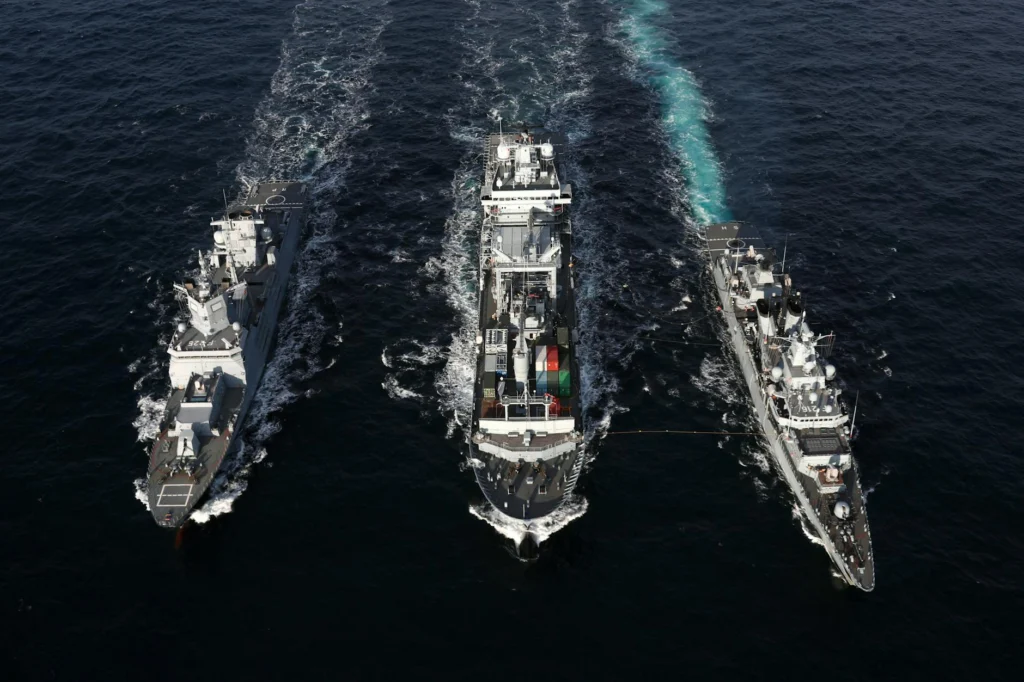
Island nation naval power follows a geographic logic that has shaped empires for centuries. Nations surrounded by water face a stark reality: they must dominate the seas or risk strangulation. This simple truth has driven maritime strategy from 18th-century Britain to 21st-century Japan, producing patterns that modern strategists still study.
Why Island Nations Build Strong Navies
When a country has no land borders to defend, its military resources can flow toward a single purpose: controlling the water. Britain demonstrated this principle for over 200 years. From the early 18th century until the Second World War, the Royal Navy was the world’s most powerful fleet, playing a key part in establishing and defending the British Empire.[s]
The American naval theorist Alfred Thayer Mahan studied this pattern and published his findings in 1890. His book, “The Influence of Sea Power upon History,” became the single most influential work in naval strategy, and its policies were quickly adopted by most major navies.[s] Mahan argued that British control of the seas, combined with a corresponding decline in the naval strength of its major European rivals, paved the way for Great Britain’s emergence as the world’s dominant military, political, and economic power.[s]
The Three Pillars of Island Nation Naval Power
Mahan identified three requirements for sustained maritime dominance. First, a merchant navy to carry goods across the seas. Second, a battleship navy to protect those trade routes and deter rivals. Third, a network of naval bases to fuel and supply the fleet far from home.[s] Island nations, freed from the expense of large standing armies, could pour resources into all three.
This framework explains why island nation naval power has historically outpaced that of continental rivals. France, despite greater population and resources, could never match Britain at sea because it had to maintain massive land forces along its borders with Germany, Spain, and the Low Countries.
Japan’s Modern Example
Japan’s geography mirrors Britain’s advantages. The Japanese islands form a crescent that brackets the Asian continent, giving Japan control over passage from the Asian continent to the Western Pacific Ocean.[s] This position allows a relatively small force to monitor and potentially block Chinese naval access to the open Pacific.
Japanese defense planners have leveraged this geographic gift through a “denial doctrine.” By stationing anti-ship and anti-air missiles along the Nansei Shoto island chain stretching from Okinawa toward Taiwan, Japan aims to make passage through critical chokepoints so hazardous that any hostile fleet would suffer unacceptable losses.[s]
Choke Points: Where Geography Becomes Destiny
Maritime choke points are narrow passages where global shipping must squeeze through. Control these, and you control trade itself. The Strait of Malacca, running between Malaysia and Indonesia, carries roughly 25% of the world’s traded goods, with over 90,000 vessels passing through annually.[s]
China’s leadership has long recognized this vulnerability. In 2003, President Hu Jintao coined the term “Malacca dilemma” to describe China’s dependence on this single passage for roughly 80% of its imported crude oil.[s] This geographic fact shapes Chinese foreign policy to this day, driving investments in alternative routes and maritime security.
The strategic relevance of maritime choke points has remained constant throughout military history. Their control has often defined the outcomes of major conflicts, shaped geopolitical balances, and influenced global economic flows.[s]
The Enduring Pattern
Island nation naval power emerges from geographic necessity rather than cultural preference. Nations surrounded by water learn to master it or perish. Britain built history’s greatest navy because the English Channel made invasion difficult but trade essential. Japan maintains sophisticated maritime forces because its archipelago both shields and constrains it. The pattern repeats wherever geography creates the same imperatives.
Island nation naval power derives from a specific geographic configuration that concentrates strategic imperatives. Without land borders requiring defense, these states can allocate disproportionate resources to maritime capabilities, creating force structures optimized for sea control, power projection, and SLOC protection.
Mahan’s Geographic Framework
Alfred Thayer Mahan developed his theory of sea power after observing the War of the Pacific (1879-1884), in which Chile decisively defeated Peru and Bolivia after seizing naval superiority.[s] His subsequent analysis identified geography as the primary determinant of naval potential.
Mahan argued that securing maritime access required three interconnected elements: a merchant navy capable of carrying products across the “great highway” of the high seas, a battleship navy to deter or destroy rival fleets, and a network of naval bases providing fuel, supplies, and open lines of communication.[s] This framework explained British dominance: island nation naval power allowed concentration of resources that continental rivals, burdened by land defense requirements, could never match.
The impact was immediate and lasting. Scholars considered Mahan’s work the single most influential book in naval strategy, with policies quickly adopted by most major navies, ultimately contributing to the World War I naval arms race.[s]
The Island Chain Strategy
American strategist John Foster Dulles formalized the island chain concept in 1951 during the Korean War. The strategy proposed surrounding the Soviet Union and China with naval bases in the Western Pacific to project power and restrict sea access.[s]
Three chains structure American Pacific defense. The first runs from the Kurils through Japan, the Ryukyus, Taiwan, the Philippines, and Borneo. The second extends through the Bonin Islands, Marianas (including Guam), and Western Carolines. The third spans from the Aleutians through Hawaii to New Zealand. For both Washington and Beijing, this framework emphasizes the geographical and strategic importance of Taiwan.[s]
Japan’s Denial Doctrine
Contemporary Japanese strategy demonstrates how island nation naval power adapts to modern technology. The Japanese islands form a crescent bracketing the Asian continent, giving Japan control over passage from the continent to the Western Pacific. The sea serves as both Japan’s greatest strength and most dire vulnerability.[s]
The Maritime Self-Defense Force has developed what strategists term a “denial doctrine.” By stationing anti-air and anti-ship missiles at strategic points along the Nansei Shoto island chain running from Okinawa toward Taiwan, Japan aims to impose unacceptable attrition on any force attempting to break out into the Western Pacific.[s] This approach transforms geography into a force multiplier, allowing relatively modest assets to control vast maritime spaces.
Indonesia’s Archipelagic Challenge
Not every archipelagic state successfully converts geography into island nation naval power. Indonesia, the world’s largest archipelagic state with over 17,000 islands, maintains naval capabilities weaker than smaller regional powers including Singapore, Thailand, and Vietnam.[s]
This paradox reflects Indonesia’s historical strategic culture. There is growing understanding that the most important security challenges the Indonesian archipelago faces are maritime in nature, yet these challenges cannot be addressed through the long-standing practice of army-based territorial defense.[s] Geography provides opportunity; exploiting it requires doctrinal and institutional adaptation.
Choke Point Calculus
Maritime choke points function as force multipliers, allowing numerically inferior defenders to thwart much larger opponents who cannot advance without first securing passage.[s] The Strait of Malacca exemplifies this principle, spanning approximately 800 kilometers while narrowing to just 2.7 kilometers at critical points.
Over 90,000 merchant vessels transit the Malacca Strait annually, carrying nearly 25% of global trade.[s] China’s “Malacca dilemma,” coined by President Hu Jintao in 2003, captures the strategic anxiety: roughly 80% of Chinese crude oil imports pass through this single corridor.[s] Similar concentrations at the Strait of Hormuz (20% of global oil) create equivalent vulnerabilities for energy-importing states.[s]
As the strategist Julian Corbett argued, sea power is not an end in itself but a means to influence events on land.[s] Island nation naval power operates within this logic, using maritime dominance to shape outcomes ashore while denying adversaries the same capability.
Strategic Implications
The 200-year pattern from British naval supremacy to contemporary Pacific strategy reveals consistent principles. Island nations that invest in maritime capabilities proportional to their geographic advantages can project power and secure trade far beyond what their size would suggest. Those that fail to adapt, like Indonesia until recently, find their archipelagic geography a burden rather than an asset. The formula Mahan identified in 1890 continues to shape fleet construction, base negotiations, and alliance structures across the Indo-Pacific.