Josh Hader returned to the Houston Astros bullpen in early June 2026, and the most telling number was not his ERA. It was 92.9: the average speed, in miles per hour, of his four-seam fastball in his last rehab appearance, a diminished mark for his heater.[s] For a closer who spent nearly a decade as one of the most durable arms in baseball, that dip is the visible edge of a question about reliever workload that has followed him since he changed teams.
For most of his career, Hader was close to indestructible. Before August 2025, the only time he had missed a stretch of the regular season was a 2021 COVID-19 case.[s] Then came a shoulder capsule sprain that ended his 2025 season in early August, followed by biceps tendinitis that erased the first two months of 2026. Two arm injuries in ten months, after nine seasons of almost nothing.
Something changed in between. When Hader signed a five-year, $95 million deal with Houston, he loosened a rule he had kept for years. From 2021 through 2023 he made zero regular-season outings longer than three outs,[s] apparently guarding his arm until free agency was settled. After the deal, he began pitching multiple innings: seven such outings in 2025,[s] the last a season-high 36 pitches across two innings against the Yankees.[s] That shift in his reliever workload is the thread tying together the dominance and the breakdown.
Why reliever workload matters
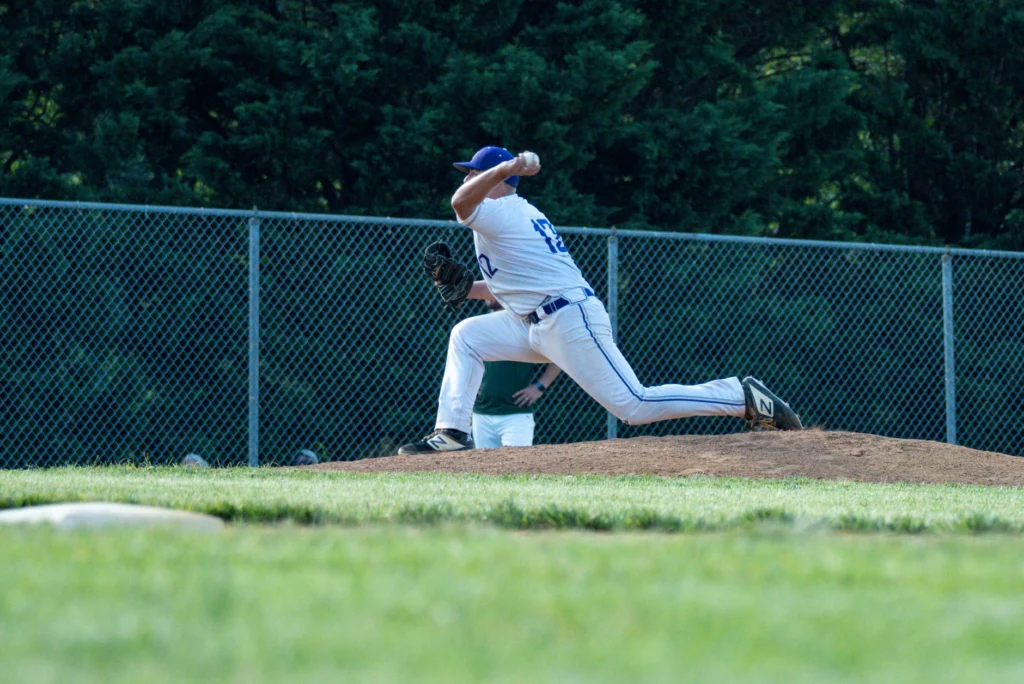
A closer throws nearly every pitch at maximum effort; there is no coasting. The mechanism is simpler than it sounds. When a pitcher tires, the large muscles that should generate power, the hips, core, and legs, fade first, and the throwing arm is left to make up the difference. More of the work lands on the shoulder and elbow. A controlled study of adolescent pitchers showed the chain of motion losing efficiency surprisingly early in an outing, with rotational power dropping pitch by pitch.[s] Multi-inning appearances can mean more pitches thrown while fatigued, which is exactly the territory a heavier reliever workload pushes a pitcher into.
The cruel part: being great is the risk
A 2026 study of MLB pitchers who needed shoulder surgery found something counterintuitive. The pitchers who broke down threw harder, spun the ball more, and graded out as nastier than the ones who stayed healthy. The researchers described it as a trade-off: chasing elite stuff raises the odds of injury.[s] Hader fits that description almost perfectly. In 2025 his strikeout, whiff, and chase rates all ranked in the 99th percentile of major-league pitchers.[s] His slider generated a 55.2% whiff rate, best in the league for that pitch type among pitchers who threw at least 300 sliders.[s] He is precisely the kind of pitcher that study flagged.
What this does not prove
Correlation is not cause, and the honest version of this story keeps the caveats in view. Hader threw 35 pitches in a game twice earlier in 2025 without getting hurt, so the 36-pitch outing right before his injury may be coincidence.[s] The two injuries may not even be linked: the Astros and Hader consider the 2025 shoulder problem and the 2026 biceps problem unrelated.[s] A heavier reliever workload raises risk; it does not guarantee an injury, and no one can name the single pitch that did the damage.
Hader is back as Houston’s closer, though reporting suggests he might be eased into the highest-pressure spots at first. The thing to watch is the radar gun. If his velocity climbs back toward his normal range, the worst is likely behind him. If it stalls near 92.9, the reliever workload question will follow him all season.[s]
The numbers that define Josh Hader also describe his risk, and the gap between them is where his arm lives. He returned to the Astros in early June 2026 having averaged just 92.9 mph with his four-seam fastball in his last rehab appearance, a diminished mark for his heater.[s] To see why that matters, start with what changed about his reliever workload, then look at what biomechanics research says happens to an arm like his.
A self-imposed limit, then released
Through the 2021 to 2023 seasons, Hader made zero regular-season outings longer than three outs,[s] a discipline widely read as protecting his value before free agency.[s] The five-year, $95 million Houston contract removed the incentive, and by his own framing the arrangement was reciprocal: the team committed years, he committed availability. The result was a measurable change in reliever workload, including a career-high 71 appearances in 2024,[s] seven multi-inning outings in 2025,[s] and a final 2025 appearance of two innings and a season-high 36 pitches covering the ninth and tenth against the Yankees.[s]
Fatigue starts from the ground up
The reason a heavier reliever workload is dangerous is not located in the arm. A 2025 study in the Journal of Strength and Conditioning Research (Johnson et al.) tracked pitchers through a throwing session and found the kinetic chain degrades from the bottom up: each additional pitch corresponded to a 2.3 degrees-per-second drop in pelvis rotation velocity, with hip-to-shoulder separation shrinking as fatigue set in.[s] One important caveat: that work used 17 high-school pitchers, and the fatigue threshold it identified appears specific to adolescents,[s] so the specific numbers do not transfer to a 32-year-old major leaguer. What transfers is the principle. When the pelvis and trunk stop delivering rotational energy, the shoulder and elbow absorb the shortfall. A 36-pitch outing is not hazardous because 36 is a magic number; it is that every pitch thrown past the point of lower-body fatigue routes more load through the joint that later failed.
That joint is also doing exotic work. Hader’s signature slider, thrown a career-high 41.4% of the time in 2025, up from 27.4% the year before,[s] gets its late, sharp break from spin acting on moving air, the same pressure-gradient physics that lets a wing generate lift. The harder and faster a pitcher spins a ball, the more violent the deceleration the shoulder must survive on every repetition.
Stuff+ as a risk factor
This is where Hader’s excellence becomes the warning. A 2026 case-control study of 35 MLB pitchers who underwent shoulder capsulolabral repair between 2017 and 2024 compared them against matched controls. The surgical group threw harder, with higher spin rates and a more medialized release point.[s] In the regression, two variables stood out as independent risk factors: a medial release point and Stuff+, the composite grade for pitch nastiness.[s] The authors’ conclusion was blunt, that “the pursuit of elite performance is linked to a greater likelihood of injury.” Capsular and labral damage already accounts for roughly 17% of pitcher injuries, and the outcomes are sobering: only 40% to 60% of pitchers regain their prior performance after surgery.[s] Hader’s 99th-percentile whiff and chase rates[s] and slider whiff rate, best in the league for that pitch type among pitchers who threw at least 300 sliders, place him near the top of exactly the population the study identified.
Failure is telegraphed, not random
A separate 2025 study examined the moment of failure itself. Analyzing seven MLB pitchers who tore the ulnar collateral ligament, an elbow injury rather than Hader’s shoulder, so the relevance is the method and not the body part, researchers found every injury pitch was a mechanical outlier, with velocity suppressed by a mean of 2.1 standard deviations and arm angle reduced by 1.5 standard deviations at the injury pitch.[s] In 86% of cases the deviation built up across the five fastballs before the tear.[s] The narrower lesson is that in this elbow-injury cohort, acute failure left a kinematic trail. A 2026 preprint pushed this toward scale, recovering 18 biomechanical metrics from ordinary broadcast video and flagging significant arm injuries at an AUC of 0.825 across 7,348 pitchers, with hip-shoulder separation and trunk orientation among the strongest signals.[s] These are machine-learning models, the same statistical tooling reshaping fields well beyond sports, and like all of them they are probabilistic.
Which is the honest limit. A model scoring an AUC around 0.81 to 0.83 still cannot tell you which pitch ends a career, for much the same reason perfect verification is impossible in any sufficiently complex system: the failure is real and the warning signs are real, but the precise moment stays out of reach. Hader’s current signal is his velocity. His rehab four-seamer at 92.9 mph[s] came after an injury and a slow ramp-up, not as a pre-injury omen, but it is the same variable the research treats as load-bearing, and it is worth watching closely.
The skeptic’s case
None of this is proof. The capsulolabral study is correlational, and a case-control design cannot establish that a heavier reliever workload caused any single injury. The fatigue data comes from adolescents. The ligament study is about the elbow. And the most deflating fact for a tidy narrative: Hader threw 35 pitches twice in 2025 without harm,[s] and the team treats his shoulder and biceps problems as unrelated.[s] A cascade story wants one root cause; the evidence offers two separate arm injuries sharing one risk profile, which is messier and more honest.
The Astros went 27-34 without their closer to open 2026,[s] so Hader rejoins a bullpen that needs him, with public reporting that he might be eased back into high-leverage situations. The larger lesson sits above any one pitcher: the analytics that build a Hader optimize for the exact traits that court a surgeon. Managing reliever workload, and reading the kinematic warning signs before they harden into an MRI, is the unsolved problem the whole sport is now staring at.