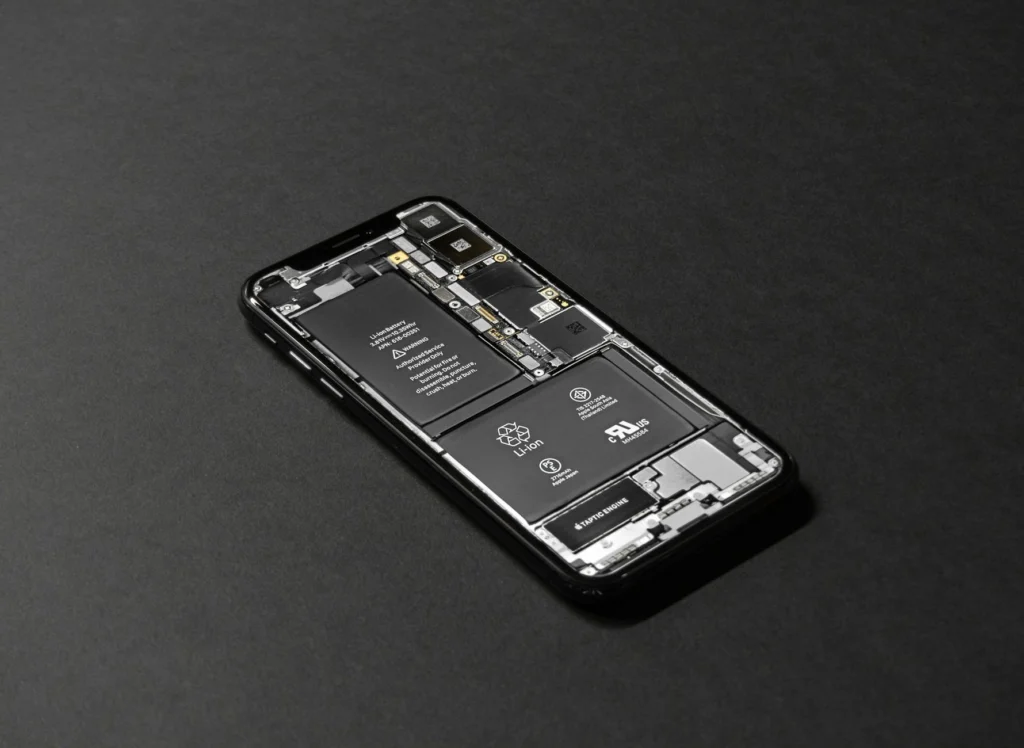
Most smartphones, laptops, and electric vehicles run on the same fundamental principle: lithium battery electrochemistry. Understanding how these devices store and release energy requires looking beyond the black box at the atomic-scale dance of ions and electrons that makes modern portable power possible.
In 2026, researchers reported experimental lithium-metal pouch cells above 700 watt-hours per kilogram of energy density.[s] To understand why that matters, you first need to understand what happens inside a lithium battery every time you plug in your phone.
The Intercalation Mechanism
Lithium battery electrochemistry works through a process called intercalation: “the process or act of inserting a guest atom or a molecule in between the layered or lamellar host material reversibly, without disrupting the structural features of the host material.”[s]
When you charge a lithium-ion battery, lithium ions leave the cathode (typically a layered metal oxide like LiCoO2) and travel through a liquid electrolyte to the anode (usually graphite). They slip between the graphite layers and nestle there until discharge, when they make the return journey. Electrons flow through the external circuit, doing useful work along the way.[s]
This differs from conversion chemistries that break and reform bonds across larger structural changes. Lithium-ion cells still operate through electrode redox reactions; intercalation is the structural mechanism that lets lithium ions move into and out of host lattices without wholesale collapse.[s]
For lithium battery electrochemistry to work, “both the anode and the cathode structures has to allow the reversible insertion and extraction of lithium ion during the discharging and charging.”[s] The layered structure of graphite makes it ideal for this, with enough space between carbon sheets for lithium to slide in and out thousands of times without destroying the host material.
The Electrolyte: Conductivity and Stability
Between the electrodes sits the electrolyte, a liquid that conducts lithium ions but blocks electrons. Most commercial batteries use lithium hexafluorophosphate (LiPF6) dissolved in organic carbonates. This salt “has a particular set of attributes such as high ionic conductivity (ca. 10-2 S cm-1 at 25 °C), excellent electrochemical stability (>4.5 V vs. Li+/Li).”[s]
The electrolyte must shuttle ions quickly while surviving the aggressive chemical environment inside a battery. LiPF6 contains more than three-quarters fluorine by weight, which creates both benefits and problems. Fluorinated additives “can stabilize the electrode materials by forming a fluorinated solid-electrolyte interphase (SEI), and/or cathode-electrolyte interphase (CEI), which improves the longevity of Li-ion batteries.”[s]
The SEI: A Protective Skin
The solid electrolyte interphase (SEI) is a battery component many readers may not have heard of. The SEI concept traces back to Peled’s 1979 description of an electronically insulating, ionically conducting passivation layer formed by electrolyte reduction near the anode during early cycles.[s]
This thin film forms automatically during a battery’s initial cycles. It blocks electrons from reaching the electrolyte while still allowing lithium ions to pass through. “Without the SEI, uncontrolled electrolyte breakdown reactions lead to rapid capacity loss, poor Coulombic efficiency, and eventual battery failure.”[s]
In 2026, a UC Berkeley/Lawrence Berkeley National Laboratory-led team and collaborators used mass spectrometry and reaction-network modeling to recover 27 previously reported SEI species and predict 28 novel species; the authors wrote that this nearly doubled scientific knowledge in the area.[s]
Why Batteries Degrade
Lithium battery electrochemistry produces mechanical stress with every charge cycle. “Insertion of Li+ in graphite leads to expansion of the interlayer spacing. The diffusion of Li+ is driven by a concentration gradient, resulting in local volume changes in the material.”[s]
This expansion and contraction cracks the SEI. “The solid electrolyte interface (SEI) formation breaks as the electrode particles expand, and the side reaction occurs again in the cracks, resulting in a continuous thickening of the SEI layer, reflecting as a continuous impedance increase and a capacity decrease.”[s]
Recent research has also overturned assumptions about how to measure degradation. Scientists found that “coulombic loss arises from a synergy between local charge neutrality and global charge compensation,” and that “contrary to conventional assumptions equating coulombic loss with irreversible capacity loss, this framework resolves systematic overestimations.”[s] In other words, measured coulombic loss does not map one-for-one to permanent capacity loss.
Thermal Runaway: When Chemistry Goes Wrong
The same lithium battery electrochemistry that enables high energy density also creates thermal runaway safety risks. “Thermal runaway (TR) of lithium-ion batteries caused by electrical, thermal, and mechanical abuse is a primary contributor to electric vehicle (EV) fires.”[s]
In full-scale testing of an NCM battery pack, researchers measured extreme temperatures: “the battery temperature reached a peak of 790.2 °C, the flame center temperature was 1233 °C.”[s] The paper also cites prior full-scale EV fire tests reporting that “compared to traditional fuel vehicles, EVs release more toxic and harmful gases such as HF after combustion.”[s]
The Frontier: Higher Energy Density
In February 2026, researchers published results in Nature. Using hydrofluorocarbon electrolytes instead of traditional oxygen-coordinating carbonate systems, they reported lithium-metal pouch cells with energy densities greater than 700 watt-hours per kilogram at room temperature.[s]
The new electrolyte design also improved low-temperature performance. The paper reports about 400 watt-hours per kilogram at -50°C and measurable ionic conductivity at -70°C.[s]
Meanwhile, South Korean researchers took a different approach: eliminating the conventional graphite or silicon anode. Using a silver nanoparticle-polymer host on copper current collectors and a designed electrolyte, a POSTECH/KAIST/Gyeongsang team reported 1,270 Wh/L volumetric energy density in anode-free lithium-metal pouch cells. The cells retained 81.9 percent of initial capacity after 100 cycles and achieved an average Coulombic efficiency of 99.6 percent.[s]
Beyond Intercalation
Some researchers are exploring non-intercalation cathodes. Conversion cathodes using transition metal fluorides “offer up to three times the gravimetric capacity of common intercalation-type cathodes.”[s] A chromium fluoride cathode demonstrated “an initial capacity of 435 mAh/g and an energy density of 0.71 Wh/g” in a thin-film solid-state test cell.[s]
The fundamentals of lithium battery electrochemistry remain the same across these innovations: move lithium ions, block electrons until they do useful work, and prevent the whole system from destroying itself. Whether the next generation uses graphite anodes, no conventional anodes, or entirely new electrode chemistries, that basic principle will persist. These results point toward higher-energy cells, but the cited papers report experimental cells rather than production batteries.
Lithium battery electrochemistry centers on the reversible movement of Li+ ions through cells and, in conventional lithium-ion batteries, their intercalation into host electrode materials. The field now includes experimental lithium-metal pouch cells exceeding 700 Wh/kg.[s] Understanding the electrochemical mechanisms, degradation pathways, and frontier research requires examining how these systems store and release energy at the atomic scale.
Intercalation Electrochemistry
The defining feature of lithium battery electrochemistry is intercalation: “the process or act of inserting a guest atom or a molecule in between the layered or lamellar host material reversibly, without disrupting the structural features of the host material.”[s]
During charge, Li+ deintercalates from cathode materials such as layered oxides (LiCoO2, LiNixMnyCozO2) or olivine LiFePO4 and intercalates into the graphite anode.[s] The LiCoO2/graphite half-reactions:
Cathode: LiCoO2 → Li1-xCoO2 + xLi+ + xe–
Anode: C6 + xLi+ + xe– → LixC6
These reactions are still redox reactions. The intercalation distinction is structural: lithium ions are stored reversibly inside host lattices rather than through wholesale bond-breaking conversion reactions.[s]
The constraint: “both the anode and the cathode structures has to allow the reversible insertion and extraction of lithium ion during the discharging and charging.”[s] Graphite’s layered structure provides staging sites that limit volume expansion as LiC6 forms.
Electrolyte Properties
The non-aqueous electrolyte must provide high ionic conductivity while remaining electrochemically stable across the cell’s voltage window. Commercial cells use lithium hexafluorophosphate (LiPF6) in carbonate solvents. LiPF6 “has a particular set of attributes such as high ionic conductivity (ca. 10-2 S cm-1 at 25 °C), excellent electrochemical stability (>4.5 V vs. Li+/Li).”[s]
Fluorinated components serve dual purposes. Besides salt anion stability, “fluorine-containing solvents or additives (e.g., fluoroethylene carbonate, FEC) can stabilize the electrode materials by forming a fluorinated solid-electrolyte interphase (SEI), and/or cathode-electrolyte interphase (CEI), which improves the longevity of Li-ion batteries.”[s]
Solid Electrolyte Interphase Formation
The SEI forms during initial cycling when electrolyte reduction products deposit on the anode surface. The SEI concept traces back to Peled’s 1979 description of an electronically insulating, ionically conducting passivation layer formed by electrolyte reduction near the anode during early cycles.[s]
This layer is essential for lithium battery electrochemistry. “Without the SEI, uncontrolled electrolyte breakdown reactions lead to rapid capacity loss, poor Coulombic efficiency, and eventual battery failure.”[s]
Recent computational-experimental work has characterized SEI composition at molecular resolution. A 2026 UC Berkeley/LBNL-led study and collaborators combined electrochemical reaction networks (209 million reactions) with FTICR-MS, recovering 27 previously reported SEI species and predicting 28 novel species.[s] Key components include Li2CO3, LiF, lithium alkyl carbonates, and various organofluorophosphates.
Degradation Mechanisms
Lithium battery electrochemistry produces diffusion-induced stress (DIS) during cycling. “Insertion of Li+ in graphite leads to expansion of the interlayer spacing. The diffusion of Li+ is driven by a concentration gradient, resulting in local volume changes in the material.”[s]
This mechanical stress propagates through the electrode structure. “The solid electrolyte interface (SEI) formation breaks as the electrode particles expand, and the side reaction occurs again in the cracks, resulting in a continuous thickening of the SEI layer, reflecting as a continuous impedance increase and a capacity decrease.”[s]
A 2025 Nature Communications study challenged assumptions about degradation metrics. Researchers demonstrated that “coulombic loss arises from a synergy between local charge neutrality and global charge compensation” and that “contrary to conventional assumptions equating coulombic loss with irreversible capacity loss, this framework resolves systematic overestimations.”[s] The work introduced physics-informed descriptors (detrimental ratio and balanced ratio ip/in) for more accurate lifespan prediction.
Thermal Runaway Kinetics
The high energy density enabled by lithium battery electrochemistry creates thermal runaway safety risks. “Thermal runaway (TR) of lithium-ion batteries caused by electrical, thermal, and mechanical abuse is a primary contributor to electric vehicle (EV) fires.”[s]
Full-scale NCM battery pack testing documented the five-stage cascade: smoke escape, sequential safety valve opening, open flame appearance, completion of valve opening, and flame extinction. Peak temperatures reached “790.2 °C” at the battery and “1233 °C” at the flame center.[s]
The paper also notes prior full-scale EV fire tests reporting that “compared to traditional fuel vehicles, EVs release more toxic and harmful gases such as HF after combustion,” a reason EV fires can require different emergency-response planning.[s]
Recent Energy Density Advances
The Nature paper reported hydrofluorocarbon electrolytes that replace traditional O-Li+ coordination with F-Li+ coordination. The electrolytes enabled lithium-metal pouch cells with energy densities greater than 700 Wh/kg at room temperature and about 400 Wh/kg at -50°C.[s]
A POSTECH/KAIST/Gyeongsang collaboration took a different approach with anode-free architecture. Using silver nanoparticle-polymer frameworks on copper current collectors and a designed electrolyte, the team reported 1,270 Wh/L volumetric energy density in anode-free lithium-metal pouch cells. Cycle life reached 81.9 percent of initial capacity after 100 cycles with an average Coulombic efficiency of 99.6 percent.[s]
Conversion-Type Cathodes
Beyond intercalation, conversion reactions offer higher theoretical capacities. Transition metal fluorides “offer up to three times the gravimetric capacity of common intercalation-type cathodes, and keeping reasonably high theoretical voltages (2.0-3.5 V).”[s]
A chromium fluoride cathode (Cr-LiF, 1.1:2 stoichiometry) demonstrated “an initial capacity of 435 mAh/g and an energy density of 0.71 Wh/g at a C/10 cycling rate” with stable capacity of 208 mAh/g after 1500 cycles at 5C.[s]
The fundamental principles of lithium battery electrochemistry, moving Li+ reversibly between electrodes while maintaining electronic insulation through the electrolyte, remain constant across these innovations. These results point toward higher-energy practical cells, but the cited papers report experimental cells and do not establish a commercialization date.