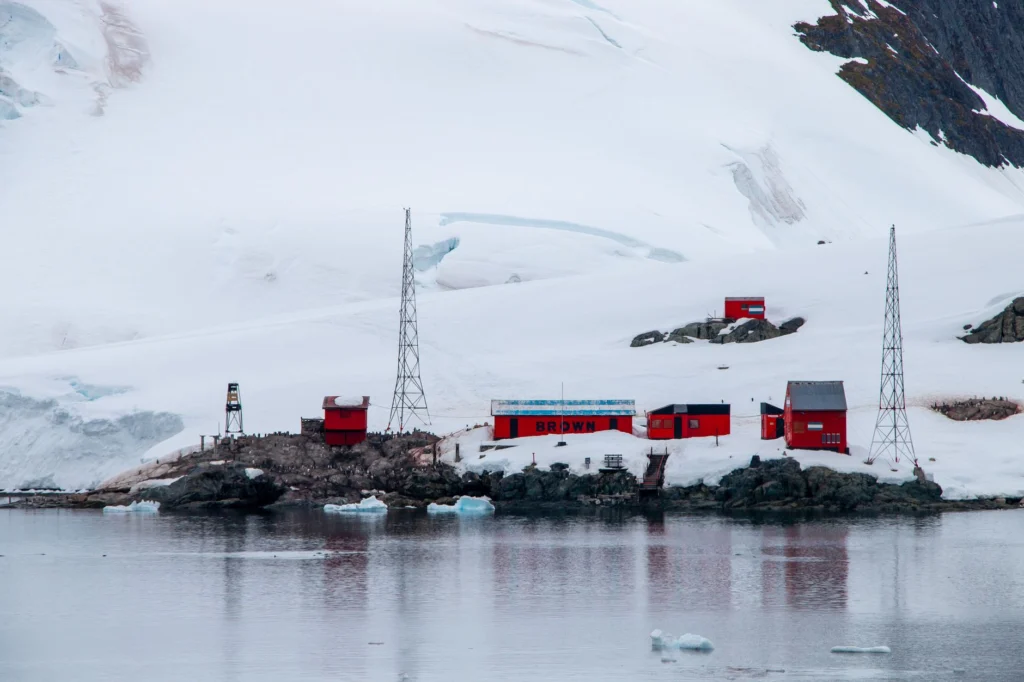
For more than six decades, the world agreed to leave one continent off the chessboard. That agreement is now being quietly tested. By mid-2026, the United States was moving ahead with the loss of its only icebreaker dedicated to Antarctic research[s], China had lodged plans for a sixth Antarctic station, a summer facility at Marie Byrd Land[s], and delegates from 44 countries gathered in Hiroshima for the treaty meeting that governs the ice[s]. Together, these moves mark the moment Antarctic geopolitics stopped being a distant hypothetical and turned into something governments are scrambling to manage.
Antarctica is not supposed to work this way. It is the only continent with no permanent population, no Indigenous nations, and, on paper, no owners. Yet beneath the ice lies a prize that grows more tempting as the planet warms: copper, iron, gold, oil, and gas, alongside fisheries and krill in the Southern Ocean[s]. The question driving the new Antarctic geopolitics is plain. If warming exposes more land and the resources become easier to reach, will the treaty that has kept the peace hold, or will it crack?
The Frozen Bargain
The rules begin with the Antarctic Treaty System, established in 1959 and in force since 1961, which sets the continent aside for “peaceful and scientific purposes” only and bans military bases, weapons testing, and fortifications[s]. A second layer, the 1991 Protocol on Environmental Protection, known as the Madrid Protocol, goes further. It declares that “any activity relating to mineral resources, other than scientific research, shall be prohibited”[s]. For now, no one may drill, mine, or pump.
Sovereignty was never resolved, only frozen. Seven states, Argentina, Australia, Chile, France, New Zealand, Norway, and the United Kingdom, hold formal territorial claims, some of them overlapping, and Australia’s slice alone covers roughly 40 percent of the landmass[s]. The arrangement echoes older imperial partitions of territory, including the Scramble for Africa, but in Antarctica those claims were never widely recognized and were deliberately set aside by the treaty. The United States and Russia recognize no claims at all, while quietly reserving a “basis of claim” for themselves[s].
The catch sits in the calendar. From 2048, any consultative party may call for a conference to review the Madrid Protocol’s mining ban, though changing the ban would still require demanding treaty hurdles and a binding legal regime for Antarctic mineral activity[s]. That date has become the lodestar of Antarctic geopolitics, a fixed horizon, 22 years off, that shapes how states position themselves today. No one needs to break the treaty now. They only need to be standing in the right place, with the right infrastructure, when the review window opens.
China and the New Antarctic Geopolitics
China has positioned itself deliberately. Beijing has set a stated goal of becoming a “polar great power” by 2030[s], and it is building toward it. China ran two year-round stations in 2020; analysts have projected its Antarctic network could reach six stations by the end of 2027[s]. The next proposed site is a summer station at Marie Byrd Land, while Beijing continues to expand icebreaker and logistics capabilities[s].
The unease is less about the stations than about what sits inside them. Much of China’s work is plainly scientific, but the same antennas that track weather can track satellites. A 2022 US Defense Department review and later analysis flagged that several Chinese stations can serve as ground references for BeiDou, China’s answer to GPS, and that its newest station, Qinling, sits where it “may enable it to collect signals intelligence from U.S.-allied Australia and New Zealand and could collect telemetry data on rockets”[s]. Australian treaty expert Jeffrey McGee notes that infrared telescopes and ground receivers installed for research “can also interface with military and surveillance satellites”[s].
This is the heart of the “dual-use” worry, and China has not exactly calmed it. Its National Defense University wrote in a 2020 strategy textbook that “military-civilian mixing is the main way for great powers to achieve a polar military presence”[s]. None of this breaks the treaty. All of it builds the kind of presence that converts, over decades, into influence, the slow currency of Antarctic geopolitics.
Russia and the Resource Question
If China plays the long game of presence, Russia is prodding directly at the resource frontier of Antarctic geopolitics. Its state mineral firm Rosgeo has run operations since 2019 to “assess the oil and gas bearing prospects of the Antarctic shelf”[s], and a report by the UK Parliament’s Environmental Audit Committee questioned whether those seismic surveys are about science or about identifying natural resources[s]. The committee’s summary was blunt: “Geopolitical tension and the prospect of potential mineral reserves are straining peace and environmental protection in Antarctica.”
One figure has dominated the headlines. Russian surveys in the Weddell Sea, a sector claimed by Britain and contested by Argentina and Chile, were reported in 2024 media coverage from evidence discussed by the UK committee to indicate as much as 511 billion barrels of oil[s]. Petroleum-geology outlet GeoExpro later warned that the claim rests on seismic data alone, not drilling, so it should be read with caution[s]; what matters is the pattern it fits. Klaus Dodds, a geopolitics professor at Royal Holloway, University of London, told the committee that Russia’s data collection could be “construed to be prospecting rather than scientific research”[s].
Russia’s intentions are read through its conduct. In 2018, a Norwegian team was blocked from inspecting runways at Russia’s Novolazarevskaya base[s], the kind of refusal that erodes the trust the whole system runs on. And in March 2025, Russia and China separately announced plans to modernize or build stations near one another in Marie Byrd Land, a slice of West Antarctica that no one claims[s], turning scientific infrastructure into a way to anchor influence on the one part of the continent still up for grabs.
America Sails Home
Against this backdrop, the United States is doing something its own strategists find baffling: stepping back. The National Science Foundation announced in September 2025 that it was terminating the lease for the RV Nathaniel B. Palmer, the sole US icebreaker dedicated to Antarctic research[s]. Strategists warn that losing that ship strips away America’s only independent maritime research capability in the southern polar region[s]. The ship matters for what it carries: the ability to reach stations, inspect rivals, and gather data without asking anyone’s permission. That capability may be the biggest variable in Antarctic geopolitics, and Washington is letting it go.
Inspection is America’s quiet advantage here. Treaty parties may show up unannounced at any base, ship, or aircraft to verify that no one is cheating, and the United States has run more of these checks than any country, sixteen since 1961[s]. In January 2026, a US interagency team including the National Science Foundation and the Defense Department completed a five-day inspection of Australian, Chinese, Indian, and Russian stations, with the results slated for the Hiroshima meeting[s]. But inspections only work if you can physically get there, and for that latest trip Washington leaned on Australian and New Zealand logistics, a sign of how quickly independent reach can shrink.
The retreat is also a budget story. In May 2025, the White House proposed cutting the National Science Foundation by 56 percent, from $9 billion to $3.9 billion[s]; Congress rejected most of the cuts and restored funding to $8.75 billion, keeping polar programs roughly intact. Yet the strategic signal lands oddly next to the other half of US policy. The same administration is authorizing new icebreakers to project power in the Arctic, even as it pulls back at the opposite pole. Washington treats presence as decisive in the geopolitics of the Arctic, then voluntarily surrenders it in the south.
The Melting Trigger
What gives 2048 its weight is the ice itself, the clock running beneath Antarctic geopolitics. A 2026 study in the journal Nature Climate Change projects that Antarctica’s ice-free land could grow by as much as 120,000 square kilometers, roughly 550 percent, over the next three centuries as the ice sheet retreats[s]. That new bare ground is expected to surface “in all regions with existing territorial claims as well as in the unclaimed sector in West Antarctica”[s], exposing mineral deposits in regions where claims and strategic interests already overlap.
The numbers being floated are large enough to reset the calculation. The Soufan Center, drawing on that research, points to estimates that Antarctica may hold 12 to 25 million metric tons of copper[s], a metal the energy transition is desperate for, alongside iron, gold, and platinum. As one Antarctic scholar quoted in the brief puts it, many oil-poor states already regard the continent’s potential mineral resources “as part of the solution to their medium-term energy needs”[s]. The ban is indefinite, but the politics around it may become harder as the prize looks less remote.
Geography compounds the stakes. The waters around the continent sit astride the Drake Passage, one of the planet’s loneliest maritime chokepoints, where the Atlantic and Pacific meet below South America. As fishing fleets, tourists, and supply ships crowd in, a region with overlapping British, Argentine, and Chilean claims, and a memory of South Atlantic war, becomes a place where a single incident at sea could escalate.
A Governance Test in Hiroshima
All of this landed on the table at the 48th Antarctic Treaty Consultative Meeting, held in Hiroshima from May 11 to 21, 2026, the first time in 32 years Japan had hosted it, drawing more than 400 delegates from 44 countries[s]. The symbolism of debating a peace regime in Hiroshima was lost on no one. The substance was harder, and it is the governance test now sitting at the center of Antarctic geopolitics.
Take tourism. Visitor numbers have climbed to almost 120,000 in the 2024 to 2025 season[s], spreading from cruise decks to remote air landings, yet the meeting produced only the outline of a framework, not the binding rules conservation groups wanted. Take the emperor penguin, elevated to “Endangered” on the IUCN Red List earlier in 2026[s] and facing functional extinction by 2100 on current emissions paths: delegates reaffirmed its importance but stopped short of granting it Specially Protected Species status, blocked by a small minority of parties.
The deeper anxiety at Hiroshima was transparency. The system has no police force; it works only if members report honestly and inspect each other in good faith. As Japan’s hosts warned, when “the activities of individual parties in Antarctica lack transparency, it can lead to distrust and suspicion among other parties”[s]. The Antarctic and Southern Ocean Coalition was blunter, warning that “the pace of diplomatic decision-making remains dangerously slow”[s] against the speed of change on the ice.
A Pause, Not a Settlement
None of this amounts to a treaty on the verge of collapse. The honest reading, shared by most analysts, is slower and more unsettling: a system being hollowed out from within rather than overthrown. The Antarctic Treaty relies on transparency, advance notification, and inspections rather than a standing enforcement body[s]; it endures only because the major powers keep choosing to make it endure. The risk in this round of great-power competition is that, one by one, those choices stop being automatic: a blocked inspection here, an ambiguous survey there, a research base that doubles as a listening post.
Some states are already moving to shore up the system. Australia and New Zealand agreed in March to launch an annual strategic dialogue on Antarctica[s], and the next treaty meeting heads to the Republic of Korea in 2027. Whether those steps add up to a defense of the commons or merely a slower retreat is the open question of Antarctic geopolitics. The coldest continent matters precisely because it is the last large place on Earth still governed by restraint rather than rivalry. What happens before 2048 will reveal whether that restraint was a permanent achievement or a long, comfortable pause.