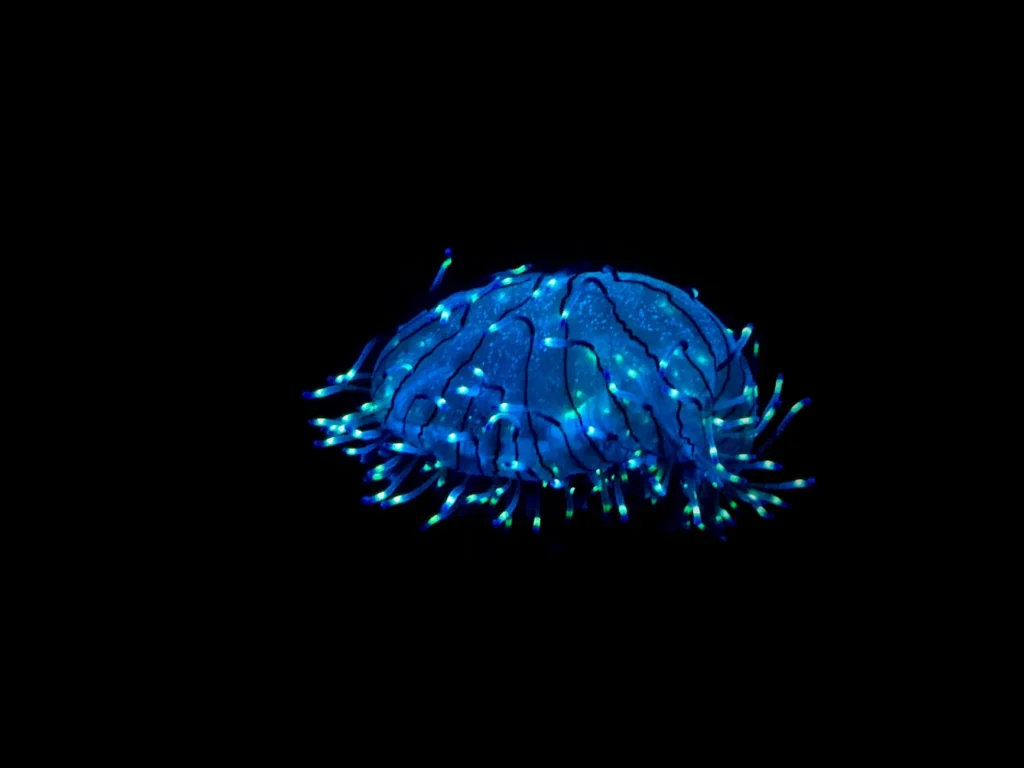
In the pitch-black waters of the deep ocean, where sunlight never reaches, an estimated 75% of deep-sea creatures possess some form of light production[s]. Animal bioluminescence, the biochemical production of cold light, has evolved independently more than 50 times across the tree of life[s]. Approximately 3,500 species are known to produce light this way, with many more likely undiscovered[s]. The phenomenon dates back some 540 million years in the marine environment[s], making it an ancient marine adaptation.
How Animal Bioluminescence Works
Unlike an incandescent light bulb, which generates light through heat, animal bioluminescence produces light through chemistry alone. The process involves two key players: a light-emitting molecule called luciferin and an enzyme called luciferase that triggers the reaction[s]. When luciferin reacts with oxygen in the presence of luciferase, it releases energy as visible light rather than heat.
This efficiency is remarkable. Firefly luciferase has been reported with a quantum yield around 88%, making it unusually efficient at converting reaction energy into light with little heat loss[s]. An incandescent light bulb, by comparison, wastes most of its energy as heat.
Animals produce bioluminescent light in three ways[s]: through specialized cells within their bodies (intracellular), by secreting chemicals that react outside their bodies (extracellular), or by hosting bioluminescent bacteria in dedicated organs (symbiotic). Deep-sea fish often use bacterial symbionts, while fireflies and jellyfish generate light within their own cells.
Why Animals Make Light
Bioluminescent organisms use their light for predator evasion, prey attraction, and communication with their own species[s]. Fireflies exchange flashes during courtship, with each species using a unique timing pattern to avoid confusion. Some female fireflies of the genus Photuris exploit this system by mimicking the flash patterns of other species to lure males, then killing and eating them[s].
In the deep sea, animal bioluminescence serves as camouflage through counterillumination: fish and squid project light downward to match the faint glow from above, rendering themselves invisible to predators below[s]. Others use light as a “burglar alarm,” flashing when disturbed to attract larger predators that might eat the attacker[s].
Color Selection
Many marine species produce blue or green light, which penetrates seawater efficiently, while terrestrial organisms often produce yellow or green hues[s]. Deep-sea dragonfish are an exception: they emit red light that is undetectable except by other dragonfish[s].
Medical Applications
Researchers have harnessed animal bioluminescence for cancer research. Scientists at USC’s Keck School of Medicine developed the Matador assay using luciferases from deep-sea crustaceans and shrimp[s]. The test detects cancer cell death in as little as 30 minutes[s]. The lab has developed more than 75 cancer cell lines expressing marine luciferases to advance cellular immunotherapies including next-generation CAR-T cells[s].
Bioluminescence-mediated photodynamic therapy (BL-PDT) is being studied as another cancer-treatment application. By using internal bioluminescent light sources rather than external lasers, researchers aim to activate photosensitizers within tumor microenvironments and address the tissue-penetration limits of conventional light-based therapies[s].
The Biochemistry of Animal Bioluminescence
Animal bioluminescence follows a recurring chemical logic despite evolving independently dozens of times. The reaction commonly involves oxidation of a substrate (luciferin) by an enzyme (luciferase), often proceeding through a high-energy peroxide intermediate that decomposes to an excited-state product (oxyluciferin)[s]. This excited state relaxes to ground state by emitting a photon.
Over 40 distinct bioluminescence pathways have been identified, each with specific luciferins and luciferases[s]. The repeated convergence on oxidation and decarboxylation shows that many independently evolved systems arrived at similar light-producing chemistry[s].
D-Luciferin System (Beetles)
Firefly luciferase (approximately 60 kDa) catalyzes the ATP-dependent oxidation of D-luciferin[s]. The reaction requires Mg2+ as a cofactor. D-luciferin undergoes adenylation, forming a luciferase-luciferin-AMP complex that reacts with molecular oxygen. The resulting excited-state oxyluciferin emits yellow-green light (peak ~560 nm) as it returns to ground state, releasing CO2 and AMP as byproducts.
Firefly luciferase has been reported with a quantum yield of 88% (±25%)[s], exceptional among bioluminescent systems. This efficiency arises from optimized enzyme architecture that minimizes non-radiative decay pathways.
Coelenterazine System (Marine Organisms)
Coelenterazine-dependent luciferases, including Renilla (36 kDa) and Gaussia (20 kDa), and the related NanoLuc system (19 kDa), do not require ATP and depend on oxygen for light production[s]. The oxidation proceeds through a dioxetanone intermediate, with emission peaks between 450-500 nm (blue-green). Gaussia luciferase, secreted by copepods, demonstrates exceptional thermal stability and catalytic rate, making it valuable for reporter applications.
Dinoflagellate System
The dinoflagellate reaction remains poorly understood despite decades of study. Light production in these single-celled plankton occurs within organelles called scintillons. Mechanical stimulation triggers a signaling cascade involving G proteins and TRP ion channels, leading to proton influx that drops scintillon pH below 6[s]. The pH change releases luciferin from its binding protein, enabling oxidation by luciferase. The entire process, from stimulus to flash, takes approximately 15 milliseconds[s].
Evolutionary Origins
One hypothesis suggests animal bioluminescence evolved as a mechanism for detoxifying reactive oxygen species when Earth’s atmosphere became oxygen-rich[s]. Early organisms unable to process oxygen productively developed oxidation reactions that disposed of it, with light production as a side effect. Natural selection subsequently repurposed this chemistry for communication, defense, and predation.
In Metridinidae copepods, bioluminescence capability is facilitated by luciferase gene duplication[s]. Studies of Metridia lucens reveal unexpectedly high genetic diversity within luciferase gene families, with evidence of purifying selection maintaining functional sequences. This pattern suggests strong selective pressure on bioluminescence-related traits across evolutionary time.
Research and Medical Applications
Copepod luciferases can offer advantages over firefly luciferase for cell biology applications: ATP independence, high secretability, high enzymatic activity under comparable experimental conditions, and stability under physiological conditions[s]. The Matador assay, developed using luciferases from deep-sea crustaceans, achieves single-cell sensitivity for detecting cancer cell death[s]. Researchers have used this system to develop more than 75 cancer cell lines for testing cellular immunotherapies and next-generation CAR-T cells[s].
Bioluminescence resonance energy transfer (BRET) enables non-radiative energy transfer from luciferase donors to fluorescent acceptors within approximately 10 nm proximity[s]. This property underpins bioluminescence-mediated photodynamic therapy (BL-PDT), which is being explored to activate photosensitizers from within the tumor microenvironment[s] and to address the tissue penetration limits that constrain conventional light-based therapies.