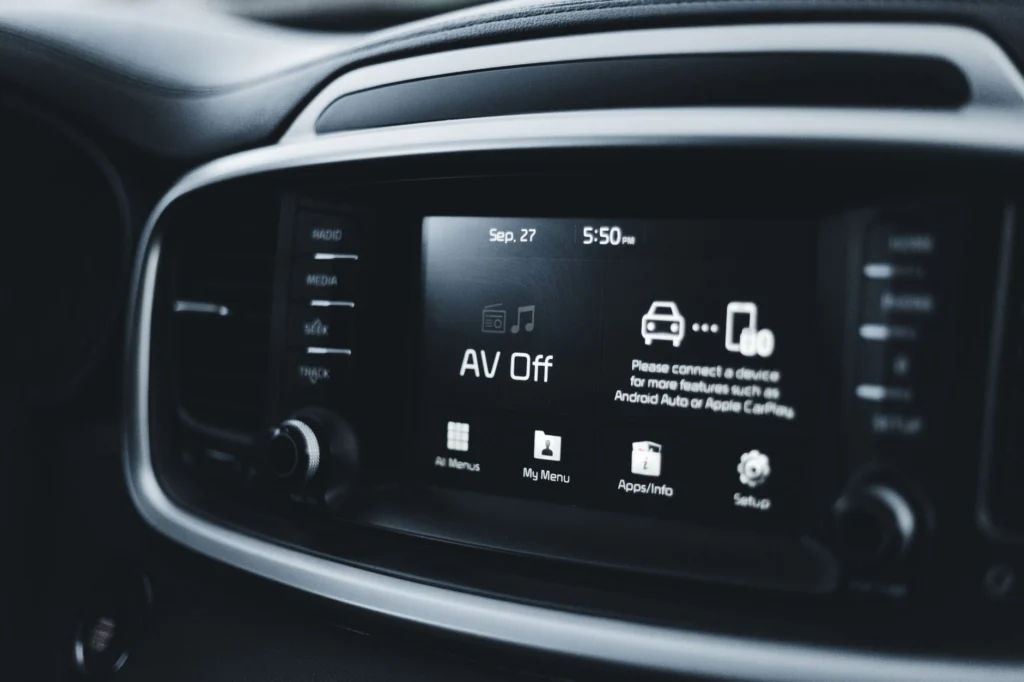
In October 2025, General Motors said its future cars will be run by a single powerful computer instead of the tangle of small chips under today’s hood, starting with the 2028 Cadillac Escalade IQ.[s] The reason is not engineering elegance for its own sake. It is money. GM reported 12 million OnStar subscribers at the end of 2025, expected that number to top 13 million by the end of 2026, and disclosed $5.4 billion in deferred revenue from OnStar services including Super Cruise.[s] Secondary reporting put 2025 realized connected-services revenue at about $2.7 billion.[s] The software-defined vehicle is how a carmaker stops selling you a product once and starts billing you for it every month.
What a Software-Defined Vehicle Changes
A modern car can run well over 100 separate little computers, called electronic control units, each handling one job and barely talking to the others.[s] GM’s new design folds dozens of those units into one central core built around an NVIDIA Thor chip, with three “aggregator” hubs and a high-speed Ethernet backbone tying everything together.[s] Think of it as moving from a house full of single-purpose gadgets to one smartphone that runs every app. GM says the payoff is roughly 10 times more software updates than its current system, and the same core works on both gas and electric models.
That central brain is what makes the subscription business possible. To sell a feature months after you drive off the lot, the car has to stay connected and accept new code from afar. GM already pushes these over-the-air updates to more than 4.5 million vehicles, a number growing by about 2 million a year.[s] The strategy is already paying back: of the 35,000 drivers whose free Super Cruise trial expired in 2025, about 30 percent chose to pay to keep it.[s]
The Hidden Engineering Bill
Rebuilding a car this way is far harder than the launch video suggests. A 2025 industry survey found that only one in 10 automotive organizations had separated their software from their hardware, the basic move a software-defined vehicle depends on, and just 14 percent had scaled a software-driven mobility use case.[s] GM’s job is tougher than most. Tesla and Rivian build a handful of electric-only models from a clean sheet, while GM is trying to convert an entire lineup of gas and electric vehicles at once.[s]
The promised savings are also smaller than they look. Simpler wiring does cut cost, but the powerful new chips that replace all those little controllers are expensive, which eats into the savings.[s] And concentrating everything into one brain raises the stakes when something goes wrong. In May 2025 a Volvo XC90 crashed after an update changed how its brakes behaved, and in October 2025 some Jeep owners lost power while driving after a failed update.[s] When one computer runs the brakes, the steering, and the entertainment screen, a single bad patch can touch all of it.
Why Drivers Keep Pushing Back
The business case still rests on people accepting fees they say they hate. Research from Cox Automotive found that nearly 70 percent of buyers would consider switching brands if key features were locked behind a paywall.[s] BMW learned this the hard way when it tried charging a monthly fee for heated seats whose hardware was already installed, and the backlash was loud enough that the program was pulled. The deeper worry is ownership: a feature you paid for at purchase can now be switched off from a server. And once a monthly charge appears, it rarely comes back down. Chinese automakers are already bundling advanced technology into the sticker price instead, which could force American brands to rethink how hard they lean on the software-defined vehicle as a cash register.[s]
GM is betting that the engineering cost it pays now to build this platform will be repaid by years of recurring fees. With 12 million OnStar subscribers at the end of 2025 and more than 13 million expected by the end of 2026, the bet is not crazy. But it depends on millions of drivers quietly accepting a model they loudly reject in surveys.
General Motors’ October 2025 announcement is best read as an electrical and electronic (E/E) architecture overhaul dressed as a product launch. The company is collapsing a distributed network of electronic control units into a centralized compute model, the structural prerequisite for any serious software-defined vehicle, and shipping it first in the 2028 Cadillac Escalade IQ.[s] The driver behind the redesign is recurring revenue: GM disclosed $5.4 billion of deferred revenue from OnStar services including Super Cruise at the end of 2025, anticipated roughly $7.5 billion in deferred revenue in 2026, and secondary reporting put realized connected-services revenue at about $2.7 billion in 2025 and $3.1 billion expected for 2026.[s][s]
How the Software-Defined Vehicle Is Wired
Today’s vehicles can carry over 100 ECUs, each a discrete controller with little cross-talk.[s] GM’s design routes everything through a liquid-cooled central compute unit built on NVIDIA Thor, fed by three zone aggregators over a high-speed Ethernet backbone.[s] Crucially, the aggregators carry zero control logic. They act as smart junction boxes, translating sensor signals into a common digital language and routing commands back to hardware, while all sensor fusion, control arbitration, and machine-learning inference run on the central core. That replaces a web of point-to-point connections with a clean star topology, the same consolidation that let Rivian strip more than two miles of wiring from one platform.[s]
The headline specifications are real: GM cites up to 35 times more AI compute measured in trillions of operations per second, a 2 to 4 times boost in infotainment performance, and 1,000 times more networking bandwidth, with NVIDIA rating the Thor platform at up to 1,000 TOPS.[s] GM also touts “hardware freedom,” keeping vehicle-specific parts isolated from the software layer so suppliers or components can change without rewriting core code, and a propulsion-agnostic design that spans combustion and electric drivetrains. Both properties exist to maximize software reuse, which is the real engine of subscription margin.
Where the Engineering Costs Hide
The cost story is more honest in the analyst data than in the press release. McKinsey notes that central and zonal architectures need less complex, less costly wiring harnesses, but the high-performance control units they require carry added cost, and warns that “further growth in the control unit market may be possible if synergies in hardware centralization lag or fail to materialize.”[s] In other words, the wiring savings can be canceled out by the silicon. The same analysis flags a cascade risk specific to legacy makers: because new EV platforms are usually the first to adopt a new E/E architecture, EV program delays also delay the software-defined vehicle architecture riding on them.
Then there is talent. A GM senior engineering executive put the core tension bluntly: “Traditional OEMs generated margins by optimizing hardware for different market segments, resulting in a wide hardware diversity. This is very counterproductive for software development.”[s] The very hardware variety that made GM money is now a software liability. Across the industry, 18 percent of OEMs cite insufficient internal skills as a key barrier,[s] while a separate survey found 94 percent struggling to source talent against tech-sector competition, 92 percent reporting conflicting requirements and siloed operations, and 91 percent citing difficulty making supplier products meet safety and cybersecurity rules.[s]
Centralization also concentrates failure. Consolidating propulsion, steering, braking, and infotainment onto one core enlarges the blast radius of any defective update. GM’s own chief product officer described the vehicle as a robot that “has to continue to work flawlessly at high speeds.”[s] The 2025 record shows why that is hard: a Volvo XC90 crashed after an over-the-air update altered braking, and Jeep owners lost power mid-drive after a failed update.[s] As one Consumer Reports expert noted, “good security is an invisible feature that they cannot evaluate,” which means the quality of GM’s validation pipeline is something buyers cannot price in.
The Revenue Model the Architecture Serves
In the standard framework, vehicle software operations are the dimension that turns engineering into income: runtime updates and dynamic feature deployment, enabled by a service-oriented architecture, are explicitly described as the foundation for recurring revenue.[s] That is why 45 percent of OEMs now rank the software-defined vehicle transition as their top strategic priority, above both advanced driver assistance and electric vehicles. Yet adoption is thin: only one in 10 organizations has achieved a decoupled architecture and only 14 percent have scaled a software-driven mobility use case.[s] Consumer resistance compounds the risk, with roughly 70 percent of buyers willing to switch brands over features locked behind a paywall, and a monthly fee that rarely comes back down once introduced.[s] GM’s wager is that the fixed engineering cost of the platform, paid now, is dwarfed by a decade of marginal-cost software sales. The architecture is sound. Whether the revenue follows is the open question.