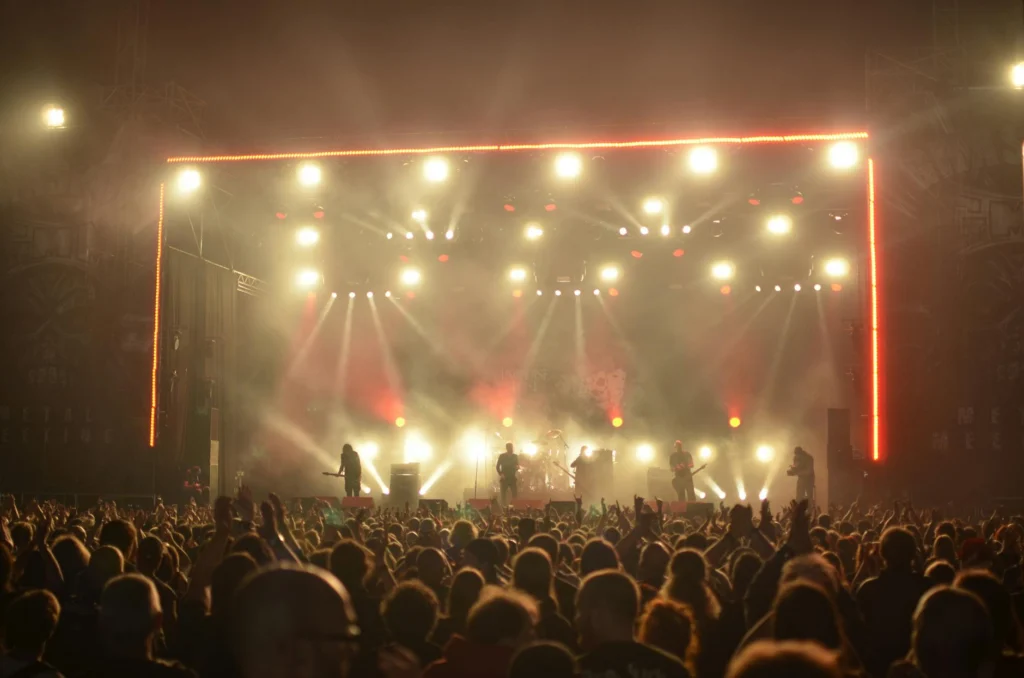
In July 2025, a 27-year-old performer walked onto a stage in Birmingham to face 40,000 heavy metal veterans at Black Sabbath’s farewell concert.[s] Dominic Harrison, known professionally as Yungblud, was there to sing Changes, Black Sabbath’s 1972 ballad. The crowd skewed decades older than his usual Gen Z fanbase. Many had no idea who he was; others suspected he was a poseur. What happened next became a case study in performance based authenticity: by the song’s end, audience members were singing along in tears.[s] The recording later won Yungblud the 2026 Grammy for Best Rock Performance.[s]
The moment crystallized a debate that had followed Harrison throughout his career. Was this calculated performance or genuine feeling? The answer, increasingly, seems to be that the question itself is obsolete. Modern pop stardom operates on a different currency: performance based authenticity, where the construct is transparent and the connection is real.
The Yungblud Persona: A Bridge, Not a Mask
Harrison has always been candid about the distinction between himself and his stage persona. “Being Yungblud has been a suit of armour for me,” he told Rolling Stone UK in 2022, “but that’s not enough anymore. I need more, I owe my fans more. ‘Yungblud’ has just been the bridge for me to meet them.”[s]
This framing is crucial. He does not claim the persona is him; he claims it serves a function. The Guardian’s Alexis Petridis noted in 2022 that Harrison “has a habit of referring to his onstage persona in the third person” after quoting Harrison’s own line from 2020: “If you know Yungblud … the music is secondary.”[s] For critics, this admission was damning evidence. For Harrison, it was an obvious description of how pop fandom works in the social media age.
His fans, who call themselves the Black Hearts Club, “are as attracted to him because of how he looks and what he says as much as how he sounds,” Petridis observed, adding: “which, as an analysis of how pop fandom works, seems fair enough.”[s] The Guardian critic landed on something Harrison himself articulated more bluntly: “They are about the music; I am about the fucking people.”[s]
Performance Based Authenticity in the Gatekeeperless Era
Harrison’s career began precisely when the influence of rock and pop’s traditional gatekeepers began to wane. As the Guardian noted, he “embarked on his career at precisely the point where the influence of rock and pop’s traditional gatekeepers, the music press and radio, had begun to dramatically wane.”[s]
No UK label would sign him, and he recalled being told his music would never get played on Radio 1. So he built an audience directly: posting videos from his phone, answering direct messages, showing up hours early to venues to hand fans cups of tea. “All I focused on was the fans, meeting them,” he recalled. “I didn’t think I was building a brand or a community or anything like that.”[s]
This grassroots model inverted the traditional hierarchy. Where older rock stars cultivated mystique through distance, Harrison’s approach required proximity and transparency. “Every iconic picture of Bowie, he’s not looking at the camera, but you can’t do that anymore,” Harrison explained. “It’s not another person’s interpretation of a moment you were doing. You have to create a moment for yourself now.”[s] The performance is visible; the work of performing is itself the content.
The Industry Plant Debate
For years, the narrative around Harrison was, as NME put it, “a battleground between people labelling him the saviour of rock versus those reducing him to a performative, privately educated ‘industry plant’.”[s] The criticism had a specific edge: if authenticity in rock meant unmediated rawness, then a performer who openly discussed his persona as a construct was by definition a fraud.
This criticism misses what performance based authenticity actually entails. The old model demanded that artists pretend the persona was not a persona. The new model acknowledges the performance and locates sincerity elsewhere: in the connection it enables, in the vulnerability beneath it, in the consistency of showing up.
Harrison articulated this distinction directly: “I think it’s an innate sense of honesty, and a fearlessness to being laid bare. I’ve always been a lot for some people, but I’ve utterly told the truth in real-time through my music even if I’ve been lost doing it.”[s]
What the Fans Understand
The Black Hearts Club operates on a different contract than traditional fandom. MetalTalk’s review of his 2026 O2 Arena show captured the dynamic: “Yungblud’s emotional connection to his fans is profound, intimate and deeply personal. Listening to his fans’ struggles, experiences, and memories, Yungblud offers a kindred form of support and a source of emotional comfort and validation.”[s]
Petridis, writing from a skeptical position, still conceded the logic: “In an era when we’re told #relatability trumps everything, maybe they want to hear stuff that sounds like it could have been ripped from their own private journals, howlers and all.”[s] The imperfection is not a bug; it is the credential. As various critics have observed, imperfection as a signal of authenticity functions in an era saturated with polished, algorithmically optimized content.
This pattern extends beyond music. Vogue Business, forecasting consumer trends for 2026, predicted that “a rejection of AI slop will translate into a renewed appetite for imperfection, humanity and authorship. Consumers will gravitate toward brands that can clearly articulate who made something, why it exists and what values shaped it.”[s]
The 2025 Vindication
The Changes performance at Black Sabbath’s farewell became the fulcrum. “In the past year, it’s the former argument that’s gained serious traction,” NME concluded in its 2026 review of Idols and Idols II.[s]
The numbers followed the cultural shift. His fourth album Idols entered the UK charts at number one, outselling its nearest competitor by 50%.[s] He received three Grammy nominations in rock categories, becoming the first British artist in history to achieve that in a single year.[s] Billy Corgan of the Smashing Pumpkins declared, “I truly believe when all is said done, he will stand up there with the greats,” adding: “And it’s worth noting that Ozzy believed this, too.”[s]
The album itself reflected a shift from exterior persona-building to interior exploration. “After my last album came out, I remember sitting in a hotel room in New York and feeling like I was starting to repeat myself,” Harrison told Melodic Magazine. “I felt like I was falling into my own cliché.”[s] His solution was not to abandon the construct but to deepen it: “We all look for inspiration and answers. But the real f*cking answers to the questions we’re all asking, they lie within us. You’ve got to be yourself, or you’re no one.”[s]
Crossing the Generational Divide
Perhaps the most telling indicator of the model’s success is its acceptance by older rock fans. A self-described “boomer” reviewer on Sputnikmusic wrote of Idols: “He sings like the guy next door, a tormented soul who decided to claim his place in the music industry as a new-age rock star: sensitive, aware, fragile, like the kids he sings for, those whose souls have known pain.”[s]
The reviewer concluded: “If that’s what a new-generation rock star looks like, I’ll take it, even if I’m a boomer raised on the untouchable, godlike icons of rock.”[s] The shift is significant. Where older generations of rock fans valued the appearance of effortless transcendence, some now accept performance based authenticity as a valid alternative: visible effort, acknowledged construction, emotional truth achieved through rather than despite the performance.
The Broader Currency
Performance based authenticity operates as a kind of calculated performance where the calculation is not hidden but displayed. Audiences know the creator is creating; the authenticity lies in why they create and how consistently they show up. This pattern mirrors broader trends across influencer culture and brand marketing.
Vogue Business identified “the intensifying need for belonging, particularly as technology accelerates and parasocial relationships deepen” as a driver of superfandom.[s] In this context, the performed persona is not a barrier to connection but its mechanism. The same forecasters noted a “bifurcation of consumption”: “On one end, algorithmically generated, low-friction content and products will continue to scale; and on the other, there will be a growing premium placed on things that carry visible human intention.”[s]
Yungblud’s model sits squarely in the latter category. The persona is the visible human intention. The hyperactivity, the pink socks, the black hearts, the 4am social media posts: all of it signals effort and presence in a media landscape drowning in frictionless content generated by algorithms and AI.
The Future of the Model
Harrison described his artistic mission in terms that reject the traditional rock star archetype entirely. “My masterpiece is not Back to Black,” he told Rolling Stone UK, referencing Amy Winehouse. “It’s a 35-year career of making other people feel like they can express themselves.”[s]
This is performance based authenticity as explicit doctrine. The value proposition is not the art object but the relationship it enables. The persona is the bridge. The crossing of the bridge is the point.
Whether this model ages well remains an open question. Rolling Stone US described Idols as “charmingly overwrought,”[s] and NME noted that the album “still arguably lack[s] that decisive knockout moment.”[s] The music may still be catching up to the model. But performance based authenticity itself, the transparent construction of persona as a vehicle for genuine connection, appears to be the currency of the moment. And Yungblud proved, standing before 40,000 skeptics in Birmingham, that the currency spends.