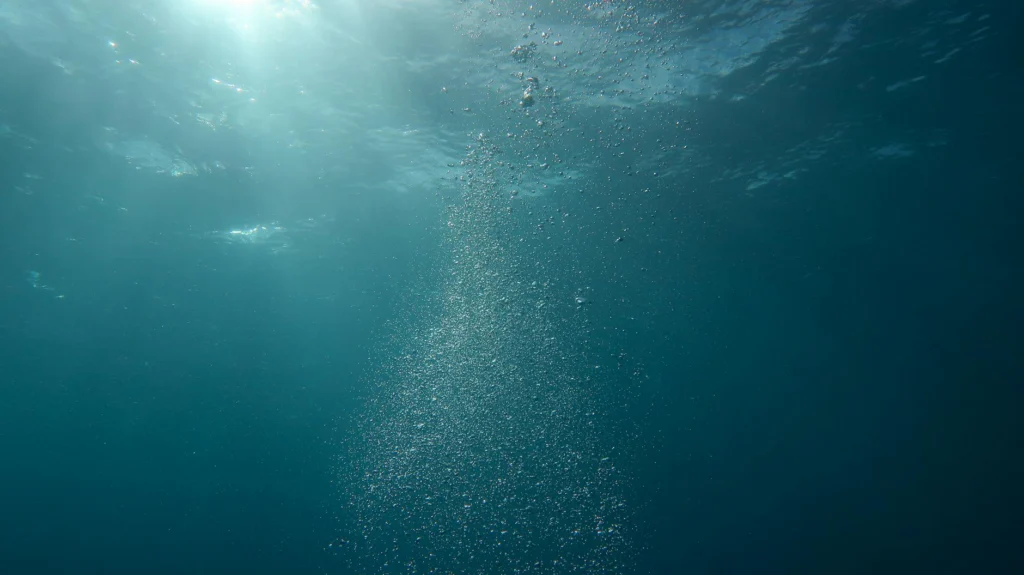
Sound moves through water four times faster than through air[s]. This makes underwater sound propagation a primary method for detecting, communicating, and navigating beneath the ocean surface, where light quickly fades with depth.
Sonar, short for SOund Navigation And Ranging, exploits this physics. Active sonar creates a pulse of sound, often called a “ping,” and then listens for reflections of the pulse[s]. The time between emission and return gives distance; differences in arrival time across multiple receivers give direction.
Why Sound Travels So Well Underwater
Water’s physical properties allow sound to travel at approximately 1,493 meters per second[s]. In air, sound travels at roughly 343 m/s. This speed difference means underwater sound propagation can carry information across distances where radio communication is severely limited.
Three factors govern how fast sound moves through seawater: temperature, pressure, and salinity. The speed of sound typically ranges from 1,450 to 1,570 meters per second in the oceans, increasing by approximately 4.5 meters per second for each degree Celsius rise in temperature and 1.3 meters per second for every practical salinity unit (psu) increase[s].
The Thermocline: Where Sound Bends
Ocean temperature varies with depth, but between 30 and 100 meters there is often a marked change called the thermocline, dividing the warmer surface water from the cold, still waters that make up the rest of the ocean[s]. Sound originating on one side tends to be bent, or refracted, away from the thermocline. This can frustrate sonar because pings from above may refract before reaching targets below the layer.
The SOFAR Channel: Nature’s Acoustic Superhighway
At a certain depth, temperature has dropped enough that its effect on slowing sound is exactly counterbalanced by pressure speeding it up. This creates a sound speed minimum. The sound speed minimum at a depth of approximately 1000 meters is called the deep sound channel or, historically, the SOFAR channel, which stands for SOund Fixing And Ranging[s].
Global data from the 2023 World Ocean Atlas shows the deep sound channel axis averages about 872 meters depth worldwide, with a median of 950 meters and significant regional variation[s]. Understanding this structure is crucial for effective sonar operation, undersea communication, and acoustic propagation[s].
Sound waves in the SOFAR channel continuously bend back toward the depth of minimum speed. Sound that does not hit the ocean surface or seafloor will still lose energy to absorption. However, low-frequency sounds lose very little energy to absorption[s]. The result is that low-frequency sounds travel farther than higher frequencies, sometimes over thousands of kilometers under favorable conditions[s].
Convergence Zones: Sound’s Periodic Focusing
Sound paths from a source near the surface come together, or converge, creating regions of higher sound pressure at about the same depth as the source every 50 to 60 km away from it[s]. These convergence zones mean that underwater sound propagation does not simply fade with distance in a smooth curve. A target can be harder to hear between convergence zones and easier to hear near one.
Underwater Sound Propagation Applications
On April 27, 2017, NATO reported that JANUS, a standardized underwater acoustic communications protocol, had been recognized as a NATO standard by all NATO Allies since March 24, 2017[s]. This standard enables interoperability between NATO and non-NATO underwater devices.
Marine mammals also rely on underwater sound propagation. Dolphins, orcas, and other cetacean species use sonar for communication, navigation, and locating prey and predators[s]. They depend particularly on sound that propagates at least four times faster through water than in air[s].
The Problem with Sonar and Marine Life
The same physics that makes sonar effective makes it potentially harmful to animals that rely on underwater sound. In 1998, a Nature paper described an unusual case of 13 beaked whales stranding during a naval sonar exercise. By 2005, researchers identified a dozen cases of more than 10 beaked whales stranding during naval exercises involving mid-frequency sonars[s].
Research reviewed at a 2024 ACCOBAMS-ASCOBANS intergovernmental workshop found that unusually low received levels of sonar disrupt echolocation-based foraging dives of beaked whales at ranges up to 100 km[s]. In a 2024 article, the Netherlands Organisation for Applied Scientific Research (TNO) described an alternative approach: instead of emitting short and loud sounds underwater, researchers tested softer but longer sound waves as part of work on effective sonar use while protecting marine mammals[s].
Underwater sound propagation occurs at approximately 1,493 m/s in seawater[s], roughly 4.4 times the speed in air at sea level. This velocity differential makes acoustics a core sensing modality below the photic zone, where radio-frequency communication is severely limited and visible light is scarce.
Active sonar creates a pulse of sound, often called a “ping,” and then listens for reflections of the pulse[s]. To measure bearing, systems employ beamforming across hydrophone arrays, measuring relative arrival times to each transducer element.
Sound Speed Dependencies
The speed of sound in seawater is governed by temperature T, hydrostatic pressure (depth d), and salinity S. An empirical approximation in imperial units: c(ft/s) ≈ 4388 + (11.25 × T(°F)) + (0.0182 × d(ft)) + S(ppt)[s]. In metric terms, the speed of sound typically ranges from 1,450 to 1,570 m/s in the oceans, increasing by approximately 4.5 m/s per degree Celsius and 1.3 m/s per practical salinity unit[s].
The thermocline, a region of rapid temperature decrease between 30 and 100 meters depth[s], creates a negative sound speed gradient that refracts downward-traveling rays back toward the surface. Snell’s law governs this refraction: sound bends toward regions of lower velocity.
Deep Sound Channel Structure
The sound speed minimum at approximately 1000 meters depth defines the deep sound channel (DSC) axis, historically termed the SOFAR channel[s]. Above this axis, the negative temperature gradient dominates; below it, the positive pressure gradient dominates. Certain sound rays oscillate across this minimum without interacting with boundaries.
Analysis of the 2023 World Ocean Atlas yields a global mean DSC axis depth of 871.6 m, median 950 m, standard deviation 400.2 m[s]. The sonic layer depth (SLD), marking the upper boundary of the DSC, has a global mean of 24.2 m with median 10 m[s].
Low-frequency sounds lose very little energy to absorption[s], enabling underwater sound propagation over thousands of kilometers through the DSC under favorable conditions[s]. Absorption increases with frequency, limiting high-frequency detection ranges.
Convergence Zones and Shadow Zones
For near-surface sources, sound paths converge at regular intervals, creating regions of higher sound pressure at about the same depth as the source every 50 to 60 km[s]. Between convergence zones lie shadow zones of reduced acoustic intensity. This spatial periodicity means detection probability is not monotonically decreasing with range.
Propagation Modeling
Common computational approaches to underwater sound propagation modeling include ray-tracing (BELLHOP), parabolic equation (RAM), and normal-mode (KRAKEN). A 2025 study in Frontiers in Marine Science found that in a 200 m deep flat ocean environment, BELLHOP achieves high accuracy for frequencies above 200 Hz, KRAKEN performs comparably to RAM below 50 Hz, and RAM excels below 200 Hz[s].
BELLHOP, based on ray theory, is well-suited for deep-sea and high-frequency scenarios. However, in low-frequency shallow-water environments, its accuracy may be reduced due to the neglect of modal interference and diffraction effects[s].
Communications Standards
On April 27, 2017, NATO reported that JANUS, a standardized underwater acoustic communications protocol, had been recognized as a NATO standard by all NATO Allies since March 24, 2017[s]. JANUS enables interoperability across NATO and non-NATO underwater devices.
Biological Implications
Many cetaceans rely on biological sonar systems. Dolphins, orcas, and other cetacean species use sonar for communication, navigation, and locating prey and predators[s].
Mid-frequency naval sonar has been linked to mass stranding events. In 1998, a Nature paper described 13 beaked whales stranding during a naval sonar exercise. By 2005, researchers identified a dozen cases of more than 10 beaked whales stranding during naval exercises involving mid-frequency sonars[s]. Research reviewed at the 2024 ACCOBAMS-ASCOBANS workshop found that sonar disrupts beaked whale foraging dives at ranges up to 100 km[s].
TNO reported in 2024 on alternative waveforms: instead of high-intensity short pulses, researchers tested softer but longer sound waves as part of work on effective sonar use while reducing behavioral disruption[s].