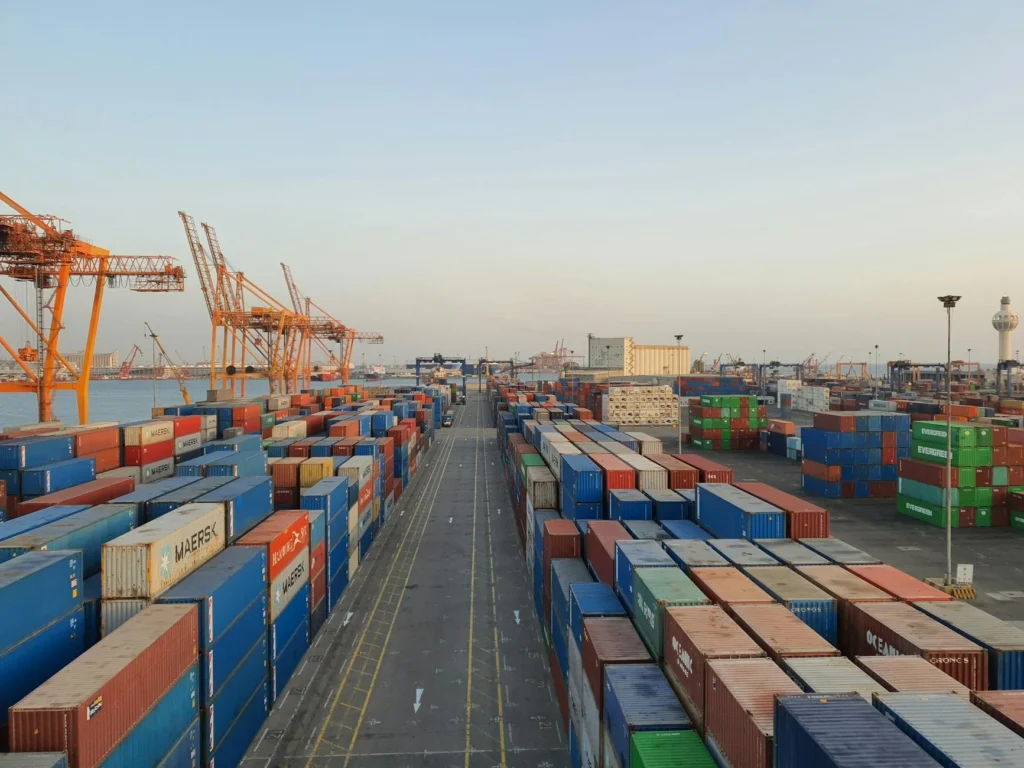
Supply chain fragility has become impossible to ignore. When a single container ship ran aground in the Suez Canal in March 2021, blocking the waterway for six days, the ripple effects cost Maersk alone $89 million[s]. The semiconductor shortage that began in 2020 cost the global automotive industry an estimated $210 billion in lost revenue in 2021 alone[s]. These disruptions exposed what decades of efficiency optimization had hidden: global commerce runs on a system designed for speed, not resilience.
Supply Chain Fragility: The Cost of Efficiency
The modern global supply chain traces its philosophy to postwar Japan. Taiichi Ohno, an engineer at Toyota in the 1950s, developed what became known as “just-in-time” manufacturing. Ohno defined it as eliminating “waste,” meaning stockpiles, extra workers, and unused minutes[s]. Instead of warehousing parts for months, suppliers would deliver components precisely when the assembly line needed them.
Toyota’s official description captures the core principle: making only what is needed, when it is needed, and in the amount needed[s]. A modern car contains more than 30,000 parts, all flowing through this synchronized system. After its introduction to Western factories in the 1980s, just-in-time spread beyond automobiles into every sector of manufacturing and retail.
The efficiency gains were real. Companies slashed warehousing costs, reduced capital tied up in inventory, and increased profit margins. But supply chain fragility grew with each step toward optimization. When every link must function perfectly, a single break can halt the entire chain.
When the System Breaks
The COVID-19 pandemic delivered a stress test that global supply chains failed spectacularly. The World Trade Organization predicted global trade volumes would decline between 13% and 32%[s]. Unlike regional disasters, COVID-19 disrupted supply chains at every stage simultaneously: sourcing, manufacturing, transportation, and delivery.
The concentration of production became impossible to hide. Chinese manufacturers account for an estimated 40% of all active pharmaceutical ingredients used worldwide, while more than 70% of India’s pharmaceutical production relies on Chinese sources[s]. When Chinese factories closed, shortages cascaded through global healthcare systems.
Air freight capacity collapsed almost overnight. Around 50% to 60% of all air cargo travels in the bellies of passenger planes, and U.S. passenger flights fell by approximately 95% compared to the previous year[s]. Medical equipment, perishable goods, and emergency supplies competed for rapidly shrinking capacity.
The Semiconductor Crisis
The global chip shortage revealed perhaps the clearest example of supply chain fragility in action. Between 2020 and 2023, the shortage affected more than 169 industries[s]. The average modern car contains between 1,400 and 1,500 chips, with some models requiring up to 3,000.
At the start of the pandemic, automakers incorrectly predicted that vehicle sales would drop. They cancelled chip orders. When demand rebounded faster than expected, chipmakers had already committed their capacity to consumer electronics[s]. The auto industry spent years recovering from a prediction error that lasted mere weeks.
Historical Warnings Ignored
The 2011 Great Tohoku Earthquake and Tsunami had already demonstrated this vulnerability. A typical motor vehicle has over 15,000 parts, and the lack of a single essential component can halt completion of vehicles and cause stoppage of assembly lines[s]. IHS Global Insight forecast that over 4 million units of vehicle production would be lost due to the disasters, with 90% of the losses from Japanese automakers.
The lesson seemed clear: supply chain fragility required attention. Toyota itself implemented changes after 2011, increasing its ability to assess alternative products quickly. Yet a decade later, the industry repeated many of the same mistakes when COVID-19 struck.
What Comes Next
Researchers studying the pandemic response identified resilience and sustainability as the primary supply chain topics emerging from the crisis[s]. The academic literature now distinguishes between “just-in-time” and “just-in-case” approaches.
Just-in-case strategies recommend larger inventories, diversification of production networks, and harmonization of parts[s]. Some researchers argue that truly robust supply chains must address uncertainty rather than merely quantifying risk. This means preparing for worst-case scenarios that cannot be precisely predicted, not just building buffers against probable disruptions.
The trade-off remains stark. Addressing supply chain fragility costs money during normal times. Larger inventories tie up capital. Multiple suppliers reduce economies of scale. Companies face pressure from shareholders to maximize short-term efficiency, while the costs of disruption arrive unpredictably and get attributed to external events rather than strategic choices.
The $210 billion lesson from the semiconductor shortage, the $89 million loss from a single ship stuck in a canal, and the cascading failures of the pandemic all point to the same conclusion: the global economy has optimized itself into a corner. Supply chain fragility is no longer an abstract risk to be managed on spreadsheets. It is a structural feature of how the world makes and moves goods, and addressing it will require accepting that some efficiency must be sacrificed for resilience.
Supply chain fragility has become a central concern in operations research and industrial organization. When the Ever Given container ship blocked the Suez Canal for six days in March 2021, Maersk’s fleet alone suffered $89 million in losses, with inventory holding costs accounting for $76 million of that total[s]. The blockage also increased the company’s carbon dioxide emissions by 44,574 tonnes due to longer voyages and waiting times. The 2020-2023 semiconductor shortage cost the global automotive industry an estimated $210 billion in 2021 revenue[s]. These events demonstrated the systemic risks inherent in lean global supply networks.
Origins of Supply Chain Fragility
Just-in-time manufacturing was developed at Toyota during the late 1940s and early 1950s, with the purpose of reducing inventories, reducing setup times, and saving costs in other aspects of the supply chain[s]. Taiichi Ohno, the engineer credited with the system, eliminated what he termed “waste”: stockpiles, excess labor capacity, and idle time[s].
Toyota’s production system rests on two pillars: jidoka (automation with human oversight) and just-in-time delivery. The company describes the objective as making only what is needed, when it is needed, and in the amount needed, synchronizing production across all facilities in continuous flow[s]. Modern vehicles require over 30,000 parts coordinated through this system.
Even Toyota’s original documentation acknowledged the primary risk: excessive reliance on suppliers who may be less resilient than the manufacturer itself[s]. Supply chain fragility was thus recognized from the system’s inception as the trade-off for efficiency gains.
Systemic Disruption: COVID-19 Case Study
The COVID-19 pandemic caused disruption scope and magnitude unlike previous supply chain shocks[s]. Previous events, including the 2011 Japan earthquake, the 2003 SARS outbreak, and the 2004 Indonesian tsunami, were geographically or temporally limited, with production recovery measured in weeks. COVID-19 affected every stage of global supply chains simultaneously and persisted for years.
The World Trade Organization projected global trade volume declines between 13% and 32%[s]. The pandemic revealed the bullwhip effect in stark terms: businesses interconnected through complex networks experienced disruptions propagated upstream, with small and medium enterprises facing the most severe impacts from erratic demand signals from larger downstream actors.
Concentration risk became quantifiable. Chinese manufacturers supply approximately 40% of all active pharmaceutical ingredients globally, while over 70% of India’s bulk drug production depends on Chinese sources[s]. Air freight capacity collapsed when passenger aviation contracted; approximately 50-60% of air cargo capacity derives from passenger aircraft bellies, and U.S. passenger flights fell by roughly 95%[s].
Semiconductor Shortage Dynamics
The global chip shortage affecting 169+ industries between 2020 and 2023[s] demonstrated supply chain fragility arising from forecast error compounded by capacity constraints. Modern automobiles typically contain 1,400 to 1,500 semiconductor chips, with some models requiring up to 3,000, yet cars account for only 15% of global chip consumption while personal electronics represent approximately 50%.
Automotive manufacturers canceled chip orders early in the pandemic based on incorrect demand predictions. When sales recovered, foundry capacity had been committed to consumer electronics orders[s]. Lead times extended from 12 weeks to over 22 weeks for certain components. The crisis was exacerbated by concurrent disruptions including Texas winter storms affecting Samsung and NXP facilities, Taiwan drought threatening water-intensive fabrication, and fires at Japanese facilities supplying 30% of global automotive microcontroller units.
Historical Precedent: 2011 Tohoku Disaster
The March 2011 earthquake and tsunami had provided a clear warning. A typical motor vehicle contains over 15,000 parts, and the absence of any essential component halts completion and stops assembly lines[s]. IHS Global Insight projected over 4 million units of lost production, with 90% of losses concentrated among Japanese automakers.
The Congressional Research Service report noted that Japan’s automotive electronics suppliers held “substantial and growing shares of the global market” with few alternative sources available. The report explicitly raised congressional interest in “evaluating the resilience of global supply chains as a result of new information about the vulnerabilities”[s]. Yet structural changes remained limited.
From Just-in-Time to Just-in-Case: Theoretical Framework
Academic research following the pandemic has distinguished between strategies for managing idiosyncratic risk versus aggregate uncertainty[s]. Just-in-case strategies, developed as alternatives to just-in-time, recommend larger inventories, production network diversification, and parts harmonization.
However, researchers argue that even just-in-case approaches may prove inadequate for aggregate shocks affecting multiple regions simultaneously. The proposed alternative, sometimes termed “just-in-worst-case,” requires firms to optimize for uncertainty rather than quantifiable risk. This approach produces allocations resembling “probability matching,” a behavior observed in evolutionary biology where organisms distribute themselves proportionally to resource availability rather than concentrating at optimal locations[s].
Bibliometric analysis of post-pandemic supply chain literature identifies resilience and sustainability as primary research themes[s]. Technology-aided tools including artificial intelligence, Internet of Things, and blockchain applications represent emerging approaches to real-time risk monitoring and response.
Structural Implications
Supply chain fragility represents a collective action problem. Individual firm optimization toward efficiency creates systemic vulnerability that no single actor bears the cost of addressing. The efficiency gains from lean operations are captured by shareholders in normal periods, while the costs of disruption are socialized across consumers, workers, and governments responding to shortages.
The $210 billion automotive industry loss from semiconductor shortages, combined with cascading effects across 169 industries, demonstrates that supply chain fragility has macroeconomic significance. Policy responses including the U.S. CHIPS Act ($52.7 billion in appropriations for domestic semiconductor manufacturing and research, alongside a separate 25% investment tax credit)[s] represent governmental attempts to address market failures in supply chain resilience investment.
The fundamental tension remains unresolved: resilience requires redundancy that reduces short-term returns, while the competitive dynamics of global markets reward efficiency optimization. Until the costs of supply chain fragility are internalized by those who benefit from lean operations, the structural incentives favor continued vulnerability.