Clap your hands, and a pulse of pressure races across the room at roughly 344 meters per second.[s] Almost no air travels with it. This is the first surprise of sound wave physics: what crosses the room is a pattern of pressure, while the air itself mostly stays where it is.[s]
Picture a long line of people standing shoulder to shoulder. Shove the first one and the bump travels down the line while everybody ends up back where they began. Air molecules behave the same way. A vibrating object crowds the molecules beside it into a region of higher pressure, called a compression, then leaves a thinned-out region of lower pressure, called a rarefaction. Each molecule nudges its neighbor and springs back, so the energy moves forward while the medium only shivers in place.[s]
Sound Wave Physics, From Push to Echo
Because sound is a relay between particles, it needs particles to relay through. Space is a near-perfect vacuum, so a sound has nothing to push against and never forms. A sound wave is mechanical to its core, which sets it apart from light and radio waves that cross empty space without trouble.[s]
The stiffer and springier the material, the faster that relay runs. Sound moves quickest through solids, slower through liquids, and slowest through gases.[s] A steel rail, for instance, carries the rumble of an approaching train to your ear sooner than the open air does.
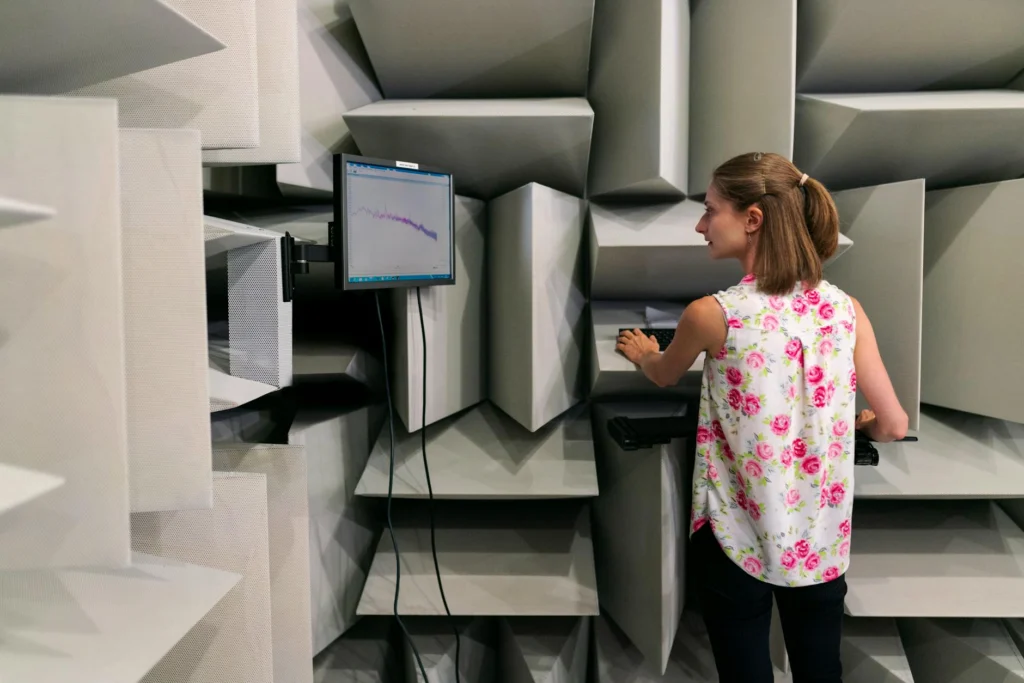
When a wave reaches the boundary between two materials, it splits three ways: part reflects, part passes through, and part is absorbed and lost as heat.[s] An echo is the reflected part coming back to you. How much bounces depends on how mismatched the two materials are, a property called acoustic impedance.[s] Soft, porous surfaces turn more of the energy into heat, which is the principle behind acoustic foam and soundproofing.
The siren that changes pitch
Stand on a corner as an ambulance races past and its siren drops in pitch the instant it goes by. The siren never changed; your relationship to it did. As the source rushes toward you, each pressure peak is launched a little closer than the last, bunching the waves into a higher frequency. As it speeds away, the waves stretch into a lower one.[s] This is the Doppler effect, and the faster the relative motion, the bigger the shift.[s]
Waves that cancel and reinforce
When two sound waves overlap, they add together point by point. Line up their peaks and they reinforce into a louder sound; set a peak against a dip and they cancel toward silence. Noise-canceling headphones run on this trick: a microphone samples the incoming drone, and the electronics play back a mirror-image wave whose peaks fall on the original’s dips.[s] Overlap two tones of slightly different pitch and the cancellation comes and goes in a slow throb that musicians call beats.[s]
Push a system at its own preferred frequency and the effect compounds. Sing a steady note into an open piano with the sustain pedal down, and the string tuned to that note hums back at you. That is resonance, the same reason a parent’s well-timed pushes send a child on a swing steadily higher.[s]
How Sound Wave Physics Is Being Rewritten
For most of history, controlling sound meant choosing materials and shapes: thicker walls, angled ceilings, softer carpet. In November 2025, engineers at the University of Connecticut showed another path. They built a metamaterial, an artificial structure with behavior no natural material offers,[s] from a grid of motorized pillars that each pivot on command. Beamed into the grid, sound bounces off the pillars, and because every pillar can be aimed independently, the structure offers an almost limitless set of paths for a wave to follow.[s]
The payoff is sound you can steer. Tuned one way, the grid focuses a wave onto a single point; tuned another, it bends or damps it. The team points to medicine, where a focused beam might heat a tumor or break a kidney stone with no incision at all.[s] The same sound wave physics that explains an everyday echo now lets researchers shape sound the way a lens shapes light.
Every sound is a traveling disturbance in pressure. In the language of sound wave physics, an acoustic wave is a longitudinal wave: the molecules of the medium oscillate back and forth along the very axis the wave travels, packing into compressions and spreading into rarefactions.[s] The molecules never migrate with the wave. They trade energy with their neighbors and return to equilibrium, which is how a sound crosses a room while the air stays put.[s]
Three numbers pin down any pure tone. Frequency sets the pitch, wavelength sets the spatial length of one cycle, and the speed of sound ties them together: wavelength equals speed divided by frequency.[s] Human ears respond from about 20 hertz to 20 kilohertz; slower oscillations are infrasound, and faster ones are ultrasound, the band medical scanners exploit.[s]
The Sound Wave Physics of Speed and Boundaries
Sound sprints through steel and crawls through air for one reason: speed climbs with a medium’s stiffness and falls with its density, so a hard, springy solid carries a wave far faster than a sparse gas.[s] In ordinary air the figure sits near 344 meters per second.[s] Compression and rarefaction are nothing exotic, only air pressure nudged above and below its resting value, the same air pressure that produces aerodynamic lift over a wing.
A wave travels undisturbed only while the medium stays uniform. Whenever density or stiffness changes, the medium presents a new acoustic impedance, and the wave splits at the boundary into reflected, transmitted, and absorbed parts.[s] The bigger the impedance mismatch, the more energy reflects, which is why so little sound passes directly from air into water: their impedances are worlds apart.[s]
Standing Waves, Resonance, and the Voices of Instruments
Trap a wave between two boundaries and the reflections interfere with the outgoing wave. At most frequencies the two scramble and fade, but at special frequencies they line up into a standing wave that appears to hold still, with fixed points of no motion and fixed points of maximum motion.[s] Driving a system at one of these natural frequencies is resonance, and every acoustic resonance is built from interference: the resonant frequencies reinforce, and the rest cancel out.[s]
Standing sound waves are often drawn in a way that misleads. Because students first meet standing waves on a vibrating string, the textbook curves look like sideways ripples. Inside a pipe the air moves along the pipe’s length, not across it; that familiar curve plots the back-and-forth displacement of air molecules, not a transverse wiggle.[s] Daniel Russell, a Penn State acoustician who spent years teaching the subject, flags this displacement-versus-pressure mix-up as one of the most stubborn errors in physics instruction.[s]
The same mechanism explains timbre. A column of air resonates not only at its fundamental frequency but at a series of higher harmonics, whole-number multiples of that fundamental.[s] A pipe closed at one end and a pipe open at both ends favor different harmonics, so middle C on a trumpet and middle C on a clarinet share a fundamental yet sound nothing alike.[s] When two pitches sit close together, their combined sound swells and fades at the beat frequency, the cue piano tuners listen for.[s]
Doppler shifts, from sirens to galaxies
When source and listener move relative to each other, the received frequency shifts. The Austrian physicist Christian Doppler, who lived from 1803 to 1853, predicted this effect in 1842 from the colored light of stars; three years later the Dutch scientist Christophorus Buys Ballot confirmed it for sound, setting musicians to play a sustained note aboard a moving open train car while listeners on the ground compared the pitch.[s] Motion toward an observer raises the frequency, motion apart lowers it, and a greater relative speed widens the gap.[s] Read in reverse, the same shift becomes a measuring tool: clinicians gauge blood velocity from the Doppler shift of reflected ultrasound, and astronomers read the recession of stars and galaxies from the shift in their light.[s]
Acoustics at the frontier
Sound is no longer confined to the audible. In a 2019 GaAs study, researchers used piezoelectric resonators to generate longitudinal bulk acoustic waves at frequencies up to 20 gigahertz in gallium arsenide crystals.[s] Bulk acoustic wave resonators in this gigahertz range underpin the compact radio-frequency filters that mobile networks depend on, and the acoustic filters tucked inside a smartphone are a direct descendant of this physics.
The UConn metamaterial pushes the other way, toward total command of ordinary sound, a fresh chapter for sound wave physics. Its 11 by 11 lattice of asymmetric, motorized pillars can be re-aimed in one-degree steps, and combinations of pillars yield, in the words of the lab’s director Osama Bilal, “more configurations than the number of atoms in the universe.”[s] Beyond focusing ultrasound for incisionless surgery, the platform can route sound only along its edges, a mechanical analog of the topological insulators that earned a Nobel Prize in physics.[s] For a science as old as sound wave physics, the frontiers are still opening.