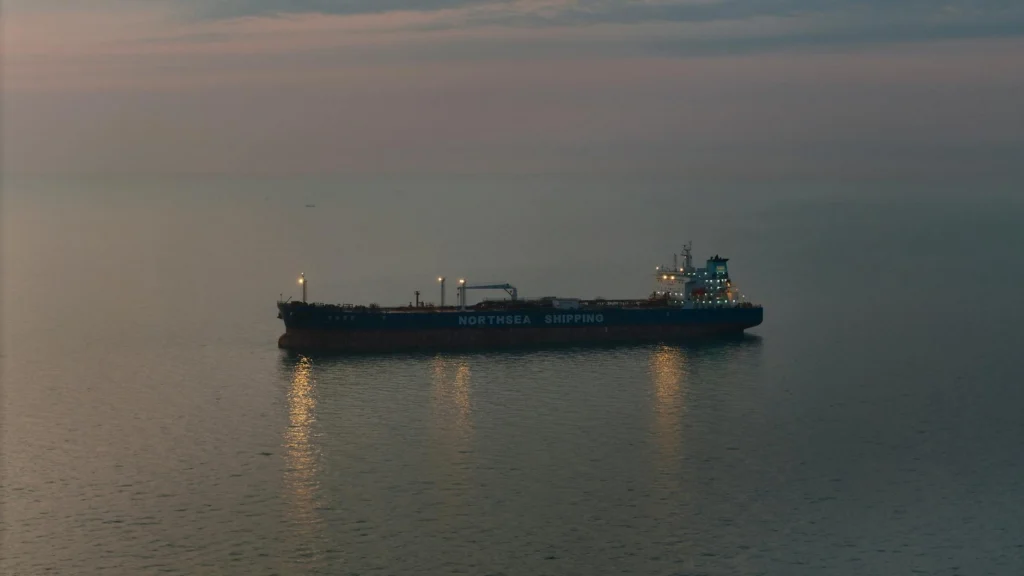
Russia’s shadow fleet sanctions evasion operation has become one of the most sophisticated schemes in modern maritime history. Since Western nations imposed restrictions on Russian oil exports following the 2022 invasion of Ukraine, hundreds of aging tankers have been quietly assembled to keep petroleum flowing to global markets, generating an estimated $87 to $100 billion annually[s] for Moscow’s war chest.
The numbers tell the story: by early 2026, approximately 600 to 800 oil tankers were operating as part of this parallel maritime network[s], representing 10 to 15 percent of the global tanker fleet. French President Emmanuel Macron estimated the trade at €30 billion annually, funding 30 to 40 percent of Russia’s military campaign[s].
How Shadow Fleet Sanctions Evasion Works
The mechanics are deceptively simple. After Western nations introduced a $60 per barrel price cap on Russian crude oil[s], Russia invested an estimated $10 billion to build a fleet outside Western regulatory reach[s]. These vessels use flags of convenience, complex ownership structures, and insurers outside the International Group of P&I Clubs to avoid restrictions.
The tactics include switching off satellite tracking systems, conducting ship-to-ship transfers in international waters to blend cargoes and obscure origins[s], and broadcasting false location data. Lloyd’s List Intelligence recorded a significant uptick in AIS spoofing incidents in 2025[s], with some tankers even stealing identification numbers from scrapped vessels.
The UK National Crime Agency identified a dual-track system: a “blue” side working with Western banks and insurers, and a “red” side trading Russian oil directly[s]. Money and oil move between the two, allowing Russian exporters to access premium prices while evading restrictions.
Environmental Time Bombs
Shadow fleet sanctions evasion comes with dangerous physical consequences. The average shadow fleet tanker is between 15 and 25 years old, compared to a global fleet average of 13 to 14 years[s]. Many exceed the 20-year recommended safe service life[s], operating without adequate maintenance or insurance.
The consequences arrived dramatically in December 2024. Two Russian tankers, Volgoneft-212 and Volgoneft-239, were caught in a storm near the Kerch Strait. Volgoneft-212, built in 1969, broke in two and sank, spilling thousands of tonnes of heavy fuel oil[s]. A senior Russian scientist, Viktor Danilov-Danilyan of the Russian Academy of Sciences, called it the country’s worst “environmental catastrophe” of the 21st century[s]. Both tankers were operating outside certifications that restrict them from leaving rivers in winter[s].
Because shadow fleet tankers typically lack insurance, cleanup costs fall on affected nations: an estimated $860 million to $1.6 billion per major spill[s].
Western Enforcement Struggles
The European Union has sanctioned nearly 600 vessels[s], yet shadow fleet sanctions evasion continues largely unimpeded. Despite UK officials vowing “assertive action,” dozens of sanctioned tankers sailed through the English Channel in January 2026[s]. By December 2025, 68 percent of all Russian crude oil was carried on sanctioned tankers[s].
France has taken a more direct approach, boarding three suspected vessels since September 2025[s]. In April 2026, the tanker Deyna was released from Marseille after its owner paid a fine for failing to prove nationality. But such enforcement actions remain exceptions.
Perhaps most troubling: a major investigation revealed that Western shipowners earned over $6 billion selling aging tankers to the shadow fleet[s]. More than a third of shadow fleet vessels were previously Western-owned[s], sold by the same nations now trying to sanction them.
What Comes Next
The shadow fleet has proven resilient. When individual vessels are sanctioned, they simply change names, flags, or ownership[s]. Russian fossil fuel exports still generate approximately €464 million daily[s].
In the Baltic, the situation has grown more acute. Dozens of shadow fleet tankers are now idling in the Gulf of Finland after Ukrainian drone strikes damaged Russian oil terminals[s]. These vessels cannot reroute to nearby ports without risking detention, raising concerns about both environmental accidents and potential sabotage in one of the world’s busiest shipping corridors.
As shadow fleet sanctions evasion continues to evolve, the gap between Western policy and maritime reality keeps widening. The fleet has become a case study in how determined actors can circumvent even coordinated international pressure, one aging tanker at a time.
The infrastructure of shadow fleet sanctions evasion represents a fundamental challenge to the post-2022 sanctions architecture. Russia’s parallel maritime logistics network, assembled at an estimated cost of $10 billion[s], now comprises between 600 and 800 tankers globally, representing 10 to 15 percent of the world’s crude and product tanker fleet[s]. According to the Center for Strategic and International Studies, these vessels move between $87 billion and $100 billion in oil annually[s].
By early 2026, the scale of the operation had become undeniable: 68 percent of Russian crude exports were transported on G7+ sanctioned tankers[s], while only 23 percent moved on vessels fully compliant with the Oil Price Cap regime. Russian fossil fuel exports continue generating approximately €464 million in revenue daily[s], with seaborne crude alone accounting for €156 million.
Architecture of Shadow Fleet Sanctions Evasion
The G7 oil price cap, set at $60 per barrel for crude[s], relies on the dominance of Western maritime services. EU and G7 companies historically provided insurance coverage for approximately 90 percent of global tanker tonnage, giving coalition states significant leverage. The shadow fleet circumvents this by operating through insurers outside the International Group of P&I Clubs, registering under flags of convenience in jurisdictions including Marshall Islands, Panama, and St. Kitts and Nevis, and routing ownership through complex shell structures.
The operational tradecraft has grown sophisticated. A July 2025 Red Alert from the UK National Crime Agency detailed how the sanctions evasion network operates on two parallel tracks: a “blue” side interfacing with Western financial institutions, insurers, and trading platforms, and a “red” side conducting direct Russian oil trades[s]. The 2RIVERS network alone utilizes over 100 shadow fleet tankers[s].
Ship-to-ship transfers in the Mediterranean, particularly in the Laconian Gulf, Hurd’s Bank near Malta, and off Ceuta[s], allow cargoes to be blended and relabeled. Oil loaded from Russian ports is transferred to secondary vessels which then deliver to end customers who may have no visibility into the cargo’s origins. The blending operations effectively launder the provenance.
Electronic Deception
Lloyd’s List Intelligence documented a significant increase in AIS manipulation throughout 2025[s]. At least 14 tankers sanctioned by the US Treasury in December 2025 used falsified AIS data to simulate port calls at Khor al Zubair, Iraq[s]; analysis suggested nearly half of all AIS-generated voyages to that port during the first half of the year were likely fabricated.
Identity manipulation extends beyond position spoofing. Shadow fleet operators have stolen IMO numbers from scrapped vessels, invented fictitious IMO numbers, hijacked identification from active tankers, and, in recent cases, appropriated IMO numbers from ships still under construction[s]. The BBC identified one vessel, the Arcusat, as among “the darkest of the dark fleet” after it obtained a new IMO number entirely[s], a practice analysts described as nearly unprecedented.
Structural Vulnerabilities: Age and Maintenance
The physical infrastructure enabling shadow fleet sanctions evasion creates systemic fragility. The average age of shadow fleet tankers ranges from 15 to 25 years, compared to 13 to 14 years for the global fleet[s]. Vessels older than 20 years constitute nearly one-third of tankers transporting Russian crude. Half of the Iranian shadow fleet vessels assessed by Pole Star Global exceeded the 20-year recommended safe service life[s], with some over 30 years old.
The December 2024 Kerch Strait disaster illustrated these vulnerabilities. Volgoneft-212, built in 1969 and operating beyond its certification limits, broke apart in a storm and sank[s]. The two tankers spilled around 4,000 tonnes of M-100 mazut, a heavy fuel oil[s], contaminating at least 60 kilometers of coastline according to Greenpeace Ukraine[s]. Viktor Danilov-Danilyan of the Russian Academy of Sciences characterized the spill as the country’s worst “environmental catastrophe” of the 21st century[s]. Both vessels were designed for inland navigation and, under Russian safety regulations, barred from leaving rivers in winter[s].
Shadow fleet tankers typically operate without adequate insurance. Cleanup costs for a major spill are estimated at $860 million to $1.6 billion[s], with affected coastal states bearing the burden. The Baltic Sea, designated a Particularly Sensitive Sea Area under IMO Resolution MEPC.136(53)[s], faces particular risk given its limited water exchange.
Enforcement: Actions and Limitations
The EU has designated nearly 600 vessels under sanctions regimes[s], yet enforcement remains inconsistent. Despite UK officials pledging assertive action, 42 sanctioned tankers transited the English Channel in January 2026[s]. BBC Verify identified six tankers operating under demonstrably false flags, technically stateless vessels subject to seizure under the UN Convention on the Law of the Sea[s].
France has adopted more aggressive tactics, boarding three suspected vessels since September 2025[s]. The Deyna, seized in March 2026 after failing to prove nationality, was released from Marseille following payment of an undisclosed fine[s]. France is considering legislation that would double penalties for registration violations, with maximum sentences of seven years imprisonment and €700,000 fines[s].
Western Complicity
A cross-border investigation by Follow the Money and 13 partner newsrooms revealed that Western shipowners earned over $6 billion selling aging tankers to shadow fleet operators[s]. More than one-third of Russia’s shadow fleet consists of vessels previously owned by companies in the same nations now imposing sanctions[s]. Many of these ships would otherwise have been scrapped.
Crewing presents another compliance gap. Twenty agencies serving shadow fleet vessels are based in Ukraine[s], with eight more operating within the European Union[s], despite EU sanctions on the fleet.
Strategic Implications and Future Trajectory
The shadow fleet operates as a decentralized network rather than a fixed pool of vessels. When one tanker becomes commercially unusable or sanctioned, it either changes identity or another vessel replaces it[s]. This resilience has led some analysts to advocate targeting technical infrastructure rather than individual ships.
The aviation sanctions model offers a precedent: restricting access to certified spare parts gradually degrades operational capability. A similar approach targeting marine propulsion components, cargo handling systems, and electronic controls could prove more effective than vessel designations alone[s]. European, Japanese, and South Korean manufacturers dominate the supply chain for specialized maritime components.
In the Baltic, Ukrainian drone strikes on Russian oil terminals at Primorsk and Ust-Luga have created a new dynamic. Between 30 and 40 shadow fleet tankers now idle in the Gulf of Finland[s], unable to load cargo but also unable to reroute without risking detention. NATO launched Operation Baltic Sentry in January 2025 to monitor suspicious activity after incidents involving suspected cable sabotage[s].
The shadow fleet sanctions evasion challenge exposes a fundamental tension in the current enforcement paradigm. Russian oil revenues of €464 million daily[s] continue funding military operations while Western nations struggle to translate vessel designations into operational disruption. As 30 percent of Russia’s federal budget flows from oil and gas sales[s], the effectiveness of shadow fleet sanctions evasion countermeasures will remain a critical variable in the broader economic warfare over Ukraine.