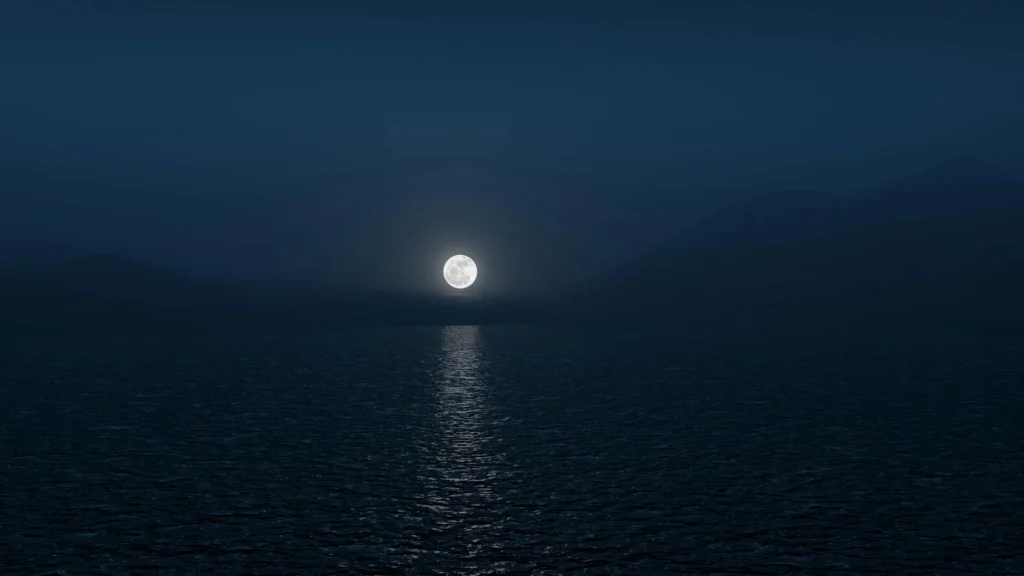
Every day, the world’s oceans rise and fall in a rhythm older than any civilization. Lunar tidal forces, the gravitational influence of the Moon on Earth’s water, drive this ceaseless motion. But the physics behind tides is stranger than most people learn in school, and the consequences extend far beyond beach visits and fishing schedules.
Here is what this article will show you: the textbook picture of tidal bulges is a useful fiction, the Moon is slowly moving away from Earth, and our planet’s days are getting longer because of it.
Why the Moon Beats the Sun
The Sun has 27 million times the Moon’s mass. By naive reasoning, it should dominate Earth’s tides. It does not. The Moon wins because tides are not caused by raw gravitational strength. They are caused by how much that gravitational pull changes across the width of a planet.[s]
Physicists call this the gravitational gradient. Physicist Christopher Baird explains that ocean tides come from differences in gravity from one spot to the next, not from gravity’s overall strength.[s] Because the Moon is much closer to Earth than the Sun, its gravitational pull varies more dramatically across Earth’s diameter. That variation is what stretches the oceans.
NASA summarizes the comparison this way: the Sun has about 27 million times the Moon’s mass but sits about 390 times farther away, giving it a little less than half of the Moon’s tide-generating force.[s]
The Tidal Bulge That Does Not Exist
Open a physics textbook and you will likely see a diagram showing two bulges of water on opposite sides of Earth, one facing the Moon and one facing away. As Earth rotates beneath these bulges, coastlines experience two high tides per day.
This is Newton’s equilibrium theory. It explains the basic pattern. It is also wrong.
The problem is physics itself. “The tidal bulge cannot exist because of the way water waves propagate,” explains a detailed analysis by Physics Forums. “If the tidal bulge did exist, it would form a wave with a wavelength of half the Earth’s circumference.”[s]
Such a wave would need to travel at 465 meters per second at the equator to keep pace with Earth’s rotation. In water about 3,800 meters deep, that shallow-water speed is about 193 meters per second. The bulge cannot keep up. Newton’s equilibrium tides are another widely taught but wrong explanation in physics education, joining misconceptions about how airplanes fly and why spinning tops stay upright.
Additionally, continents block any hypothetical bulge’s path around the globe. The Americas form a nearly pole-to-pole barrier in the western hemisphere. Africa and Eurasia form another in the east.
How Tides Actually Work
The correct model comes from Pierre-Simon Laplace, who developed his dynamic theory of tides in the late 18th century. A Physics Forums analysis describes Laplace’s dynamic theory as accounting for flowing water, varying ocean shapes and depths, bottom friction, resonances, and other factors.[s]
Instead of two bulges circling the globe, tides form complex rotating patterns within ocean basins. These patterns have amphidromic points: locations that experience no tide at all for a given tidal frequency, with the tidal response rotating around them for that frequency.[s]
Around each amphidromic point, tides rotate like water swirling around a drain. Some ocean basins have multiple such points. The result is that high tide marches around coastlines in complex patterns that have little resemblance to the simple bulge diagram.
Spring Tides and Neap Tides
Twice a month, the Sun and Moon align with Earth, either at new moon or full moon. When this happens, their tidal forces combine, producing the exceptionally high tides called spring tides.[s]
The name “spring” confuses many people. Baird notes that the phrase refers to the verb “spring,” meaning to leap forth, not the season.[s]
A week later, when Sun and Moon form a right angle with Earth, the Sun’s tidal influence partially cancels the Moon’s. These moderate tides are called neap tides. The spring-neap cycle repeats about every two weeks.
The Moon Is Leaving
Here is where lunar tidal forces produce their most dramatic long-term effect. The Moon is slowly spiraling away from Earth, and tides are the cause.
NASA describes the mechanism as a slight shift in Earth’s mass and shape: the planet is distorted a little like a football, elongated at the equator and shortened at the poles.[s] Because Earth rotates faster than the Moon orbits, this tidal distortion gets carried slightly ahead of the Moon’s position. “The high tide bulges are never directly lined up with the Moon, but a little ahead of it.”[s]
That forward offset is critical. The mass in this forward-shifted tidal response pulls the Moon forward in its orbit. This adds energy to the Moon’s orbit, causing it to climb to a higher altitude.
Scientists have measured this precisely. A 43-year LLR analysis reported that tides induce a semimajor-axis rate of +38.08 ± 0.19 mm/yr, with a corresponding lunar mean-longitude acceleration of -25.82 ± 0.13 arcseconds per century squared.[s]
That measurement comes from bouncing lasers off reflectors left on the Moon by Apollo astronauts. NASA describes the laser-ranging method as timing light reflected from lunar panels to calculate Earth-Moon distance down to less than a few millimeters.[s] Every year, the Moon drifts about 38 millimeters farther from Earth.
Earth Is Slowing Down
Energy and angular momentum must be conserved. If the Moon gains orbital energy from the tidal interaction, Earth must lose something. What it loses is rotational speed.
The LLR paper describes the same transfer: Earth’s rotation carries the delayed tidal response forward, accelerating the Moon and decelerating Earth’s spin as energy and angular momentum move into the lunar orbit.[s]
Earth’s days are getting longer. Tidal friction alone predicts an increase of about 2.3 milliseconds per century in length of day; eclipse and occultation records show an average increase closer to 1.8 milliseconds per century because nontidal processes partially offset the tidal effect.[s] Over geological time, the effect accumulates. Geological evidence and model calculations show that tidal evolution has varied over Earth’s history as ocean basins changed, and that Earth spun faster in the past.[s]
Tides Drive Ocean Circulation
Beyond moving water up and down coastlines, lunar tidal forces contribute to the deep ocean’s circulation. As tidal energy dissipates, it stirs the ocean in ways that matter for global climate.
A Woods Hole lecture notes that tidal energy can excite far-traveling internal waves, which can transfer energy to smaller scales and contribute to oceanic mixing.[s]
Researchers have suggested this mixing as a possible driving mechanism for the thermohaline circulation, the global conveyor belt of ocean currents that redistributes heat around the planet.[s]
The Takeaway
Lunar tidal forces are not a simple matter of water being pulled toward the Moon. The physics involves gravitational gradients, not raw gravitational strength. The textbook bulge model is a lie-to-children that breaks down under scrutiny. Real tides form rotating patterns with amphidromic points of zero tide.
And the consequences extend far beyond beach erosion. The Moon’s slow recession, measured at 38 millimeters per year, represents angular momentum transferred from Earth’s rotation. Our days grow longer. The Moon grows more distant. In the deep ocean, tidal energy contributes to circulation that affects global climate.
The next time you watch a tide roll in, you are watching a process that is gradually transforming the Earth-Moon system, one centimeter at a time.
Lunar Laser Ranging has measured lunar tidal recession to half-percent precision, yet the mechanism of tides is routinely misrepresented in introductory courses. This technical overview covers the actual physics: gravitational gradients as the tidal forcing function, the failure of equilibrium tide theory, Laplace’s dynamic tidal equations, the M2 tidal constituent, and the quantitative measurements of lunar orbital evolution from Lunar Laser Ranging data.
Gravitational Gradient as Tidal Forcing
The tidal acceleration at any point on Earth is not the total gravitational acceleration from the Moon. It is the difference between the Moon’s gravitational acceleration at that point and the Moon’s gravitational acceleration at Earth’s center of mass.
For a body of mass M at distance r, gravitational acceleration scales as GM/r². The gradient of this field, which determines tidal forcing, scales as GM/r³: it increases linearly with mass and falls with the cube of distance.[s]
The Sun’s mass is 27 million times the Moon’s, but its distance is 390 times greater. The tidal forcing scales as mass divided by distance cubed. Lunar tidal forces therefore dominate solar tidal forces by a ratio of approximately 2.2:1, despite the Sun’s overwhelming gravitational dominance in absolute terms.[s]
Why Equilibrium Tide Theory Fails
Newton’s equilibrium tide model posits two antipodal bulges of water that remain aligned with the Moon as Earth rotates beneath them. This model predicts high tides when the Moon is at zenith or nadir. Observational data falsify this prediction: the phase offset between lunar transit and high tide varies by location and is often several hours.
The fundamental problem is wave mechanics. “The tidal bulge cannot exist because of the way water waves propagate. If the tidal bulge did exist, it would form a wave with a wavelength of half the Earth’s circumference.”[s]
A shallow water wave of wavelength L in water of depth d travels at velocity √(gd), where g is gravitational acceleration. The mean ocean depth is approximately 3,800 meters, giving a propagation velocity of about 193 m/s. At the equator, Earth’s surface rotates at 465 m/s. The hypothetical tidal bulge wave cannot keep pace with the lunar subpoint. This is another widely taught but wrong explanation that joins other physics education misconceptions, comparable to the equal-transit-time fallacy for aerodynamic lift.
Continental barriers further preclude a global bulge. The Americas form a nearly complete barrier in the western hemisphere; Afro-Eurasia forms another in the eastern hemisphere.
Laplace’s Dynamic Tidal Equations
Laplace’s dynamic theory accounts for flowing water, varying ocean shapes and depths, bottom friction, resonances, and other factors that the equilibrium model leaves out.[s]
Laplace’s tidal equations treat the ocean as a thin fluid layer on a rotating sphere, forced by the tidal potential and constrained by continental boundaries. Solutions produce amphidromic systems: regions where the tidal response rotates around a central point of zero amplitude.
For a given tidal frequency, amphidromic points are points of no tidal amplitude, and the tidal response rotates around them.[s]
The dominant tidal constituent is M2, the principal lunar semidiurnal tide with period 12.421 hours. The S2 (principal solar semidiurnal) period is exactly 12 hours. “When Moon and Sun are aligned with the Earth, their semi-diurnal components interfere constructively, giving rise to tides of larger amplitude, known as spring tides.”[s]
Etymology note: Baird traces “spring tides” to the verb “spring,” meaning to leap forth, not to the season.[s]
Lunar Orbital Evolution from LLR
The tidal interaction transfers angular momentum from Earth’s rotation to the lunar orbit. Because Earth rotates faster than the Moon orbits, the tidal distortion is carried ahead of the Earth-Moon line. “The high tide bulges are never directly lined up with the Moon, but a little ahead of it.”[s]
This forward-positioned mass exerts a torque that accelerates the Moon forward, raising its orbit. The LLR paper describes the same transfer: Earth’s rotation carries the delayed tidal response forward, accelerating the Moon and decelerating Earth’s spin as energy and angular momentum move into the lunar orbit.[s]
Quantitative measurement comes from Lunar Laser Ranging. Apollo missions placed retroreflector arrays on the lunar surface. Ground stations time laser pulses reflected from these arrays to determine the Earth-Moon distance to less than a few millimeters in favorable measurements.[s]
A 43-year LLR analysis reported a semimajor-axis rate of +38.08 ± 0.19 mm/yr and a corresponding lunar mean-longitude acceleration of -25.82 ± 0.13 arcseconds per century squared.[s]
The uncertainty is about 0.5% by division. The measurement tracks the Moon’s orbital recession at millimeter scale over decades.
Earth’s Rotational Deceleration
Conservation of angular momentum requires that Earth’s spin angular momentum decrease as the Moon’s orbital angular momentum increases. Tidal friction alone predicts an increase of about 2.3 milliseconds per century in length of day; historical eclipse and occultation records show an average increase of about 1.8 milliseconds per century because nontidal processes partially offset the tidal effect.[s]
Geological evidence from tidal rhythmites and fossil coral growth bands indicates that this rate has varied substantially over Earth’s history due to changing ocean basin geometries. Plate tectonics alters the resonant frequencies of ocean basins, modulating tidal dissipation efficiency. Past rates were likely lower during periods when ocean basins were less resonant with the M2 forcing frequency.[s]
Tidal Dissipation and Ocean Mixing
The principal lunar tide alone dissipates 2.50 ± 0.05 terawatts, according to a National Academies overview.[s] Where tidal energy goes matters for climate. A Woods Hole lecture notes that tidal energy can excite far-traveling internal waves, which can transfer energy to smaller scales and contribute to oceanic mixing.[s]
This mixing has been suggested as one possible driver of the thermohaline circulation. Internal tides generated over rough bathymetry can propagate long distances before breaking, delivering kinetic energy to the deep ocean interior. The magnitude of lunar tidal forces thus influences global heat transport.
Summary
Lunar tidal forces operate through gravitational gradients, not absolute gravitational strength, explaining why the nearby Moon dominates the massive but distant Sun. Newton’s equilibrium bulge model is pedagogically convenient but physically untenable given wave propagation limits and continental barriers. Laplace’s dynamic theory, with its amphidromic systems and harmonic constituents, correctly describes observed tidal patterns.
Precise LLR measurements establish the Moon’s recession at 38.08 ± 0.19 mm/yr, with a corresponding tidal transfer of angular momentum from Earth’s spin to the lunar orbit. That transfer is measured at half-percent precision over four decades of laser ranging.