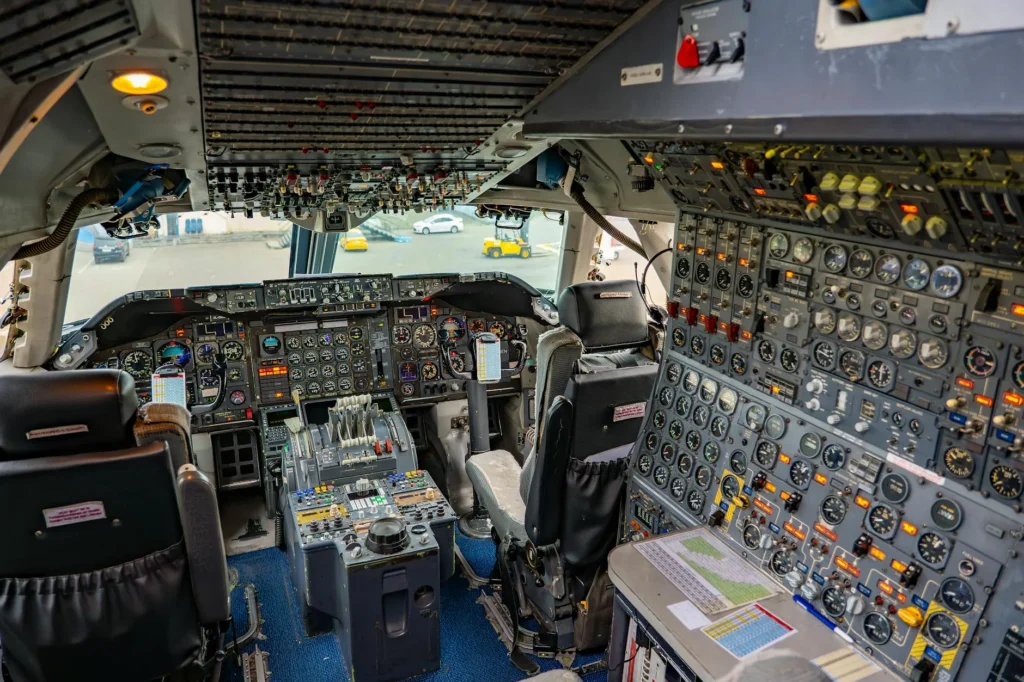
On May 25, 1972, NASA test pilot Gary Krier climbed into a modified F-8C Crusader and took off from Edwards Air Force Base. Unlike any earlier aircraft, this fighter routed every stick input through a digital flight computer that then drove the ailerons, elevators, and rudder. It was the first flight of a digital fly-by-wire systems aircraft with no mechanical backup[s], and it would reshape how humans interact with flying machines.
How Fly-by-Wire Systems Replaced Mechanical Control
For decades, pilots controlled aircraft through a direct physical chain: pull back on the stick, and cables and pulleys physically moved the elevator. The system was intuitive, immediate, and entirely dependent on the pilot’s judgment and skill.
Fly-by-wire systems changed that relationship fundamentally. In a fly-by-wire aircraft, the pilot’s control inputs are converted to electronic signals. Computers process these signals and decide how to move the control surfaces[s]. The pilot is no longer directly commanding the aircraft; the pilot is requesting, and the computer is deciding whether and how to comply.
The technology that made this possible came from an unexpected source: the Apollo program. The guidance computer that helped astronauts navigate to the Moon proved that digital systems could be trusted with human lives. Neil Armstrong, after returning from the lunar surface, championed the transfer of this technology to aircraft[s].
The 13-Year Experiment
NASA’s F-8 Digital Fly-By-Wire program ran for 13 years and completed 211 flights[s]. The research proved that digital fly-by-wire systems could be made reliable enough for practical use, and that they offered advantages mechanical systems could not match: reduced weight, lower maintenance, and the ability to fly aircraft configurations that would otherwise be uncontrollable.
This NASA work directly influenced the Space Shuttle, which used a quad-redundant digital fly-by-wire system. During testing of the shuttle Enterprise in 1977, a pilot-induced oscillation problem emerged upon landing, caused by a time delay in the flight control system[s]. The issue was identified and corrected thanks to lessons learned from the F-8 program.
Two Philosophies Emerge
When fly-by-wire systems moved from military jets to commercial airliners, two competing design philosophies emerged.
Airbus, with the A320 in 1988, introduced the first commercial aircraft with full flight envelope protection[s]. This system prevents pilots from exceeding the aircraft’s structural and aerodynamic limits, even if they try. Pull back too hard on the sidestick, and the computer will refuse to pitch the aircraft beyond the stalling angle. Bank too steeply, and the computer will limit the roll. These “hard limits” cannot be overridden in normal flight[s].
Boeing took a different path with the 777 in 1994. Boeing’s philosophy states that “the pilot is the final authority for the operation of the aeroplane”[s]. Its fly-by-wire systems provide warnings and resistance, but pilots can override them by applying excessive force to the controls[s].
Real Consequences
Both philosophies have been tested in emergencies.
In January 2009, Captain Chesley Sullenberger faced dual engine failure after birds struck US Airways Flight 1549 shortly after takeoff from LaGuardia. During the emergency descent and water landing, the A320’s flight envelope protection allowed him to pull full aft on the sidestick without risking a stall, extracting maximum performance from the crippled aircraft[s]. All 155 people aboard survived.
Less than five months later, Air France Flight 447 presented a darker outcome. When pitot tubes iced over and provided inconsistent airspeed data, the A330’s computers degraded to “alternate law,” which disabled stall protection. The pilots, disoriented by the failure cascade, made control inputs that put the aircraft into an aerodynamic stall. Without the normal stall protection, the aircraft descended uncontrolled into the Atlantic Ocean, killing all 228 aboard[s].
The safety record overall favors envelope protection. Airbus reports that loss-of-control accidents have been reduced by 89% for aircraft equipped with full flight envelope protection[s].
The Ongoing Debate
The question of pilot authority remains unsettled. Airbus argues that envelope protection “liberates the pilot from uncertainty”[s] by allowing maximum evasive action without fear of overstressing the airframe. Boeing maintains that pilots must retain ultimate control for unforeseen situations.
Both positions have merit. What began with Gary Krier’s 1972 test flight has become the foundation of modern aviation, with fly-by-wire systems now standard on virtually all large aircraft. The technology has enabled aircraft designs that would otherwise be unflyable, from the Space Shuttle to the B-2 bomber[s]. But the fundamental question posed by that first flight remains: when a pilot and a computer disagree, who should win?
On May 25, 1972, NASA research pilot Gary Krier conducted the first flight of a digital fly-by-wire systems aircraft operating without mechanical reversion capability. The F-8C Crusader testbed used an Apollo Primary Guidance, Navigation, and Control System adapted for aeronautical use[s]. This flight validated the core premise of digital fly-by-wire: that electronic signal processing and computer-mediated control could replace direct mechanical linkages in safety-critical aerospace applications.
Architecture of Modern Fly-by-Wire Systems
Contemporary fly-by-wire systems employ multiple redundant digital flight control computers that process pilot inputs from transducers mounted on the control column or sidestick. These computers execute control laws, algorithms that translate pilot commands into actuator deflection commands while accounting for current flight conditions, aircraft configuration, and protection limits.
The F-8 program demonstrated that fly-by-wire systems could provide significant advantages: reduced system weight by eliminating mechanical components, decreased maintenance requirements, and the ability to implement advanced control laws impossible with hydro-mechanical systems[s].
Critically, fly-by-wire enables relaxed static stability. The more aerodynamically unstable an aircraft, the more maneuverable it can be. A computer monitoring attitude at high frequency can compensate for instability that would overwhelm human reaction times[s]. The F-16, one of the first production fly-by-wire fighters, exploits this principle for superior combat performance.
Control Laws and Flight Envelope Protection
The Airbus A320, introduced in 1988, was the first commercial aircraft with full flight envelope protection integrated into its control laws[s]. Bernard Ziegler, Airbus’s senior vice president for engineering, drove this development[s].
Airbus fly-by-wire systems implement multiple protection modes in their “Normal Law” configuration[s]:
- High angle-of-attack protection: Limits pitch commands to prevent aerodynamic stall
- High-speed protection: Prevents overspeed that could cause control difficulties or structural damage
- Pitch attitude protection: Constrains pitch angle to prevent excessively steep climbs or descents
- Bank angle protection: Limits roll angle and rate to prevent excessive banking or inversion
- Load factor protection: Keeps vertical acceleration within structural limits
- Alpha floor protection: Automatically increases thrust when low energy states are detected
These protections operate as “hard limits” in Normal Law. The pilot cannot override them without the system degrading to Alternate or Direct Law, which typically requires multiple system failures[s].
Boeing vs Airbus: Soft Limits vs Hard Limits
Boeing’s fly-by-wire implementation on the 777 reflects a different philosophy. Boeing’s stated position: “The pilot is the final authority for the operation of the aeroplane”[s]. The 777’s fly-by-wire systems provide tactile feedback and increased control force gradients as the aircraft approaches envelope limits, but pilots can override these “soft limits” by applying sufficient force[s].
This design choice preserves continuity with Boeing’s legacy aircraft handling characteristics, simplifying crew transitions across the fleet. It also reflects a belief that unforeseen emergencies may require exceeding normal flight envelope limits.
The China Airlines Flight 006 incident in 1985 illustrates the argument for override capability. The Boeing 747SP-09 entered an uncontrolled descent after an engine flame-out and improper handling. Recovery required an estimated 5.5G pull, more than twice the aircraft’s design limit[s]. A hard-limited fly-by-wire system would have prevented this maneuver.
System Failure Modes
Fly-by-wire systems introduce failure modes that do not exist in mechanical systems. The Air France 447 accident demonstrated the consequences when iced pitot tubes provided inconsistent airspeed data. The flight control computers, unable to reconcile the conflicting inputs, degraded from Normal Law to Alternate Law, removing stall protection. The crew, confronted with cascading failures and erroneous airspeed indications, applied nose-up inputs that induced an aerodynamic stall from which they did not recover[s].
The Boeing 737 MAX MCAS failures in 2018 and 2019 revealed a different failure mode. The Maneuvering Characteristics Augmentation System, designed to augment pitch handling at elevated angles of attack rather than provide full envelope protection, received erroneous angle-of-attack data and repeatedly commanded nose-down trim. The system’s authority and persistence overwhelmed the pilots’ ability to counteract it, resulting in two crashes and 346 fatalities[s].
Redundancy and Reliability
Achieving acceptable reliability in fly-by-wire systems requires extensive redundancy. The NASA F-8 Phase II program developed a triplex digital system with fault detection and isolation capabilities[s]. Modern commercial fly-by-wire systems typically employ multiple redundant computers, sensors, and actuators, with voting logic to detect and isolate failed components.
The Space Shuttle used a quad-redundant architecture with four IBM AP-101 computers operating in parallel. The F-8 DFBW program directly contributed to Shuttle flight control development, identifying hardware issues and helping resolve pilot-induced oscillation problems discovered during Enterprise testing[s].
The 54-Year Evolution
From Krier’s 1972 test flight to modern fly-by-wire systems, the technology has matured considerably. The F-16 proved fly-by-wire viable for production fighters; the F/A-18 Hornet in 1978 became the first production aircraft with digital rather than analog fly-by-wire[s]. The technology has enabled aircraft designs that would be impossible with mechanical controls, including the aerodynamically unstable B-2 bomber and the Space Shuttle[s].
Airbus reports an 89% reduction in loss-of-control-in-flight accidents for aircraft with full flight envelope protection[s]. This statistic argues strongly for the hard-limit approach. Yet the fundamental design tension persists: the system that prevents pilot error may also prevent pilot heroics. Both possibilities are real. The debate over who should have final authority, the human or the computer, remains aviation’s most consequential open question.