The National Weather Service issued a High Wind Warning for Southern Nevada on May 16, threatening the final night of the Electric Daisy Carnival’s 30th anniversary edition with gusts projected between 50 and 60 mph.[s] The warning arrives with more than 500,000 attendees expected across three nights at Las Vegas Motor Speedway for EDC’s 30th-anniversary edition.[s] Festival scalability, the capacity to grow attendance while maintaining safety and quality, has become the defining challenge of the modern mega-festival era.
The Numbers Behind Festival Scalability
EDC 2026 spreads more than 240 artists across nine stages, up from the single Shrine Expo Hall that hosted roughly 4,000 people in 1997.[s] The 2025 edition drew 540,000 attendees across three nights, a figure that makes EDC Las Vegas the largest dance music festival in North America.[s] That growth has delivered substantial economic returns: a 2016 Beacon Economics study found that EDC Las Vegas generated $1.3 billion for Clark County over five years, with the 2015 edition alone contributing an estimated $350 million to the local economy and $21.9 million in state and local tax revenue.[s]
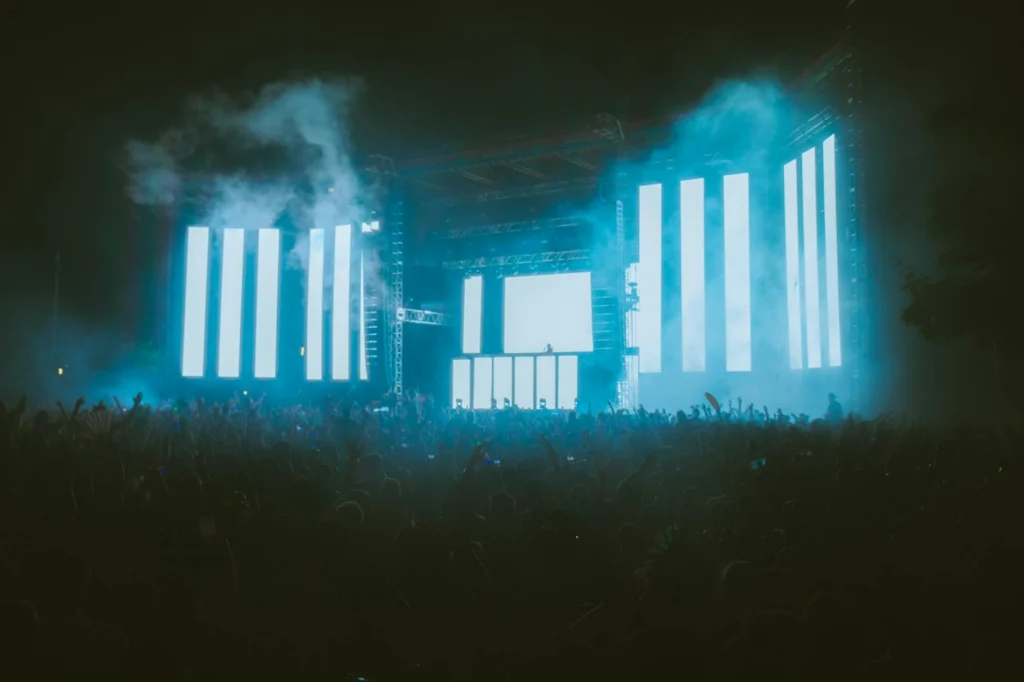
Scaling attendance from 4,000 to 500,000 demands infrastructure that did not exist in the warehouse rave era. The speedway venue requires temporary LED production walls, overhead lighting trusses, carnival rides, and art installations, all vulnerable to desert conditions. Structural engineers note that gusts over 40 mph present severe operational risks to this temporary architecture.[s]
When Festival Scalability Fails
The wind warning is not theoretical. During the 2025 edition, sudden gusts forced a multi-hour shutdown of the Circuit Grounds, Quantum Valley, and Bionic Jungle stages.[s] Similar conditions forced an early shutdown in 2012 and stage closures in 2019.[s] The 2026 weather transition, from a 104-degree heat wave earlier in the week to Sunday night temperatures in the mid-50s, compounds the operational strain. The desert environment, intensified by the urban heat island effect in the Las Vegas metro, swings from extreme heat to gusty cold fronts within days.
Festival scalability is not merely about fitting more people on the grounds. Industry data shows that labor costs such as staff wages, security, crowd management, and production crew costs typically account for roughly 30 to 35 percent of total festival operating budgets, alongside compliance, logistical supervision, and seasonal workforce coordination.[s] Some event producers report production expenses 20 to 30 percent above pre-pandemic budgets, creating what Ticket Fairy describes as a crisis in festival staffing and recruitment.[s]
The Economics Squeezing Mid-Tier Festivals
EDC operates at a scale that smaller festivals cannot match. Live Nation, which entered a creative partnership with Insomniac in 2013 amid reports of an approximately 50 percent stake, brings infrastructure and booking leverage that independent promoters lack. At the headliner level, festivals are financial structures built on ticketing certainty, risk mitigation, and return on investment.[s] Live Nation has outlined in investor reports that major headliners drive a disproportionate share of early ticket sales and overall demand, often determining commercial viability before undercard acts are finalized.[s]
Mid-tier festivals face a different reality. Insurance premiums for liability and event cancellation have climbed approximately 50 percent in the past decade, and in some cases have tripled in just the past few years.[s] Festival ticket prices have increased by roughly 8 percent per year over the past five years to offset these costs.[s] By mid-2024, the Association of Independent Festivals reported that 45 UK festivals had been canceled or postponed, already exceeding the total for the entire previous year.[s]
The festival scalability gap between mega-festivals and independent events is widening. Sponsorship has become the leading revenue stream across the events industry, with brands increasingly turning to live events for targeted audience engagement.[s] Large festivals attract sponsorship dollars; smaller ones struggle to survive on ticket revenue alone.
Infrastructure as the New Competitive Moat
When attendance reaches hundreds of thousands, margin is won or lost on operations. Infrastructure, real-time data visibility, and integrated systems are critical to managing risk, scaling profitably, and delivering a seamless experience at scale.[s] EDC’s 2026 nine-stage footprint, including bionicJUNGLE, illustrates the strategy: expand the physical footprint to accommodate more attendees while distributing crowd density across distinct environments.[s]
The World Party Parade on May 14 shut down the north end of the Las Vegas Strip for 15 floats accompanied by performers, entertainers, and marching bands.[s] Clark County commissioners approved the closure of Las Vegas Boulevard, putting an official EDC parade on the Strip for the festival’s 30th anniversary.
The global events industry is projected to reach $2.5 trillion by 2035, up from $736.8 billion in 2021, marking a nearly 3.5x expansion.[s] Festival scalability will determine which promoters capture that growth and which collapse under cost pressures.
What Happens Next
The High Wind Warning remains in effect until 5 a.m. Monday. Insomniac is working with Clark County public safety agencies to monitor real-time conditions at the speedway.[s] Whether EDC’s final night proceeds without disruption will test the infrastructure investments that underpin its festival scalability model.
For the industry, the stakes extend beyond one weekend. EDM festival attendance is growing by up to 20 percent in some industry benchmarks.[s] The question is whether the physical, financial, and operational infrastructure can keep pace, or whether the economics of festival scalability will hit a ceiling that no lineup can overcome.