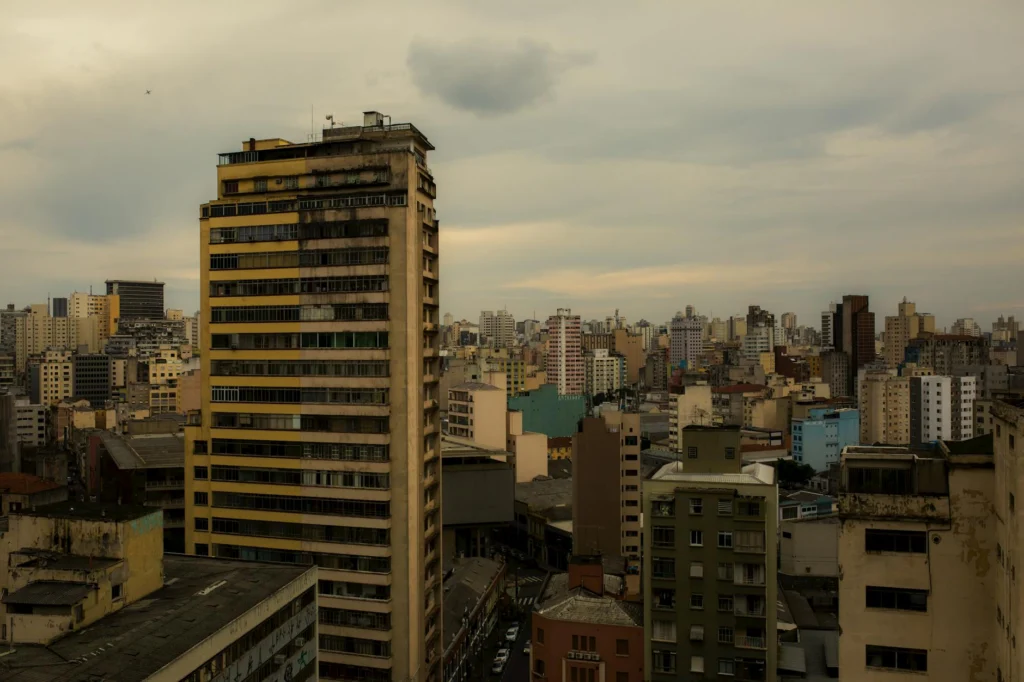
Walk from a city park into a downtown parking lot on a summer afternoon, and the temperature difference hits you immediately. This is the urban heat island effect in action: cities are measurably, consistently hotter than the countryside around them. In the United States, this temperature gap reaches 1 to 7°F during the day and 2 to 5°F at night[s]. In extreme cases, highly developed urban areas can run 15 to 20°F hotter than surrounding vegetated areas during mid-afternoon[s].
This is not random. Five physical mechanisms combine to turn cities into thermal batteries.
Dark Surfaces Absorb More Heat
The first mechanism involves albedo, the fraction of sunlight a surface reflects. Forests and grasslands reflect a good portion of incoming solar energy back into space. Asphalt and dark roofing materials do not. They absorb that energy and convert it to heat[s].
On a warm day, conventional roofing materials can reach temperatures 66°F higher than the surrounding air[s]. Dark asphalt roads behave similarly. This absorbed heat radiates into the air above, warming the entire neighborhood.
Concrete Stores Heat Like a Battery
Urban materials do not just absorb heat; they store it. Concrete, brick, and stone possess high thermal mass, meaning they absorb large amounts of heat energy with only small increases in surface temperature[s].
During the day, these materials soak up solar energy. At night, they release it slowly. The midday sun delivers approximately 800 watts per square meter, and about half that energy gets stored in surfaces like concrete before being released after sunset[s]. Rural areas cool quickly after dark because vegetation and soil release their heat rapidly. Cities stay warm because their thermal mass keeps radiating stored energy for hours.
Urban Heat Island Effect: Buildings Trap Heat
Tall buildings create what climatologists call urban canyons. The geometry matters: narrow streets lined with tall structures limit the view of the open sky and reduce wind flow[s]. Heat that would normally escape upward into the atmosphere bounces between building walls instead, unable to dissipate.
Research on urban canyons found that areas with lower sky view factors, meaning less visible sky from street level, retained more heat. The geometry of these spaces plays a decisive role in urban heat island intensity[s].
Human Activity Generates Heat Directly
Cities concentrate people, vehicles, and machines. All of these release heat. Waste heat from traffic accounts for up to 30% of anthropogenic heat emissions in cities, making it the second largest source after buildings[s].
In Vienna, car traffic alone generates approximately three times as much waste heat daily as the body heat of the entire population[s]. During heat waves, air conditioning systems add another layer: they can increase outdoor heat by 20% as they pump warmth from building interiors to the street[s].
Missing Trees Mean Missing Cooling
Vegetation cools air through evapotranspiration, absorbing water through roots and releasing it through leaves. This process consumes heat energy, lowering ambient temperatures. A review of 308 studies found urban forests were on average 3°F cooler than urban non-green areas[s].
Cities replace trees with pavement. Without evapotranspiration, that natural air conditioning disappears, and the urban heat island effect intensifies.
Why Nights Are Worse
The urban heat island effect peaks after sunset, not during the day. Rural areas cool quickly as vegetation and soil release their heat into the atmosphere. Cities cannot. Their thermal mass continues radiating stored energy, while reduced atmospheric mixing at night limits how fast that heat can escape[s].
Paris, during certain conditions, can be 10°C (18°F) warmer at night than the surrounding countryside[s]. This matters for human health because bodies need cooler night temperatures to recover from daytime heat stress.
The Stakes
Across 65 major U.S. cities, the average resident experiences 8°F of additional heat due to their built environment[s]. Across 93 European cities, heat islands contribute to approximately 6,700 premature deaths annually, representing 4% of all summer deaths[s].
Each 1°C increase in temperature raises energy demand by 0.5 to 5%, depending on local air conditioning penetration[s]. The physics of urban heat islands translates directly into mortality and energy bills.
The urban heat island phenomenon represents a systematic deviation in the surface energy balance of built environments compared to natural landscapes. Empirical measurements across U.S. cities show daytime temperature elevations of 1 to 7°F and nighttime elevations of 2 to 5°F relative to rural surroundings[s]. Under optimal conditions for heat island formation, clear skies and calm winds, mid-afternoon differentials in highly developed areas can reach 15 to 20°F above surrounding vegetated zones[s].
Five coupled physical mechanisms drive this temperature differential.
Albedo and Shortwave Radiation Partitioning
Surface albedo, the ratio of reflected to incident shortwave radiation, determines how much solar energy enters a system versus escaping to space. High-albedo surfaces reflect more sunlight back into the atmosphere; low-albedo surfaces such as dark pavement absorb it and raise ambient temperatures[s].
The practical consequence: conventional roofing materials can reach surface temperatures 66°F above ambient air on warm days[s]. This absorbed energy converts to sensible heat flux, warming the urban boundary layer directly.
Urban Heat Island Effect: Thermal Mass and Heat Storage
Urban materials function as thermal reservoirs due to their combination of high specific heat capacity, high density, and moderate thermal conductivity[s]. Concrete, masonry, and asphalt absorb substantial heat energy with minimal surface temperature increases during diurnal heating cycles, then release that energy during nocturnal hours.
The quantitative scale: midday solar irradiance delivers approximately 800 W/m². Concrete surfaces store roughly half this incoming energy, releasing it as longwave radiation after sunset[s]. Anthropogenic heat emissions from buildings and vehicles contribute an additional few tens of watts per square meter. In Tokyo, this anthropogenic component alone adds approximately 1°C to nocturnal temperatures[s].
Canyon Geometry and Sky View Factor
Urban morphology modulates longwave radiative exchange through the sky view factor (SVF), defined as the fraction of the hemisphere above a point that is open sky versus obstructed by buildings. Lower SVF values indicate less visible sky and more building surface area for radiation trapping[s].
Studies in Constantine City, Algeria, examining canyons with aspect ratios from 1 to 6.7 and SVF values from 0.076 to 0.58, found that increased SVF correlated with higher daytime canyon temperatures, while increased aspect ratio (building height to street width) reduced temperatures by limiting solar penetration[s]. The geometry determines whether longwave radiation from heated surfaces escapes to space or is absorbed by adjacent building faces, creating a local greenhouse effect.
Anthropogenic Heat Flux
The urban heat island includes direct thermal contributions from human activities. Vehicle waste heat constitutes up to 30% of anthropogenic emissions in cities[s]. In Vienna, vehicular traffic releases approximately three times the thermal energy of the city’s entire population’s metabolic output[s].
The Manhattan extreme case: on a typical winter day, anthropogenic heat release from fossil fuel combustion exceeds incoming solar radiation by a factor of four[s]. During summer heat waves, space cooling systems amplify outdoor temperatures by transferring interior heat to the exterior, adding approximately 20% to outdoor heat loads[s].
Parked vehicles also contribute: each additional ten cars on narrow streets raises local temperatures by 0.5 to 1.6°C[s].
Evapotranspiration Deficit
Vegetation provides latent heat flux through evapotranspiration, converting sensible heat to latent heat as water transitions from liquid to vapor. This process consumes energy that would otherwise warm the air[s].
Urban development replaces vegetated surfaces with impervious materials, eliminating this cooling pathway. Meta-analysis of 308 studies documented an average temperature reduction of 1.6°C (3°F) in urban forests compared to non-vegetated urban zones[s].
Nocturnal Intensification
The urban heat island effect reaches maximum intensity three to five hours after sunset[s]. Two mechanisms explain this: continued longwave emission from thermal mass as rural areas cool rapidly, and reduced nocturnal boundary layer mixing. At night, atmospheric mixing height drops to approximately one fifth of its daytime value[s], concentrating released heat near the surface.
The Paris urban area demonstrates extreme nocturnal differentials, reaching 10°C above surrounding rural temperatures[s].
Quantified Impacts
Climate Central analysis of 65 major U.S. cities found average residents experience 8°F of additional heat from built environment characteristics[s]. The mortality burden across 93 European cities reaches approximately 6,700 attributable deaths annually, 4% of summer mortality[s].
Energy system feedbacks follow: each 1°C temperature increase drives 0.5 to 5% increases in electricity demand, depending on air conditioning saturation[s]. This creates a positive feedback loop where heat island intensity drives cooling demand, which generates additional anthropogenic heat.
Distributional Inequity
Urban heat island intensity correlates with historical discriminatory housing practices. Analysis of 179 U.S. cities found that 84% show higher summer temperatures in historically redlined areas compared to non-redlined neighborhoods in the same city, with average differentials of 6.5°F[s]. The physical mechanisms remain the same: less vegetation, more impervious surface, higher building density.