Bread rises. Beer bubbles. Yogurt thickens. Three foods with almost nothing in common share a biochemical secret: an ancient metabolic pathway that humans have exploited in fermentation for at least 6000 years.[s] In these transformations, fermentation biochemistry follows related initial steps, then diverges at a critical branch point that determines whether you get alcohol or acid.
The Universal Starting Point
Many familiar food fermentations begin with microorganisms breaking down sugars to extract energy. In glycolysis, one molecule of glucose is converted into two molecules of pyruvate while generating a small amount of cellular energy in the form of ATP.[s]
This pathway is ancient and universal. The same sequence of enzyme reactions that makes bread rise also powers your muscle cells during a sprint. The fermentation biochemistry shared across species reflects billions of years of evolutionary conservation.
But glycolysis alone does not explain why bread tastes different from yogurt. The magic happens at the branch point: what the cell does with pyruvate determines everything that follows.
The Branch Point: Alcohol or Acid
In the absence of oxygen, pyruvate faces a choice. It can be converted to ethanol and carbon dioxide, or it can be converted to lactic acid.[s] Different microorganisms favor different downstream reactions, and that metabolic branch creates the difference between beer and yogurt.
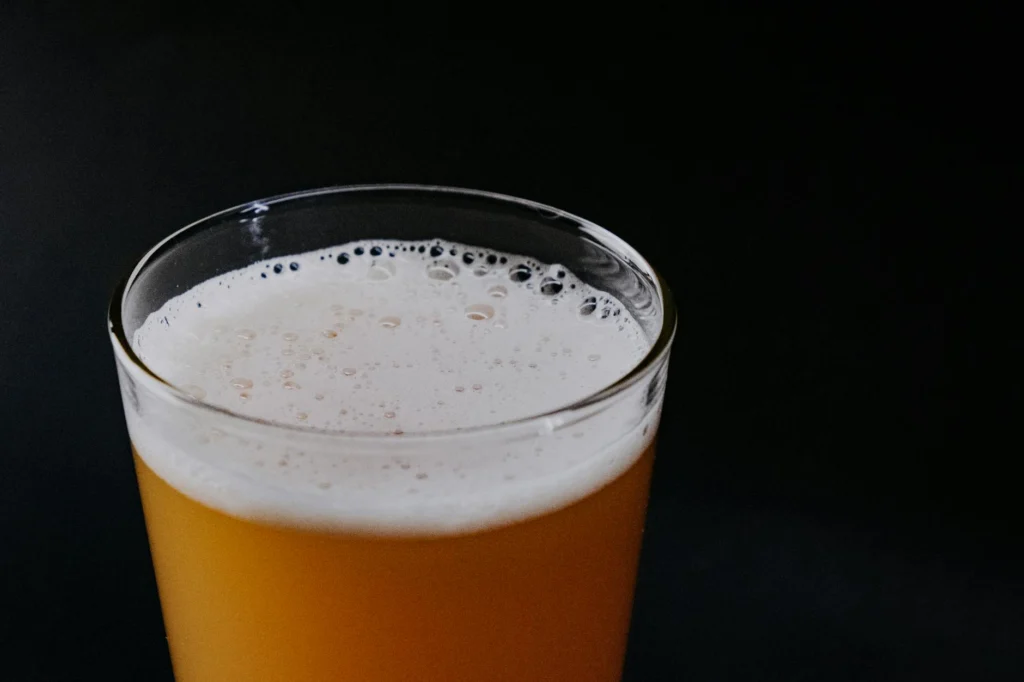
Yeasts, the fungi responsible for brewing and baking, take the alcohol route. They convert pyruvate to ethanol and release carbon dioxide as a byproduct. The bubbles in your beer and the rise in your bread both come from this CO2 production.
Lactic acid bacteria take the other path. They convert pyruvate directly to lactic acid, which drops the pH of whatever medium they inhabit. This acidification gives yogurt its tang and also acts as a natural preservative by creating conditions hostile to harmful bacteria.[s]
Fermentation Biochemistry in Bread
When you mix flour, water, and yeast, two transformations begin simultaneously. Proteins in the flour (glutenin and gliadin) combine to form gluten, the elastic network that gives bread its structure.[s] Meanwhile, yeast cells start fermenting sugars in the flour.
Deprived of oxygen inside the dough, yeasts convert glucose into ethanol, carbon dioxide, and various flavor compounds including organic acids.[s] The carbon dioxide gets trapped in the gluten network, inflating the dough. The ethanol evaporates during baking, contributing to the aroma rather than making the finished loaf alcoholic.
Sourdough adds complexity. In traditional sourdough, lactic acid bacteria work alongside yeasts. The LAB produce acids that add flavor; together, the fermentation can reduce phytic acid, a mineral-chelating compound, thereby improving mineral bioavailability.[s]
Fermentation Biochemistry in Beer
Beer fermentation relies on the same core pathway but under different conditions. The yeast species Saccharomyces cerevisiae is traditionally used for ales, while Saccharomyces pastorianus is traditionally used for lagers.[s]
Beyond ethanol and CO2, brewing yeasts generate many intermediate compounds that define a beer’s character: esters that add fruity notes, higher alcohols that contribute body, and phenols that create spicy or smoky flavors.[s] The specific enzyme profile of each yeast strain determines which compounds accumulate.
Craft brewers have expanded beyond traditional yeasts. Non-conventional species like Torulaspora and Lachancea can release thiols and terpenes from hop compounds, enhancing fruity aromas while reducing off-flavors like diacetyl.[s]
Fermentation Biochemistry in Yogurt
Yogurt takes the lactic acid branch. Industrial production uses a co-culture of two bacteria: Streptococcus thermophilus and Lactobacillus delbrueckii subsp. bulgaricus. These organisms work synergistically to acidify milk and develop yogurt’s characteristic texture and flavor.[s]
The bacteria metabolize lactose (milk sugar) into lactic acid. This acidification helps milk proteins coagulate, creating yogurt’s thick texture, and helps suppress spoilage organisms and harmful pathogens.[s][s]
Flavor compounds in yogurt include acetaldehyde (which creates the characteristic tang) and diacetyl (which adds butteriness).[s] These arise as byproducts of the same metabolic pathways that generate lactic acid.
Why It Matters
Understanding fermentation biochemistry explains not only how these foods are made but why controlled fermentation helps preserve them. The acidification from lactic acid fermentation and the alcohol from yeast fermentation both create environments hostile to dangerous microbes. Humans discovered this empirically millennia ago; biochemistry eventually explained why it works.
The same pathways that produce beer and yogurt are now being engineered for sustainability applications, from bioethanol fuel production to low-alcohol beverages designed for health-conscious consumers.[s]
Glycolysis: The Shared Upstream Pathway
Fermentation biochemistry begins with the Embden-Meyerhof-Parnas (EMP) pathway, the glycolytic sequence that converts one molecule of glucose (C6H12O6) into two molecules of pyruvate. This process yields a net gain of 2 ATP and 2 NADH per glucose molecule.[s]
The pathway comprises ten enzyme-catalyzed reactions. Hexokinase phosphorylates glucose to glucose-6-phosphate, committing the sugar to catabolism. Through subsequent isomerization, second phosphorylation, and aldol cleavage, the six-carbon sugar becomes two three-carbon triose phosphates. The energy-yielding phase oxidizes these to pyruvate while substrate-level phosphorylation generates ATP.[s]
This portion of the fermentation biochemistry pathway is highly conserved across domains of life and tightly regulated. Gene expression and enzyme activity are finely tuned to balance energy production against biosynthetic demands.[s]
The Pyruvate Branch: Decarboxylation vs. Reduction
Pyruvate sits at a metabolic crossroads. Under aerobic conditions, it enters the mitochondria for oxidative phosphorylation. Under anaerobic conditions, the cell must regenerate NAD+ from the NADH produced during glycolysis, and pyruvate serves as the electron acceptor.[s]
In alcoholic fermentation, pyruvate decarboxylase removes CO2 from pyruvate, yielding acetaldehyde. Alcohol dehydrogenase then reduces acetaldehyde to ethanol, oxidizing NADH to NAD+ in the process. The net reaction: C6H12O6 yields 2 C2H5OH + 2 CO2.
In lactic acid fermentation, lactate dehydrogenase (LDH) directly reduces pyruvate to lactate while oxidizing NADH. This homofermentative pathway, characteristic of many lactic acid bacteria (LAB), converts glucose almost entirely to lactic acid via the EMP pathway.[s]
Alcoholic Fermentation: Yeast Metabolism
Saccharomyces cerevisiae remains the primary organism for bread and ale production. S. pastorianus, a cold-tolerant hybrid species, dominates lager brewing.[s] For glucose specifically, the stoichiometry of alcoholic fermentation gives a theoretical maximum ethanol yield of about 51% by mass.
Beyond ethanol, yeast metabolism generates flavor-active compounds through overflow pathways. The Ehrlich pathway converts amino acids to higher alcohols and their ester derivatives. Acetyl-CoA serves as precursor for medium-chain fatty acid ethyl esters. Phenolic compounds arise from ferulic acid decarboxylation.[s]
Recent research has identified the Rim15p-Msn2/4p signaling cascade as a major regulator of fermentation capacity. This pathway governs a metabolic trade-off: glucose flux can be directed toward ethanol production or toward 1,3-beta-glucan synthesis for cell wall construction. Sake yeast strains carry loss-of-function mutations in this pathway, helping explain their high fermentation rates.[s]
Bread Fermentation: CO2 and Gluten Dynamics
In bread dough, yeast fermentation serves a structural rather than alcoholic purpose. The CO2 generated nucleates and expands gas cells within a gluten matrix. Gluten, formed from the wheat storage proteins glutenin and gliadin through hydration and mechanical working, provides viscoelastic properties that trap the gas.[s]
The anaerobic environment of dough interior favors fermentative metabolism. Products include ethanol that volatilizes during baking, CO2, and secondary metabolites: acetic acid, lactic acid, and volatile aldehydes and alcohols that contribute to bread aroma.[s]
Sourdough fermentation involves LAB and yeasts. During sourdough fermentation, these microbes substantially reduce phytic acid (myo-inositol hexaphosphate), a mineral chelator, improving mineral bioavailability.[s]
Lactic Acid Fermentation: LAB Metabolism
Standard yogurt production employs a defined two-species starter: Streptococcus thermophilus and Lactobacillus delbrueckii subsp. bulgaricus. These organisms rapidly acidify milk and develop yogurt’s characteristic texture and flavor through synergistic activity.[s]
Both species are homofermentative, converting lactose to lactic acid via the EMP pathway with LDH catalyzing the terminal reduction. Acidification lowers milk pH and promotes milk-protein coagulation, forming the gel structure characteristic of yogurt.[s]
Flavor development in yogurt involves acetaldehyde and diacetyl, two dominant compounds produced during starter metabolism.[s] LAB also synthesize bacteriocins (antimicrobial peptides), exopolysaccharides (which modify texture), and B-vitamins as secondary metabolites.[s]
Applications and Engineering
Fermentation biochemistry now extends beyond traditional foods. Metabolic engineering of S. cerevisiae targets bioethanol production for renewable fuel. Low-alcohol beverage development uses yeast strains with attenuated ethanol output, including approaches based on Rim15p-pathway research or selection of non-conventional species with limited sugar fermentation capacity.[s][s]
In dairy, probiotic adjunct strains are added to traditional starters to broaden metabolic activity. In one study, Lacticaseibacillus paracasei L9 used high-affinity lactose transport and the Leloir pathway to support rapid growth and stable viability during refrigerated storage.[s]
Understanding the core pathways, their regulation, and their integration with secondary metabolism provides the foundation for both preserving traditional fermented foods and engineering novel bioprocesses.