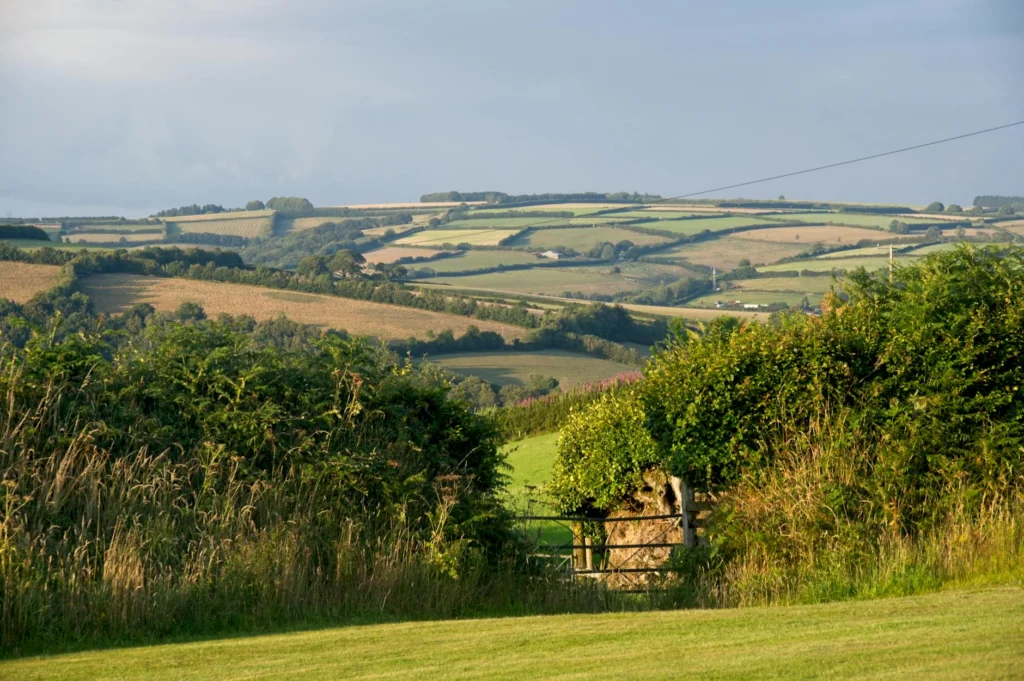
The English enclosure movement ranks among the most consequential transformations in Western history, yet few people outside academic circles have heard of it. Between 1604 and 1914, over 5,200 Parliamentary acts converted roughly 6.8 million acres[s] of common land into private property, fundamentally reshaping who owned England, who worked its soil, and on what terms.
Before the Fences: How Common Land Actually Worked
For centuries, English agriculture operated under the open field system. The lord of the manor held legal title, but peasants exercised a web of usufructory rights[s] that allowed them to graze livestock, cut wood, draw water, and grow crops on shared land at specified times of year. This was not lawless chaos. Locally elected councils met annually[s] to distribute plots, schedule seasonal uses, and set “stints,” or fees, to prevent overgrazing. Strips of farmland were deliberately scattered across fields so no single family monopolized the best soil.
The system was imperfect. Wealthier farmers could dominate village councils, and productivity lagged behind what consolidated farms might achieve. But for ordinary families, the commons provided a crucial safety net: foraged food, fuel, and grazing rights that kept starvation at bay even in lean years.
English Enclosure Movement: Tudor Origins and Wool Profits
The earliest enclosures date to the Tudor period (1485-1603)[s], driven by the Crown’s desire to reward noble allies and, more powerfully, by surging demand for wool. Manorial lords fenced off common land and converted it to sheep pasture. These early enclosures were informal agreements, often backed by coercion or outright violence. Entire parishes were sometimes enclosed with ruthless disregard for smallholders.
Resistance was fierce. Villagers tore down fences and leveled hedges in what historians call “enclosure riots.” The largest was Kett’s Rebellion of 1549[s], when roughly 16,000 Norfolk rebels camped at Mousehold Heath outside Norwich, capturing England’s second-largest city. Robert Kett, a landowner who sided with the dispossessed, drew up demands including a plea that “from henceforth no man shall enclose any more.” The government crushed the rebellion with 12,000 troops and German mercenaries, executing Kett at Norwich Castle.
Parliament Takes Over: The Machinery of Dispossession
The first Parliamentary enclosure act came in 1604, but the English enclosure movement accelerated dramatically after 1750. The process was deceptively orderly. A prominent landholder, sometimes just one, petitioned Parliament. Commissioners were appointed[s] to survey and redistribute the land. In theory, objections could be heard. In practice, the commissioners came from the same class as the petitioners.
As historian Joseph Stromberg observed, “the great landholders awarded themselves the best land and the most of it, thereby making England a classic land of great, well-kept estates with a small marginal peasantry and a large class of rural wage labourers.”[s]
Displaced families received compensation, but it was often poor-quality land with no access to water or wood. Many could not afford the legal costs of the enclosure process itself, and were forced to sell. The General Enclosure Act of 1801 standardized these procedures, accelerating the conversion.
From Peasant to Proletarian
The human cost of the English enclosure movement was staggering. According to J.M. Neeson’s landmark study, enclosures between 1750 and 1820 dispossessed former occupiers from roughly 30 percent of England’s agricultural land[s]. The historians J.L. and Barbara Hammond described the transformation in their 1911 work The Village Labourer: “The peasant with rights and a status, with a share in the fortunes and government of his village, standing in rags, but standing on his feet, makes way for the labourer with no corporate rights to defend, no corporate power to invoke, no property to cherish.”
With no land to farm, former commoners faced three choices: become tenant laborers on the newly enclosed estates, emigrate to the colonies, or move to the cities in search of work in the emerging factories[s] of the Industrial Revolution. Most chose the cities, or were compelled toward them. The English enclosure movement did not merely change land ownership; it manufactured the workforce that powered industrialization.
Productivity Gains, Inequality Costs
Enclosure’s defenders point to genuine agricultural improvements. Enclosed land allowed individual farmers to adopt crop rotation, selective breeding, and soil management without coordinating with dozens of neighbors. A 2022 NBER study[s] analyzing all Parliamentary enclosure acts between 1750 and 1830 found that enclosed parishes saw, on average, a 45 percent increase in agricultural yields.
But the same study found that the Gini coefficient, a standard measure of inequality, rose by 30 percent in enclosed parishes compared to those that remained common. Productivity and dispossession advanced together. Crop yields and livestock output increased while productivity gains created a surplus of labor[s], feeding the factories with desperate workers willing to accept any wage.
A Legacy Written in Hedgerows
By 1873, a government report on land ownership revealed that almost all of the top 100 landowners were also members of the House of Lords[s]. The English enclosure movement had completed its work: a nation of smallholders and commoners had become a nation of landlords and laborers. Karl Marx called it “systematic theft of communal property,”[s] arguing it served to “set free the agricultural population as a proletariat for the needs of industry.”
Today, nearly half of England is owned by roughly 40,000 land millionaires, or 0.06 percent of the population[s]. The hedgerows that tourists photograph as quintessential English countryside are, in fact, the physical scars of enclosure, the fences that divided a commons into private estates. The English enclosure movement did not merely rearrange property lines. It created the economic order, the division between those who own and those who work, that defines industrial capitalism to this day.
The English enclosure movement remains one of the most debated processes in economic and social history, a transformation that converted approximately 6.8 million acres of commonable land into private property[s] through over 5,200 Parliamentary acts between 1604 and 1914. Its significance extends beyond agrarian history into debates about primitive accumulation, property rights theory, and the origins of industrial capitalism.
The Open Field System and Commons Governance
Pre-enclosure English agriculture operated through a complex commons governance regime. Under the open field system, peasants held usufructory rights[s] permitting grazing, fuel-gathering, gleaning, and cultivation on land to which the lord of the manor held nominal title. These rights were not informal customs but legally recognized entitlements administered through manorial courts.
Ellen Rosenman’s analysis in BRANCH[s] details how locally elected councils met annually to distribute arable strips, schedule rotational uses, and set stinting fees. Each allotment consisted of scattered long strips to ensure equitable distribution of soil quality. Some villages set income ceilings for commons access, reserving pasture for the very poor. Christopher Rodgers et al. characterize the governing ideal as “good neighborhoods” oriented toward sustaining the resource and equitable access.
The system’s inefficiencies were real: coordinating crop rotation, fallowing, and grazing across dozens of scattered strips constrained individual innovation. But as anthropologist Arthur McEvoy argued in response to Garrett Hardin’s “Tragedy of the Commons” thesis, English commoners were not the atomized, non-communicating actors[s] of Hardin’s model. They managed shared resources through active collective governance.
English Enclosure Movement: Tudor Through Parliamentary Phases
The English enclosure movement proceeded in distinct phases. Tudor-era enclosures (1485-1603)[s] were driven by wool demand and Crown patronage, executed through informal agreements often backed by force. The conversion of arable to sheep pasture provoked sustained resistance, from localized hedge-leveling to Kett’s Rebellion of 1549[s], in which approximately 16,000 Norfolk rebels seized Norwich and articulated demands including the cessation of all further enclosure.
The shift to Parliamentary enclosure after 1604, and particularly after 1750, institutionalized the process. The National Archives documents how acts named commissioners[s] to survey and redistribute land within specified timeframes. The process required petitions to Parliament, nominally allowed objections, and provided compensation. But as Stromberg’s research demonstrates, commissioners were “invariably of the same class and outlook as the major landholders who had petitioned in the first place.”[s]
Economic historian Sudha Shenoy calculated that between 1730 and 1839, 4,041 enclosure bills passed, while 581 faced counter-petitions and 872 failed[s]. The General Enclosure Act of 1801 (the Inclosure Consolidation Act) standardized procedures, and the General Enclosure Act of 1845 appointed permanent commissioners who could issue awards without Parliamentary approval.
Quantifying the Dispossession
The scale of the English enclosure movement is documented through multiple historiographic traditions. Rosenman cites approximately 4,000 Parliamentary acts between 1750 and 1850[s] alone. J.M. Neeson’s Commoners: Common Right, Enclosure and Social Change in England, 1700-1820, winner of the 1993 Whitfield Prize, found that enclosures between 1750 and 1820 dispossessed former occupiers from some 30 percent of England’s agricultural land[s].
A 2022 NBER working paper by Heldring, Robinson, and Vollmer[s], analyzing all Parliamentary enclosure acts between 1750 and 1830 across over 15,000 parishes, provides the most rigorous quantitative assessment to date. Their findings: enclosures were associated with a 45 percent increase in agricultural yields, but also a 30 percent increase in the Gini coefficient measuring land ownership inequality. Agricultural patents increased modestly, road quality improved, and adoption of soil-replenishing practices like turnip cultivation and appropriate fallowing rose, suggesting that enclosure enabled productivity gains that also created a surplus of labor[s].
Class Transformation and Proletarianization
The Hammonds’ The Village Labourer 1760-1832 (1911) provided the foundational social history: “The peasant with rights and a status… makes way for the labourer with no corporate rights to defend.”[s] This “pessimist” interpretation, emphasizing the destruction of peasant autonomy and the creation of a dependent wage-labor class, was challenged by “optimist” revisionists who argued poverty predated enclosure and that increased productivity ultimately raised living standards.
More recent scholarship has reframed this debate. Rosenman characterizes the revisionist position as an “over-correction,” noting that the majority of villagers who did not own land could not farm independently after enclosure but had to hire themselves out[s], a less secure and less profitable arrangement regardless of baseline poverty levels. The English enclosure movement’s role in proletarianization, the creation of a class dependent entirely on selling its labor, is now broadly accepted even among historians who dispute the magnitude of material decline.
Marx’s analysis of enclosure as “primitive accumulation” in Capital, where he called it “systematic theft of communal property”[s] that served to “set free the agricultural population as a proletariat for the needs of industry,” remains influential in structuralist interpretations. The increased labor supply is widely considered one of the factors facilitating the Industrial Revolution[s].
Enduring Consequences
By 1873, a government report revealed that almost all of the top 100 landowners were members of the House of Lords[s]. The concentration has persisted: nearly half of England today is owned by approximately 40,000 individuals, or 0.06 percent of the population[s].
The English enclosure movement also reshaped intellectual history. Garrett Hardin’s influential 1968 “Tragedy of the Commons” thesis used English common land as its archetypal example of inevitable commons degradation, an argument Hardin himself later retracted, conceding his title should have been “The Tragedy of the Unmanaged Commons.” The historical record demonstrates that English commons were, in fact, actively managed, and that their dissolution served the interests of those powerful enough to petition Parliament, not the abstract logic of resource depletion.
The hedgerows, stone walls, and property boundaries that define the English countryside are the physical legacy of this transformation: monuments to a process that converted a nation of commoners into a nation of wage earners, and in doing so, laid the groundwork for industrial capitalism.