On the morning of May 29, 1453, the longest continuous political institution in European history ceased to exist. Constantinople 1453 marks the moment when Ottoman cannons accomplished what no army had managed in over a thousand years: breaching the Theodosian Walls and ending the Roman Empire. The city that Constantine I had founded in 324 CE as the new capital of Rome fell to Sultan Mehmed II after a siege lasting 55 days, and with it collapsed an entire civilizational order.[s]
Constantinople 1453: A City on Borrowed Time
By the mid-fifteenth century, the Byzantine Empire was an empire in name only. The capital that had once commanded territories stretching from Spain to Mesopotamia now controlled little more than the city itself and a few Aegean islands. Constantinople’s population had plummeted from roughly 400,000 in the twelfth century to somewhere between 40,000 and 50,000.[s] Vast open fields occupied spaces where bustling markets and neighborhoods had once stood. The treasury was empty. The once-powerful Byzantine navy had dwindled to a mere 26 ships, most of them belonging to Italian colonists rather than to the empire itself.[s]
Yet Constantinople retained one supreme advantage: its walls. The Theodosian Walls, built during the reign of Theodosius II and completed by 439 CE, were the most formidable defensive system in the medieval world. A triple line of fortifications stretched 6.5 kilometers across the peninsula, featuring a 20-meter-wide moat, an outer wall with a patrol track, a second wall with regular towers, and a massive inner wall nearly 5 meters thick and 12 meters high, studded with 96 projecting towers.[s] In a thousand years, the city had been besieged some 23 times. No army had ever cracked open those land walls by force.[s]
The Sultan and the Cannon Maker
The man who would change that calculus was Mehmed II, who became sultan for the second time in 1451 at the age of 19. Young, ambitious, and consumed by the desire to fulfill an ancient Muslim prophecy promising great honor to whoever conquered Constantinople, Mehmed spent two years in meticulous preparation.[s] He secured peace treaties with Hungary and Venice. He built the fortress of Rumelihisarı at the narrowest point of the Bosporus, choking off maritime traffic between the Black and Mediterranean seas.[s]
Then came the weapon that would rewrite the rules of siege warfare. Early in 1452, a Hungarian engineer named Orbán arrived in Constantinople offering Emperor Constantine XI the ability to cast large bronze cannons. Constantine was desperate for such weapons, but his treasury could not meet the price. Orbán’s stipend went unpaid, and the destitute craftsman eventually made his way to Mehmed’s court in Edirne.[s] The sultan offered four times what Orbán had originally asked.
When Mehmed asked if the engineer could build a cannon powerful enough to shatter the walls, Orbán replied: “I can shatter to dust not only these walls with the stones from my gun, but the very walls of Babylon itself.”[s] What emerged from his foundry was a monster: 27 feet long, with a barrel diameter of 30 inches, capable of hurling a stone ball weighing over half a ton more than a mile.[s] Two hundred men and 60 oxen hauled the great gun 140 miles from Edirne to Constantinople at a pace of two and a half miles per day.[s]
Constantinople 1453: 55 Days Under Fire
By early April, Mehmed’s army had assembled outside the walls. The Venetian physician and eyewitness Nicolò Barbaro recorded the arrival: “Mahomet Bey came before Constantinople with about a hundred and sixty thousand men.”[s] Modern historians estimate a more realistic figure of 60,000 to 80,000 soldiers, supported by 69 cannons and a fleet of over 100 vessels.[s] Against this force stood between 6,000 and 7,000 trained soldiers, supplemented by 30,000 to 35,000 armed civilians.[s]
On April 12, the bombardment began. Barbaro described a cannon at the Gate of St. Romanus that “threw a ball weighing about twelve hundred pounds, more or less, and thirteen quarte in circumference, which will show the terrible damage it inflicted where it landed.”[s] The psychological effect was devastating. The ground shook for two miles around, and civilians ran from their houses crossing themselves, convinced the apocalypse had arrived.[s]
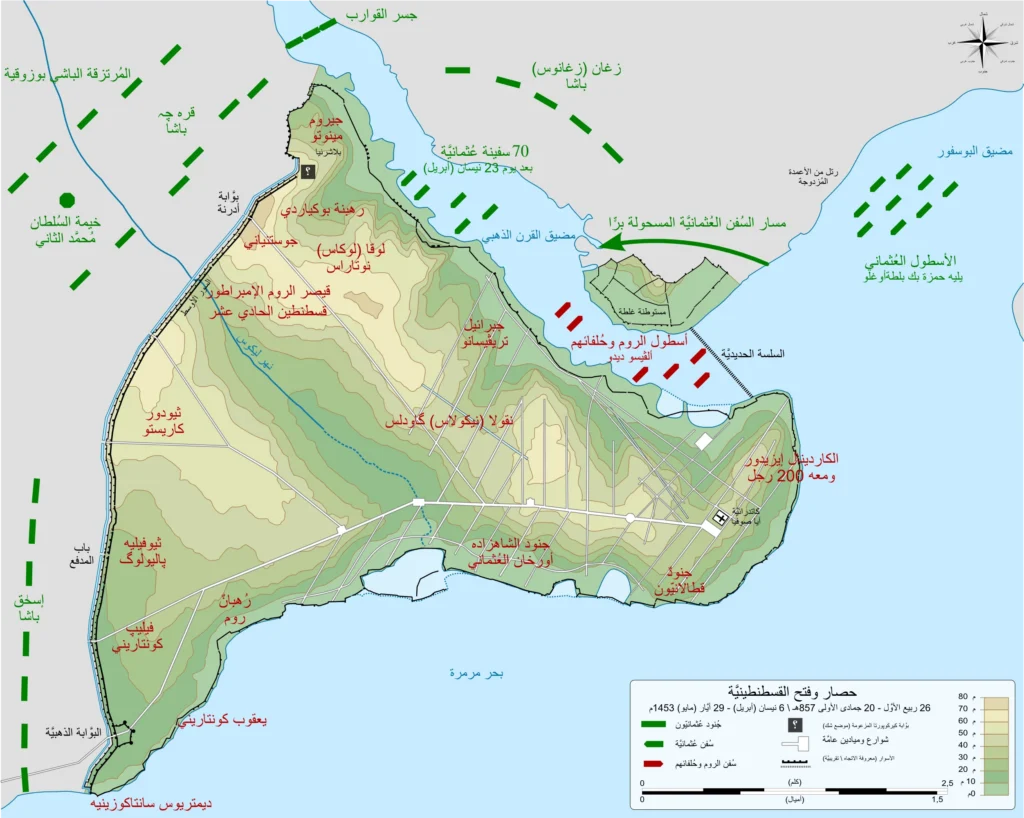
Despite the unprecedented firepower, the defenders fought with extraordinary tenacity. They repelled multiple assaults, repaired the walls each night with earth, timber, and rubble, and even managed to break through the Ottoman naval blockade when three Genoese ships carrying papal supplies, accompanied by a large Byzantine grain ship, slipped past the Turkish fleet on April 20.[s] Mehmed, infuriated by his navy’s failure, devised a stunning countermeasure: he built a greased wooden ramp across the hills behind the Genoese colony of Galata and portaged some 70 ships overland into the Golden Horn, bypassing the great chain that blocked the harbor.[s]
The Last Day of Rome
By late May, the defenders were exhausted. Mehmed offered Constantine safe passage to the Peloponnese, but the emperor refused.[s] In the early hours of May 29, Mehmed launched his final assault. First came waves of irregulars and conscripts, then better-armed regulars, and finally 3,000 elite Janissaries from the sultan’s own palace regiment.[s]
The turning point came when the Genoese commander Giovanni Giustiniani, who had led the land defense with remarkable skill, was mortally wounded by Ottoman gunfire on the ramparts. His withdrawal sowed confusion among the defenders.[s] The Janissaries surged forward and took the inner wall at the Gate of St. Romanus. Ottoman flags rose above the battlements.
Emperor Constantine XI reportedly discarded his imperial regalia and charged into the Ottoman ranks. His body was never recovered.[s] As Barbaro recorded, “the blood flowed in the city like rainwater,” and around 60,000 people were taken in chains to the Ottoman camps as slaves.[s] That afternoon, Mehmed rode through the conquered streets to the Hagia Sophia, the greatest cathedral in Christendom, and ordered it converted into a mosque.[s]
What Fell with the Walls
Constantinople 1453 did not just end a city’s independence. It extinguished the last living link to the Roman Empire, a continuous political tradition stretching back to Augustus. Mehmed, now styled “the Conqueror,” began calling himself Kayser-i Rûm, “Caesar of Rome,” claiming the imperial inheritance for himself.[s]
The consequences rippled across the Mediterranean. Genoa lost its key ally and much of its eastern trade, entering a spiral of decline; by the sixteenth century, the republic became heavily dependent on the Spanish-Habsburg system while remaining formally independent after Andrea Doria’s 1528 settlement.[s] Venice, which had helped weaken Byzantium by diverting the Fourth Crusade in 1204, now found itself locked in decades of costly wars against the very power that filled the vacuum.[s] The fear was justified: in 1480, Ottoman forces invaded Southern Italy and seized Otranto, slaughtering some 800 residents who refused to convert.[s]
Yet the destruction also seeded a cultural rebirth. Fleeing Greek scholars carried manuscripts and knowledge westward, decisively influencing the Renaissance in Italy.[s] Ioannis Argyropoulos, who fled Constantinople 1453 for the Peloponnese before reaching Florence, became head of the Greek department at the Florentine Studium, teaching the sons of the Medici.[s] Demetrios Chalkokondyles published the first printed editions of Homer in 1488, making ancient Greek literature available to a mass audience for the first time.[s] The philosopher Georgios Gemistos Plethon had already reintroduced Plato’s ideas to Italy during the Council of Florence in 1439, possibly inspiring Cosimo de’ Medici to found the Platonic Academy.[s]
The event that closed the medieval world also helped open the modern one. Constantinople 1453 remains one of history’s sharpest turning points: the end of Rome, the rise of the Ottomans, the reshaping of Mediterranean power, and an unexpected catalyst for the intellectual revolution that was already transforming Europe.
Constantinople 1453: The Strategic Context
The siege that ended the Byzantine Empire on May 29, 1453 was not a sudden catastrophe but the culmination of a century-long Ottoman strategy of strangulation. By the time Mehmed II assembled his army outside the Theodosian Walls, the Byzantine “empire” controlled little more than the capital itself and a few Aegean outposts. Constantinople’s population had collapsed from roughly 400,000 in the twelfth century to between 40,000 and 50,000, and vast tracts within the walls lay empty.[s] The treasury was bankrupt, the navy negligible, and diplomatic appeals to Western Christendom had yielded little beyond papal demands for ecclesiastical union, which the city’s Orthodox population rejected with riots.[s]
Mehmed’s preparations were systematic. In 1452, he secured peace treaties with both Hungary and Venice, neutralizing potential intervention. He constructed the fortress of Rumelihisarı at the narrowest point of the Bosporus, establishing a chokepoint that effectively sealed Constantinople from Black Sea resupply.[s] When a Venetian ship defied the new blockade, Mehmed’s batteries sank it and had its captain decapitated and impaled.[s]
The Artillery Revolution at Constantinople 1453
The siege of Constantinople 1453 represented a watershed in military technology. The Hungarian engineer Orbán had first offered his cannon-casting expertise to Emperor Constantine XI, but the Byzantine treasury could not afford bronze weapons. Orbán defected to Mehmed, who offered four times the original asking price.[s]
The resulting Basilica cannon measured 27 feet in length, with a barrel diameter of 30 inches walled with 8 inches of solid bronze, designed to accommodate a stone shot exceeding half a ton.[s] In a test firing outside the palace at Edirne in January 1453, the projectile traveled a mile before burying itself six feet into soft earth. Moving the weapon 140 miles to Constantinople required 200 men, 60 oxen, and weeks of road-building ahead of the convoy, which advanced at a pace of two and a half miles per day.[s]
The Ottoman artillery train comprised approximately 69 cannons organized into 14 or 15 batteries, each large bombard supported by clusters of smaller guns in a formation the Ottoman gunners called “the bear with its cubs.”[s] Mehmed’s total force numbered between 60,000 and 80,000 troops, with a fleet of 31 large and midsize warships plus nearly 100 smaller vessels.[s]
The Bombardment and Its Limits
On April 12, 1453, the first concerted artillery barrage in recorded history erupted along a four-mile front.[s] The eyewitness Nicolò Barbaro, a Venetian physician stationed with the defenders, documented a cannon at the Gate of St. Romanus throwing “a ball weighing about twelve hundred pounds.”[s]
The Basilica itself proved problematic. Impurities in the cast bronze meant that intense heat and shock created hairline fractures after each firing. Crews soaked the barrel in warm oil to prevent cold air from widening the fissures, but the gun eventually cracked and had to be repaired with iron hoops before cracking again.[s] In the end, the slightly smaller bombards inflicted the decisive structural damage, particularly after a visiting Hungarian observer advised Ottoman gunners to fire in triangular patterns, with smaller guns making two outer hits and a large gun completing the triangle through the weakened center.[s]
The defenders proved resourceful. They constructed makeshift barriers of earth, timber, brushwood, and barrels of soil that actually absorbed cannon shot more effectively than rigid masonry. Barbaro records nightly repair operations in which men and women carried materials from the city to rebuild breaches before dawn.[s] Byzantine sappers also defeated multiple Ottoman mining operations through countermining, flooding, and the use of Greek Fire in underground tunnels.[s]
The Naval Dimension and the Final Assault
The Ottoman portage of approximately 70 ships overland on greased logs into the Golden Horn, bypassing the great chain, was a logistical masterstroke that enclosed the city completely.[s] With defenders now forced to man the weaker sea walls in addition to the land defenses, the garrison was stretched to breaking.
The final assault on May 29 followed a calculated three-wave structure: irregulars to exhaust the defenders, regulars to probe weaknesses, and 3,000 elite Janissaries from the sultan’s own palace regiment as the decisive strike force.[s] The mortal wounding of the Genoese commander Giovanni Giustiniani during the third wave caused a cascade of confusion among the defenders, allowing the Janissaries to take the inner wall at the Gate of St. Romanus.[s]
Barbaro’s account captures the aftermath starkly: “The blood flowed in the city like rainwater,” with around 60,000 people taken as slaves.[s] According to the World History Encyclopedia account, approximately 4,000 were killed outright and over 50,000 enslaved.[s]
Geopolitical and Cultural Aftermath
Mehmed, now al-Fatih (“the Conqueror”), declared himself Kayser-i Rûm, “Caesar of Rome,” asserting direct continuity with the Roman imperial tradition.[s] He repopulated the city with people of diverse backgrounds and faiths, transforming Constantinople into Istanbul, the multicultural capital of a multicultural empire. The Hagia Sophia, Christendom’s greatest cathedral for nearly a millennium, became a mosque that afternoon.[s]
The consequences of Constantinople 1453 for the Mediterranean balance of power were profound. Genoa’s eastern commerce collapsed, precipitating a political crisis that culminated in the republic’s submission to Spain.[s] Venice was drawn into a grinding series of wars against the Ottomans, from Cyprus to Albania, that weakened the republic over decades.[s] The Ottoman threat became tangible in 1480, when Turkish forces seized Otranto in Southern Italy, massacring approximately 800 inhabitants who refused conversion.[s]
The Greek Intellectual Diaspora
The refugees who fled Constantinople 1453 carried with them something the Ottomans could not seize: the intellectual heritage of Greco-Roman civilization. Byzantine scholars had already been migrating to Italy for decades, but the fall accelerated the exodus dramatically.[s] These refugees included grammarians, humanists, philosophers, scientists, and scribes, and they brought manuscripts from the destroyed libraries of Constantinople.[s]
The impact on the Italian Renaissance was transformative. Ioannis Argyropoulos, who fled to the Peloponnese after the fall before reaching Italy in 1456, became head of the Greek department at the Florentine Studium, where his pupils included Lorenzo de’ Medici and the young Leonardo da Vinci.[s] Demetrios Chalkokondyles, originally from Athens, became the first person to publish printed editions of Homer’s works in 1488, fusing Byzantine learning with Gutenberg’s invention.[s] Earlier, Georgios Gemistos Plethon had reintroduced Platonic philosophy to Florence at the Council of Florence in 1439, an influence so powerful that Cosimo de’ Medici may have founded the Accademia Platonica as a direct result.[s]
Constantinople 1453 thus occupies a paradoxical place in historiography: the catastrophe that ended the medieval world simultaneously helped spark the intellectual revolution that defined the early modern one. The Roman Empire‘s final chapter was also, in an unexpected sense, the prologue to the Renaissance.