In 476 CE, a Germanic chieftain named Odoacer forced the last Western Roman emperor to abdicate. The western half of Rome’s empire was finished. Yet in Constantinople, the eastern half barely flinched. Byzantine Empire survival was not an accident or a stroke of luck: it was the product of strategic geography, adaptive institutions, and a governing class that consistently chose pragmatism over pride. The result was an empire that endured from 330 CE until 1453, outlasting its western counterpart by nearly a thousand years.
Why the East Survived When the West Fell
The split between east and west began in earnest under Emperor Diocletian in the late 3rd century, when the empire’s sheer size made centralized rule impractical. By the time Theodosius I died in 395 CE, his sons Arcadius and Honorius governed two effectively separate states.[s] The western half deteriorated rapidly under barbarian pressure, economic collapse, and political fragmentation. The eastern half, centered on Constantinople, had structural advantages the west lacked: a wealthier tax base, shorter frontiers, and a capital that was nearly impossible to take by force.
Constantinople: A Capital Built for Byzantine Empire Survival
Constantine I chose wisely when he refounded the ancient Greek city of Byzantium as his new capital in 330 CE. Situated on the Bosporus strait, Constantinople sat at the crossroads of Europe and Asia, controlling maritime traffic between the Mediterranean and the Black Sea.[s] The city stood on a rocky peninsula. Attacking it from the sea meant fighting strong currents, and the Golden Horn estuary provided a natural harbor that could be sealed with a 300-meter chain.[s]
There was only one viable land approach, and the Byzantines turned it into the most formidable defensive barrier in the medieval world: the Theodosian Walls.
The Theodosian Walls: 800 Years of Defiance
Alarmed by Rome’s fall to the Goths in 410 CE, the young Emperor Theodosius II ordered a massive line of triple fortifications across the peninsula. Completed by 439 CE, the walls stretched 6.5 kilometers from the Sea of Marmara to the Golden Horn.[s] Attackers first had to cross a 20-meter-wide, 7-meter-deep ditch that could be flooded with water. Behind it stood an outer wall, then a middle wall with towers, and finally the massive inner wall: 12 meters high, nearly 5 meters thick, and bristling with 96 projecting towers capable of holding artillery.[s]
The distance between the outer ditch and inner wall was 60 meters, and the height difference was 30 meters. Siege engines could not get close enough to threaten the main fortification. These walls kept Constantinople unconquered for 800 years, repelling Persians, Avars, Arabs, Bulgars, and Rus Vikings before the Fourth Crusade captured the city in 1204 by assaulting the weaker sea-wall sector along the Golden Horn, rather than overcoming the land fortifications themselves.[s]
Governance That Bent Without Breaking
Byzantine Empire survival depended on more than walls. The empire’s administrative system evolved constantly. In the 7th century, facing Arab armies that had already swallowed Syria, Egypt, and North Africa, the Byzantines created the theme system. This replaced the old Roman model of separate civil and military authorities with unified provincial commands.[s] Land was granted to farmers who, in return, provided the empire with soldiers. The state retained ownership of the land and leased it in exchange for hereditary military service.[s]
This was a calculated trade. The Byzantines abandoned the professional standing army inherited from Rome and built something cheaper, more resilient, and rooted in the provinces. The theme system allowed the empire to defend Anatolia, its economic heartland, even as it lost its richest provinces to the Islamic Caliphate.
Byzantine governance was also remarkably meritocratic. The title of emperor was not strictly hereditary. Justinian I, widely regarded as one of the empire’s greatest rulers, was born a Macedonian peasant. Basil I came from similarly humble origins.[s] The bureaucracy employed eunuchs in key administrative and military roles precisely because they could not found dynasties, reducing the risk of power grabs.
Diplomacy Over War
One golden rule defined Byzantine foreign policy: avoid wars at almost all costs. Byzantine rulers understood that even a victory was a net loss if it depleted the soldiers and treasury needed to face the next threat.[s] Wars were expensive, and bribing the enemy or finding a diplomatic resolution was almost always cheaper.
The empire ran what amounted to a proto-ministry of foreign affairs: the “Office of Barbarian Affairs.” This bureau housed interpreters and translators, prepared envoys for missions abroad, analyzed incoming diplomatic reports, organized visits by foreign dignitaries, and prepared international treaties.[s] It also functioned as an intelligence service, maintaining networks of official and unofficial agents, including merchants, missionaries, and military officers, who gathered information from neighboring states.
Edward Luttwak, in The Grand Strategy of the Byzantine Empire, argues that the Byzantines relied less on military strength and more on persuasion: recruiting allies, dissuading threatening neighbors, and manipulating potential enemies into attacking one another.[s] Ideally, barbarians should be paid to go away or redirected against other threats rather than fought. This approach to Byzantine Empire survival proved far more sustainable than the western empire’s reliance on military force.
Greek Fire: The Secret Weapon
When diplomacy failed, the Byzantines had a technological trump card. Greek Fire was an incendiary weapon first deployed in 678 CE, credited to a Christian Greek refugee named Kallinikos who fled Muslim-held Syria for Constantinople.[s] The liquid burned on water and could not be extinguished with water; sources describe sand, vinegar, and similar countermeasures as among the few effective responses. It was sprayed under pressure from bronze siphons mounted on warships, and its composition was a state secret so closely guarded that the formula has been lost entirely.
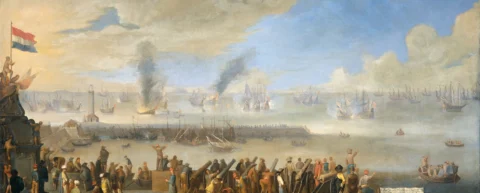
Greek Fire proved decisive during the Arab siege of Constantinople from 674 to 678 CE, when Byzantine ships sailed out spouting flames and routed the Arab fleet. The weapon repeated its performance against another Arab blockade in 717 to 718 CE.[s] It was also used to devastating effect against Russian fleets in 941 and 1043 CE. Emperor Romanos II declared three things must never reach foreign hands: the imperial regalia, a royal princess, and Greek Fire. The first two were occasionally given away; the third never was.[s]
A Pattern of Resilience
Byzantine Empire survival was never guaranteed. The Plague of Justinian beginning in 541 CE killed millions. The 7th-century Arab conquests stripped away the empire’s wealthiest provinces. The Battle of Manzikert in 1071 cost the empire most of Anatolia.[s] The Fourth Crusade sacked Constantinople in 1204. Each time, the empire contracted, reorganized, and recovered. Even after 1204, variant forms of the empire reconstituted themselves, and the Empire of Nicaea retook Constantinople in 1261.
The final fall came on May 29, 1453, when Ottoman cannons, firing 1,500-pound stone cannonballs, breached the Theodosian Walls that had stood for over a millennium.[s] Emperor Constantine XI refused to flee. According to tradition, he removed his imperial regalia and charged into the Ottoman lines, dying alongside his soldiers.
The Byzantine Empire was among Europe’s longest-lived imperial states, lasting about 1,123 years if counted from Constantinople’s refounding in 330 to the Ottoman conquest in 1453. The formula was never one thing: it was the combination of an impregnable capital, an administrative system willing to reinvent itself, a diplomatic tradition that treated war as a last resort, and a strategic geography that bought the time needed for all of those advantages to work.
In 476 CE, the Germanic warlord Odoacer deposed Romulus Augustulus, the last Western Roman emperor, sending the imperial insignia to Constantinople. The western empire’s collapse, long anticipated, changed remarkably little in the east. Byzantine Empire survival across the following millennium was not a simple continuation of Roman power; it required repeated structural transformation, strategic recalculation, and institutional adaptation that historians have only recently begun to analyze on its own terms rather than as an epilogue to Rome’s story.
Structural Advantages of the Eastern Empire
The division of the empire, formalized by Diocletian’s Tetrarchy in 293 CE and made permanent after Theodosius I’s death in 395 CE, left the eastern half with significant structural advantages.[s] The eastern provinces held the empire’s wealthiest cities, including Antioch, Alexandria, and Constantinople itself. The eastern frontier, while contested, was a single front facing the Sassanid Persians, a peer competitor with whom diplomatic protocols already existed. By contrast, the west faced simultaneous pressure from Goths, Vandals, Huns, and Franks across a sprawling frontier it could not adequately garrison.
Constantinople’s geographic position on the Bosporus gave the eastern empire a capital that doubled as a commercial chokepoint and a natural fortress. According to the founding legend, the ancient Greek prince Byzas chose the site after the oracle of Delphi told him to settle “opposite the land of the blind,” referring to the Chalcedon colony in Asia Minor, whose inhabitants had failed to recognize the European shore’s superiority.[s] The location ensured the city could be supplied by sea during any siege, a tactical advantage exploited repeatedly over the following centuries.
Byzantine Empire Survival Through Fortification
The Theodosian Walls, commissioned after Rome’s sack by the Goths in 410 CE and supervised by Praetorian Prefect Anthemius, represent one of the most sophisticated defensive systems ever constructed. The triple fortification stretched 6.5 kilometers across the peninsula, expanding the city’s enclosed area by five square kilometers.[s]
The system comprised a 20-meter-wide, 7-meter-deep moat fed by an engineered pipe system; an outer patrol wall; a middle wall with regularly spaced towers and an interior firing terrace; and the massive inner wall, 12 meters high, nearly 5 meters thick, presenting 96 projecting towers at 70-meter intervals. Each tower reached 20 meters in height and could hold up to three artillery machines.[s] The towers on the middle wall were deliberately offset from those on the inner wall to avoid blocking fields of fire.
After the earthquake of 447 CE, the walls were rebuilt with an additional outer curtain and the moat system, completing the configuration that would define Constantinople’s defenses for the next thousand years. The fortifications survived the Arab siege of 674 to 678 CE, another Arab siege involving 1,800 ships and 80,000 men in 717 CE, and attacks by Thomas the Slav in 821 CE, Russian forces in 860, 941, and 1043 CE, and Bulgar armies across multiple centuries.[s]
The Theme System: Administrative Revolution
The theme system (themata), established in the mid-7th century, represented the most consequential administrative reform in the empire’s history. The themes replaced Diocletian’s provincial system with military-administrative districts whose commanders, the strategoi, held unified civil and military authority. This abolished the traditional Roman separation between civil governors (praesides) and military commanders (duces), returning to a model closer to the Roman Republic’s provincial governorships.[s]
The economic basis was equally transformative. Soldiers received land grants from the state in exchange for hereditary military service. The state retained ownership of the land, distinguishing this system from Western European feudalism where land passed to vassals outright.[s] This gave the empire a self-sustaining military system when its treasury could no longer support the professional standing armies of the late Roman model. As historian Anthony Kaldellis notes in his review of Luttwak’s work, the standard view holds that the Byzantines “preferred persuasion and co-option over decisive battles,” a strategy the theme system supported by ensuring that territorial defense was locally embedded rather than dependent on central deployment.[s]
The theme system reached its apex in the 9th and 10th centuries as older themes were subdivided and conquests created new ones. Its decline came under the Komnenian dynasty in the 11th and 12th centuries, when Alexios I Komnenos replaced thematic forces with a centralized army heavily reliant on mercenaries, including the renowned Varangian Guard.
Diplomatic Infrastructure and Byzantine Empire Survival
Byzantine diplomacy was arguably the empire’s most distinctive contribution to statecraft. The “Office of Barbarian Affairs” functioned as a proto-ministry of foreign affairs, maintaining archives, preparing envoys, analyzing diplomatic reports, and managing visits by foreign dignitaries.[s] A proto-intelligence service employed networks of merchants, missionaries, and military officers as information-gathering agents abroad.
The Byzantines inherited and synthesized diplomatic practices from multiple civilizations: elaborate protocol and dynastic marriage from the ancient Near East, rhetorical tools from the Greek city-states, and divide-and-conquer tactics from Rome.[s] They added innovations of their own, particularly in the use of soft power. The conversion of Slavic tribes to Christianity, the education of future neighboring rulers in Constantinople’s schools, and the spectacular court ceremonies in the Magnaura throne room, where the emperor sat on an automated golden throne surrounded by roaring golden lions and tweeting golden birds, all served to project imperial power without military expenditure.[s]
Luttwak’s thesis, while debated by Byzantinists, identifies the confrontation with Attila and the Huns as the pivotal moment when diplomacy became the empire’s primary strategic instrument. The successful deflection of Attila toward the western empire through monetary persuasion rather than military confrontation established a template that would persist for centuries.[s] Kaldellis notes, however, that this framing oversimplifies: the Byzantines had already been dealing with Gothic warlords “in a typically ‘Byzantine’ way” for a century before Attila, and the eastern armies were likely not as outmatched as Luttwak suggests.
Greek Fire and Technological Adaptation
Greek Fire, an incendiary weapon first deployed during the Arab siege of 674 to 678 CE, represents the empire’s capacity for technological innovation under existential pressure. Credited to Kallinikos, a Christian refugee from Muslim-held Heliopolis, the weapon consisted of a flammable liquid, likely based on light petroleum or naphtha combined with quicklime, sulphur, resin, and possibly other compounds, projected under pressure through bronze siphons mounted on warships.[s]
The weapon’s psychological and tactical impact was enormous. The Byzantine historian Theophanes recorded that it “caused enemies to shiver in terror.”[s] Liutprand of Cremona, describing a Byzantine engagement in 941 CE, wrote that “the Rusii seeing the flames threw themselves in haste from their ships, preferring to be drowned in the water rather than burned alive in the fire.”[s] Greek Fire burned on water, could not be extinguished, and its formula was a state secret so closely guarded that it has never been recovered.
Decline, Recovery, and Final Fall
The arc of Byzantine Empire survival is not a story of steady endurance but of repeated catastrophe and recovery. The Plague of Justinian (541 CE) devastated the population. The 7th-century Arab conquests removed Egypt, Syria, and North Africa from imperial control. The Battle of Manzikert in 1071 cost the empire most of Anatolia and, critically, the manpower base that sustained the theme system.[s] Anna Komnene wrote that “the fortunes of the Roman Empire had sunk to their lowest ebb.”[s]
The Fourth Crusade’s sack of Constantinople in 1204 was the wound from which the empire never fully recovered. The Latin Empire of Constantinople lasted until 1261, when the Nicaean successor state retook the capital, but the restored empire was a diminished entity. By the 15th century, the “empire” controlled little more than Constantinople itself and parts of the Peloponnese, its population reduced from a peak near 500,000 to fewer than 40,000.[s]
On May 29, 1453, Ottoman cannons firing 1,500-pound stone cannonballs breached the Theodosian Walls. The last emperor, Constantine XI, reportedly said: “God forbid I should live as an emperor without an Empire. As my city falls I will fall with it.”[s] He charged into the Ottoman advance and was killed. The line of Roman emperors, stretching back to Augustus, ended.
Byzantine Empire survival lasted 1,123 years. The empire’s longevity rested on no single factor but on the interplay of impregnable fortifications, adaptive governance, disciplined diplomacy, technological innovation, and the strategic geography of a capital positioned at the hinge of two continents. Modern historians increasingly study the Byzantine state not as Rome’s afterthought but as one of the most successful exercises in political adaptation in recorded history.