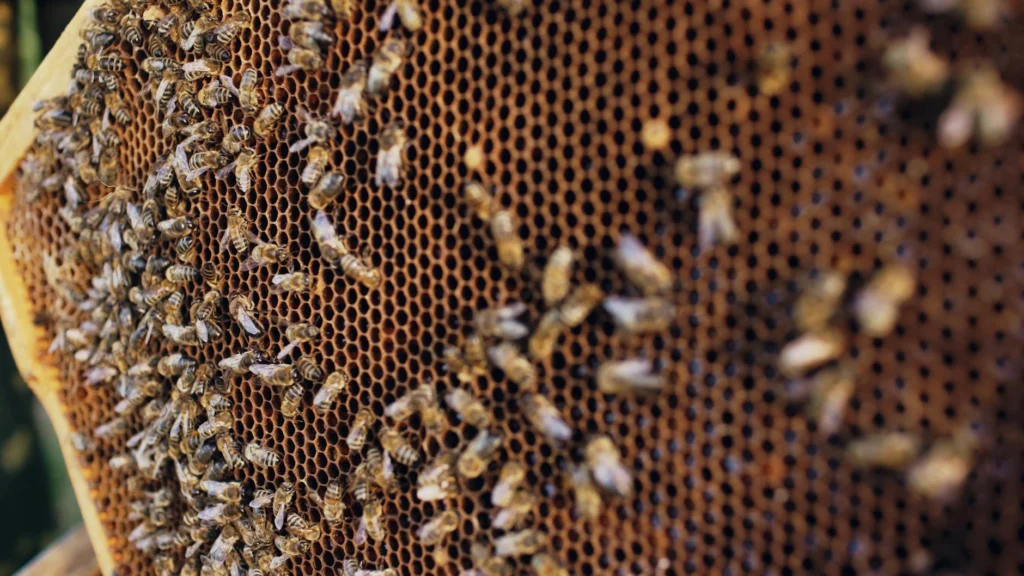
By spring 2025, American commercial beekeepers had lost 1.7 million colonies since the prior summer, more than 60% of commercial beekeeping colonies, with an estimated financial impact of $600 million.[s] For April 2024 to April 2025, the U.S. Beekeeping Survey estimated annual managed-colony losses at 55.6%, the highest recorded since formal tracking began in 2010.[s] These numbers invite an obvious question: what killed the bees?
The answer is not a single culprit. Parasitic mites, viruses, pesticides, poor nutrition, and climate stress all contribute. But the more important question is different: why do colonies that seemed healthy yesterday collapse so suddenly today? The answer to that question is mathematical.
The Colony as a Mathematical System
A honeybee colony is not just a group of insects. It is a superorganism, a collective entity where tens of thousands of individuals function as a single biological unit. Steven Coy, president of the American Honey Producers Association, told Food Tank that a colony is a superorganism and that mite pressure or poor nutrition can become the tipping point for colony death.[s]
That phrase “tipping point” is not a metaphor. Mathematical models of bee colony collapse show how colonies can operate near critical thresholds. Below a threshold, a modeled colony can absorb stress and recover. Above it, collapse risk can rise sharply. The math helps explain why bee losses do not always accumulate gradually; they can arrive as sudden catastrophes.
Two Critical Thresholds
A 2026 study published in Scientific Reports developed a mathematical model of how the gut parasite Nosema ceranae spreads through colonies. The researchers identified two critical thresholds governing whether infection is cleared, persists, or cycles.[s]
The first threshold is called a transcritical bifurcation. It marks the boundary between disease eradication and endemic persistence. If infection pressure stays below this threshold, the model clears the parasite. If it crosses the threshold, the infection becomes persistent.
The second threshold is a Hopf bifurcation. This one emerges when resources for treatment become limited. Beyond this point, the colony enters sustained oscillations, cycles of infection and partial recovery that repeat endlessly. The researchers describe what happens at this boundary: “The coexistence of stable equilibria and periodic orbits highlights bistability, indicating that small perturbations or change in control interventions can trigger large amplitude outbreaks.”[s]
Bistability means the model can settle into different stable regimes. A small push at the wrong moment can tip it from one regime to the other. That does not prove every real-world collapse has one mathematical switch, but it shows why colony health can change abruptly near a threshold.
Understanding Mathematical Systems
The mathematics here belongs to a field called dynamical systems theory. Researchers use differential equations to model how populations change over time. A systematic review of 107 publications on pollinator modeling, published in September 2025, catalogued the mathematical tools scientists use: ordinary differential equations, partial differential equations, network models, stochastic models, and delay equations.[s] The review concluded that “the problem associated with pollinators is complex and should be analyzed from multiple scientific perspectives, particularly biology, chemistry, and mathematics.”
These mathematical systems have limits. They simplify reality to make analysis tractable. But they reveal patterns invisible to observation alone, including the existence of thresholds where colony behavior changes qualitatively. Understanding mathematical systems does not guarantee prediction, but it identifies the variables that matter most.
The Amitraz Resistance Crisis
USDA identified a proximate cause of the 2024-2025 collapse: parasitic mites that had become resistant to a widely used treatment. USDA researchers sampled mites from collapsed colonies and found that “this miticide resistance was found in virtually all collected Varroa.”[s] The miticide amitraz had been a critical defense against Varroa destructor. When it stopped working, mite control failed.
The mites harm bees directly and also vector viruses. USDA analysis identified “high levels of deformed wing virus A and B and acute bee paralysis in all recently USDA-sampled bees.”[s] A separate metagenomic study of California colonies found that weak colonies harbored 3.6 times more viral species than strong colonies.[s]
In mathematical terms, the loss of mite control shifted colonies closer to their critical thresholds. Conditions that colonies had tolerated before could become more dangerous once mite pressure and viral load crossed critical levels.
The Winter Timing Failure
A separate mathematical model, also published in Scientific Reports, revealed another mechanism by which stressors can contribute to bee colony collapse: they disrupt seasonal timing.
The cited model estimated dramatically different seasonal “apparent longevity” for colonies: about 20 to 30 days from late April to late September, extending to 160 to 200 days by the end of wintering.[s] Long-lived winter workers are essential. They must survive months without the same level of brood replacement. If winter longevity fails to extend, the colony can collapse before spring.
The researchers found that “abnormal seasonal changes in longevity, which does not extend even if winter approaches, are shown for the bee-colony ingesting neonicotinoid-containing pollen and for the colony infested with Varroa mites.”[s] The authors inferred that neonicotinoid-containing pollen and Varroa infestation can damage the colony’s ability to adjust for winter. Workers can keep dying at shorter-lived seasonal rates, and the population can crash.
Collective Behavior at the Critical Point
The mathematical signature of collapse extends beyond population models. A 2025 arXiv study reported that honeybee movement inside the hive exhibits characteristics of a critical phase transition, a family of mathematics used to study abrupt changes such as magnetic ordering. The researchers found that “the collective behavior of numerous animal species, including insects, exhibits scale-free behavior indicative of the critical (second-order) phase transition.”[s]
Systems operating near critical points are exquisitely sensitive. Small perturbations propagate across the entire system rather than being absorbed locally. This may explain why colonies tolerate stress until they suddenly do not: they operate near the edge of a phase transition, where resilience and fragility coexist.
Early Warning Through Temperature
If collapse has mathematical signatures, can we detect it early? A 2025 study on arXiv analyzed temperature data from 22 hives, including 3 that collapsed. Healthy hives maintain precise temperature control near the brood area. The researchers found “statistical signatures of stress that reveal whether honeybees are doing well or are at risk of failure.”[s]
They proposed a simple scale: stable, warning, and collapse. In that framework, degraded temperature control can reveal risk before collapse is obvious to human observers.
Accelerated Aging and the Premature Exit
Another mathematical model, published in Apidologie in 2025, examined how stress affects worker bee development. The researchers discovered that developmental stress causes young workers to exit the hive before they can fly, leading to premature death. They found that “higher rates of premature hive exiting behavior can accelerate colony collapse.”[s]
The model identified interventions that can reverse the collapse trajectory: “Our results suggest that both supplemental feeding and implementing brood breaks can bring a colony back from the brink of collapse.”[s] A brood break, where the queen stops laying eggs temporarily, interrupts the mite reproductive cycle. Supplemental feeding addresses nutritional deficits. Both interventions shift the colony away from its critical threshold.
Gene Editing Technology Addresses Nutrition
In August 2025, an Oxford-led team reported a potential breakthrough in colony nutrition. Using gene editing technology, the researchers engineered yeast to produce six essential sterols that bees normally obtain from pollen. In controlled glasshouse trials, colonies fed the sterol-enriched yeast reared up to 15 times more larvae to the viable pupal stage than colonies fed control diets.[s]
The Oxford release cautioned that larger field trials are still needed to assess long-term effects on colony health and pollination efficacy.[s]
This addresses a mathematical reality: if worker death rates exceed birth rates for long enough, the population crashes. Boosting larval survival shifts the demographic balance back toward stability.
The Workshop for New Mathematics
The urgency of bee colony collapse has drawn mathematicians into direct collaboration with biologists and beekeepers. The American Institute of Mathematics scheduled a March 30 to April 3, 2026 workshop specifically to “develop high-dimensional, nonlinear, and non-smooth models capturing the interplay of environmental change, agrochemical exposure, disease, and habitat fragmentation.”[s]
The workshop agenda called for applying reinforcement learning and Bayesian inference to predict collapse thresholds. The goal is decision-support tools for beekeepers and policymakers, with interventions timed to keep colonies away from critical boundaries.
What the Math Reveals
Bee colony collapse is not only a mystery of individual causes. It is also a mathematical problem with identifiable structure. Colonies can behave as dynamical systems near critical thresholds. Multiple stressors, mites, viruses, pesticides, and poor nutrition, all push colonies toward those thresholds. When thresholds are crossed, model trajectories can move sharply toward collapse.
The mathematical limits of any single intervention become clear in this framework. Killing mites is necessary but not sufficient if nutritional stress or pesticide exposure has already moved the colony close to its threshold. Effective management requires monitoring multiple variables and intervening before critical boundaries are approached.
The 1.7 million colonies lost in 2024-2025 were not killed by a single cause. They fit a pattern in which accumulated stressors push colony systems toward tipping points. Understanding that structure is the first step toward preventing the next collapse.
By spring 2025, American commercial beekeepers had lost 1.7 million colonies since the prior summer, more than 60% of commercial beekeeping colonies, with an estimated financial impact of $600 million.[s] For April 2024 to April 2025, the U.S. Beekeeping Survey estimated annual managed-colony losses at 55.6%, the highest recorded since formal tracking began in 2010.[s] USDA identified amitraz-resistant Varroa destructor and the viruses they vector as a proximate cause. But the deeper question is why colonies transition from stable to collapsing states so abruptly. The answer lies in nonlinear dynamics.
Colony Dynamics as a Nonlinear System
A honeybee colony functions as a superorganism: a collective entity where tens of thousands of individuals maintain homeostasis through distributed feedback. Steven Coy, president of the American Honey Producers Association, told Food Tank that a colony is a superorganism and that mite pressure or poor nutrition can become the tipping point for colony death.[s]
Mathematically, colonies are modeled as systems of coupled ordinary differential equations (ODEs). The state variables typically include susceptible, infected, and recovered worker populations, along with terms for brood production, forager attrition, and pathogen load. A 2025 systematic review of 107 pollinator-modeling publications catalogued the mathematical frameworks in use: “ordinary differential equations, partial differential equations, graph theory, difference equations, delay differential equations, stochastic equations, numerical methods, and other types of theories, like fractional order differential equations.”[s]
Bifurcation Analysis of Nosema Dynamics
A 2026 study in Scientific Reports formulated a nonlinear SIRS (Susceptible-Infected-Recovered-Susceptible) model for Nosema ceranae dynamics incorporating resource saturation in treatment capacity. The analysis identified two bifurcation points governing infection dynamics.[s]
The first is a forward (transcritical) bifurcation marking the transition from disease-free equilibrium to endemic persistence. Below the critical transmission threshold, the parasite population converges to zero. Above it, infection becomes persistent.
The second is a Hopf bifurcation induced by resource limitations in treatment capacity. When the infected population exceeds available intervention resources, the system transitions from a stable equilibrium to a stable limit cycle. The researchers characterize this regime: “The coexistence of stable equilibria and periodic orbits highlights bistability, indicating that small perturbations or change in control interventions can trigger large amplitude outbreaks.”[s]
Bistability means the model can possess different locally stable regimes. Initial conditions and perturbation timing determine which basin of attraction the system enters. For colony-collapse models more broadly, this is the mechanism by which a perturbation can push the state trajectory across a boundary into a declining regime.
Age-Structured Population Models
Worker bees exhibit age polyethism: young bees perform in-hive tasks while older bees forage. Mathematical models of bee colony collapse must capture this structure. A 2025 Apidologie study modeled the effects of developmental stress on age-class transitions.[s]
The model incorporated a novel behavioral observation: young workers that experienced developmental stress can exit the hive prematurely, leaving the colony before they can fly and dying on the ground. The researchers found that “higher rates of premature hive exiting behavior can accelerate colony collapse.” The mechanism is accelerated depletion of the hive bee pool, which reduces brood care capacity and triggers a positive feedback loop toward collapse.
The model identified two interventions capable of reversing collapse trajectories: “Our results suggest that both supplemental feeding and implementing brood breaks can bring a colony back from the brink of collapse.”[s] Brood breaks interrupt mite reproduction; supplemental feeding reduces nutritional stress. Both shift system parameters away from bifurcation thresholds.
Longevity Scheduling and Seasonal Disruption
The cited model estimates colony “apparent longevity” varying seasonally from about 20-30 days in the active season to 160-200 days near the end of wintering.[s] This extension is essential for colony survival through broodless winter months. A 2025 Scientific Reports study developed a mathematical model of apparent longevity and reported that both neonicotinoid-containing pollen and Varroa infestation disrupt the seasonal switch.
The researchers found that “abnormal seasonal changes in longevity, which does not extend even if winter approaches, are shown for the bee-colony ingesting neonicotinoid-containing pollen and for the colony infested with Varroa mites.”[s] The authors inferred that those stressors can damage the colony’s ability to detect the arrival of winter. Workers can continue dying at shorter-lived seasonal rates, and the population can decline through winter until collapse becomes likely.
Viral Load Scaling and Metagenomics
Viral diversity scaled with colony health status in the sampled colonies. A 2026 metagenomic study of 15 California commercial colonies found that weak colonies had 2.2 and 3.6 times the number of viral species on average compared with medium and strong colonies, respectively, along with larger viral read pools despite similar library sizes.[s]
Varroa-vectored viruses (DWV-A, DWV-B, IAPV) were over-represented in weak colonies. USDA analysis of 2025 collapsed colonies identified “high levels of deformed wing virus A and B and acute bee paralysis in all recently USDA-sampled bees.”[s] Amitraz resistance was found “in virtually all collected Varroa,” helping explain the failure of standard mite control protocols.
Critical Phase Transitions
Beyond population dynamics, colony behavior itself may exhibit criticality. A 2025 arXiv study modeled honeybee movement using a 2D cellular automaton and reported that hive activity shows hallmarks of a second-order phase transition: “The collective behavior of numerous animal species, including insects, exhibits scale-free behavior indicative of the critical (second-order) phase transition.”[s]
Systems at criticality exhibit divergent correlation lengths and power-law cluster size distributions. This collective behavior near a critical point maximizes responsiveness but also maximizes sensitivity to perturbation. The mathematical limits of stability become apparent: systems poised at criticality can transition rapidly between qualitatively different regimes.
Early Warning Indicators from Temperature Time Series
If colonies operate near bifurcations, early warning signals may precede collapse. A 2025 arXiv study analyzed temperature time series from 22 hives including 3 that collapsed. Healthy colonies maintain precise thermoregulation; loss of control provides a measurable signature.
The researchers found “statistical signatures of stress that reveal whether honeybees are doing well or are at risk of failure”[s] and proposed a three-state classification: stable, warning, and collapse. This approach treats thermoregulation as a practical early-warning signal.
Nutritional Intervention via Synthetic Biology
Gene editing technology has enabled a targeted nutritional intervention. In August 2025, an Oxford-led team reported using CRISPR-Cas9 to engineer Yarrowia lipolytica yeast to produce six essential pollen sterols. In controlled glasshouse trials, colonies fed the sterol-enriched yeast reared up to 15 times more larvae to the viable pupal stage than colonies fed control diets.[s]
The Oxford release cautioned that larger field trials are still needed to assess long-term effects on colony health and pollination efficacy.[s]
In dynamical systems terms, this intervention increases the brood recruitment rate, shifting the balance between worker death and replacement away from the collapse basin.
High-Dimensional Nonlinear Models
The American Institute of Mathematics workshop description argued that traditional models often struggle to represent interacting factors across spatial and temporal scales. AIM scheduled a March 30 to April 3, 2026 workshop to “develop high-dimensional, nonlinear, and non-smooth models capturing the interplay of environmental change, agrochemical exposure, disease, and habitat fragmentation.”[s]
The workshop agenda called for integrating reinforcement learning and Bayesian inference for collapse threshold prediction. The goal is optimal control frameworks: intervention timing and intensity calibrated to keep colonies away from bifurcation boundaries.
Synthesis: Bee Colony Collapse as a Bifurcation Phenomenon
The mathematical structure of bee colony collapse is becoming clearer. Colonies can be modeled as nonlinear dynamical systems exhibiting bistability and threshold behavior. Multiple stressors, Varroa, viruses, neonicotinoids, nutritional deficits, all shift system parameters toward bifurcation points. When critical thresholds are crossed, model trajectories can move sharply toward collapse.
The 1.7 million colonies lost in 2024-2025 fit a pattern of systems pushed toward stability boundaries. Amitraz resistance weakened a parameter, mite control efficacy, that had helped keep colonies away from threshold. The remaining stress tolerance was insufficient.
The mathematical systems governing colony dynamics exhibit limits: no single intervention can protect colonies from all perturbations. Effective management requires monitoring multiple state variables and intervening before bifurcation boundaries are approached. Temperature time series, viral load assays, and demographic modeling together could provide predictive capacity beyond biological observation alone.