In December 1894, a French military tribunal convicted Alfred Dreyfus of treason. It was the opening move in what became known as the Dreyfus Affair. France then took twelve years to admit it had the wrong man, during which time the French army forged evidence, suppressed exculpatory documents, prosecuted the officers who found the truth, and acquitted the actual spy.
The Dreyfus Affair is sometimes taught as a story about antisemitism. It was that, Dreyfus was Jewish, and his Jewishness was the ambient assumption that made the accusation plausible to people who should have known better. But it is also something else: one of the most thoroughly documented case studies in modern history of how institutions behave when they have made a catastrophic error and cannot bring themselves to fix it.
The Arrest
In September 1894, French counter-intelligence recovered a torn document, the bordereau , from the wastepaper basket of the German military attaché in Paris. The letter offered to pass military secrets to Germany and was unsigned. The Intelligence Section needed a spy. Alfred Dreyfus, an artillery captain on the general staff, was the candidate who fit: he had access to the relevant information, and he was Jewish.
The handwriting analysis that identified the bordereau as Dreyfus’s was contested from the start. Of the experts consulted, opinion was divided \x{2014} some concluded the handwriting did not match his, others said it did. The military proceeded on the basis of those who supported a match. Dreyfus was arrested in October 1894, tried in December before a closed military tribunal, convicted on evidence that included a secret dossier shown to the judges but not to the defense, and sentenced to life imprisonment and public military degradation.
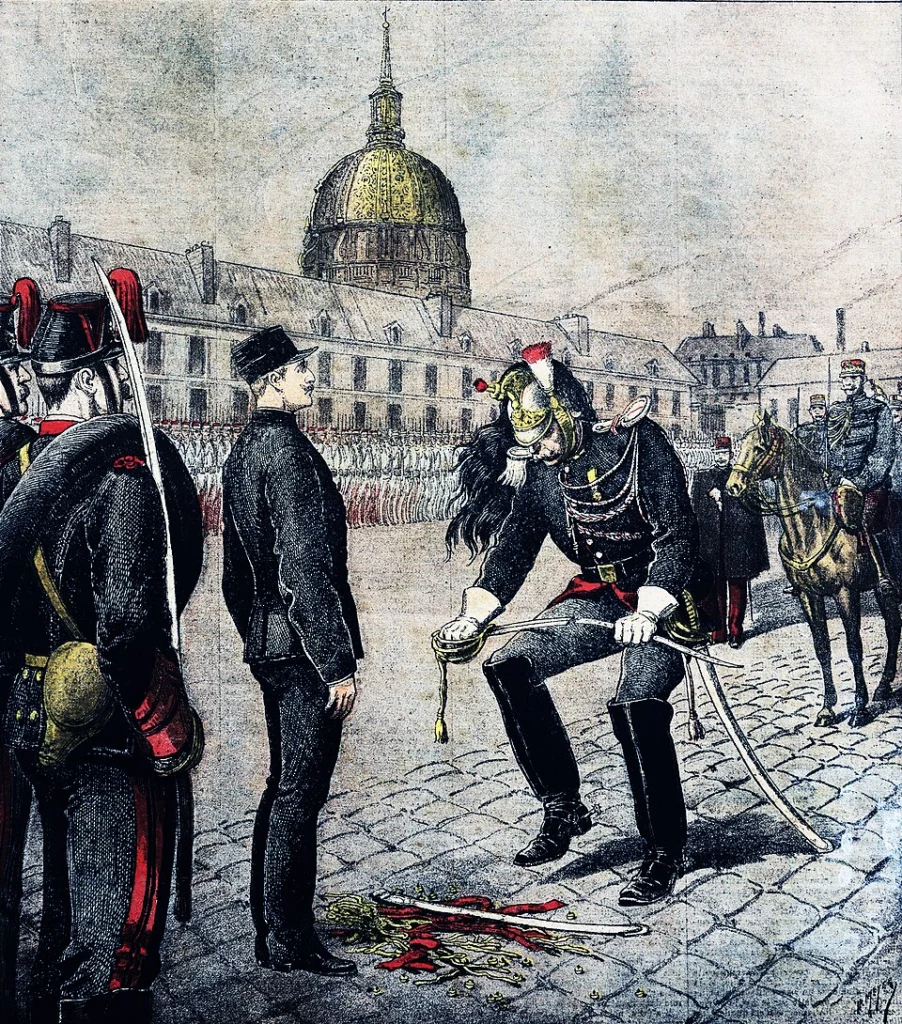
The degradation ceremony was designed to be witnessed. On January 5, 1895, in the courtyard of the École Militaire in Paris, Dreyfus’s rank insignia was stripped from his uniform in front of troops and spectators. He was shipped to Devil’s Island, a French penal colony off the coast of French Guiana, where he would spend the next five years in a stone hut, in the tropics, largely in solitary confinement.
The Wrong Man
The actual author of the bordereau was Ferdinand Walsin Esterhazy, a French army officer with a genuine motive, he was deep in debt and contemptuous of the institution he served. Esterhazy had been passing information to German intelligence since 1893. He was not subtle about it.
The evidence pointing to Esterhazy was identified in 1896 by Lieutenant Colonel Georges Picquart, the new head of the Intelligence Section. Picquart brought his findings to his superiors. His superiors told him to drop it, had him transferred to Tunisia on a series of increasingly dangerous postings, and opened an investigation into Picquart himself on fabricated charges. The army then commissioned the creation of additional forged documents to strengthen the case against Dreyfus, a decision that, when it eventually became public, was difficult to explain away.
The forgeries were produced primarily by Major Hubert-Joseph Henry, who confessed in August 1898 and killed himself in his cell the following morning. Esterhazy had already fled to England by then. The army, faced with a forger who had confessed and a real spy who had run, was left defending a conviction with no remaining foundation.
Zola Intervenes
On January 13, 1898, the newspaper L’Aurore ran a front-page open letter from Émile Zola to the President of France under the headline J’accuse , “I accuse.” The letter named names. It accused specific generals and officers of knowingly convicting an innocent man, suppressing evidence, forging documents, and facilitating the acquittal of the guilty party. Zola explicitly invited prosecution for libel, recognizing that a trial would force the evidence into public view.
He got his trial. He was convicted and fled to England to avoid imprisonment. But the letter had already done its work: it transformed a legal matter into a political crisis that divided French society. The affair split republican from conservative, secular from religious, left from right, and produced a fracture whose effects on French institutional life lasted for decades.
The Second Conviction
Dreyfus was brought back from Devil’s Island in 1899 for a retrial. The retrial was widely expected to result in acquittal; the evidence of forgery and the flight of the actual spy had made the original conviction indefensible on its face. The court found him guilty again, with “extenuating circumstances.” He was sentenced to ten years and then pardoned by the President within days.
A pardon is not an exoneration. The army accepted a pardon arrangement because it meant Dreyfus went free without requiring an official verdict of error. Dreyfus’s family initially refused, accepting a pardon meant accepting that there was something to be pardoned for. Dreyfus himself eventually accepted, because he had been in detention for years and was in poor health.
Full legal exoneration came in 1906. A military commission reviewed the case and annulled the original conviction. Dreyfus was reinstated to the army, promoted, and awarded the Legion of Honor. He served in the First World War. He died in 1935.
What the Dreyfus Affair Actually Demonstrates
The temptation in historical writing is to identify the villain and be done with it. The Dreyfus Affair is not especially useful at that level of analysis. The antisemitism was real and pervasive and necessary, without it, the original accusation does not land and the doubling-down does not make sense. But antisemitism alone does not explain the twelve-year resistance to correction.
What explains it is institutional logic: the army had made a public error and calculated that the cost of admitting it was higher than the cost of sustaining it. A guilty Dreyfus damaged one man. An innocent Dreyfus damaged the tribunal, the general staff, the evidence chain, and the professional credibility of everyone who had handled the case. The institution chose the option that protected the institution.
This pattern, institutional error compounded by institutional defensiveness, is not unique to the French army in 1894. It is recognizable in corporate disaster litigation, in policing, in medicine, in finance. The specific historical moment produces the specific injustice; the underlying mechanism is remarkably consistent. An error is made. Acknowledging it is possible but costly. A cover-up is attempted. The cover-up requires additional errors. The additional errors are harder to contain than the original one.
In the Dreyfus case, the cover-up required forgery. The forgery required the forger to confess and kill himself. At that point the original error, convicting the wrong man on contested handwriting evidence, was structurally minor compared to everything that had been done to sustain it.
The Role of the Press
The affair is also instructive about the press as an institution. The nationalist and anti-Dreyfusard newspapers, La Libre Parole most prominently, were not passive observers. They actively promoted and amplified the case against Dreyfus, treated doubters as traitors, and provided rhetorical cover for the army’s sustained dishonesty. The press did not cause the Dreyfus Affair, but it extended it.
The Dreyfusard press, L’Aurore, which published Zola, served a different function, eventually a corrective one. But it took years. Zola’s letter in 1898 was decisive, but it was published three years after Dreyfus’s conviction. Three years is a long time to wait for a newspaper to tell the truth about a man sitting in a stone hut on a tropical island.
Institutions fail. What corrects them, and how long correction takes, depends on the countervailing pressures that exist: investigative journalism, internal dissenters willing to surface evidence (Picquart paid heavily for his role), political opposition, and public opinion that can be moved. The Dreyfus Affair eventually produced all of these. It also demonstrates how long an institution can resist them before it breaks.