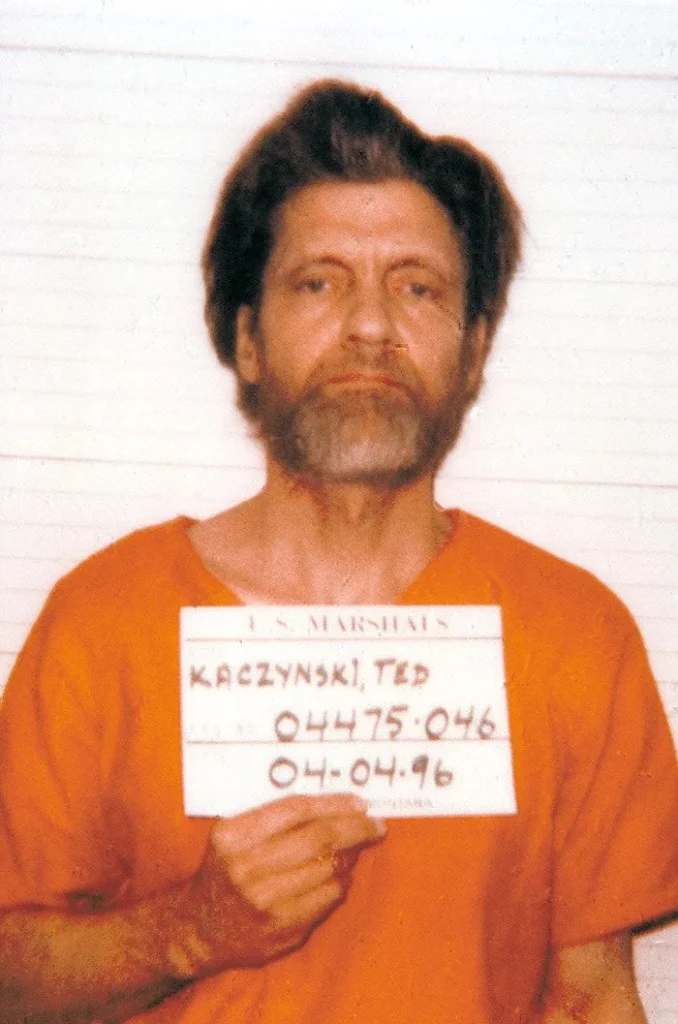
On the morning of April 3, 1996, FBI agents approached a one-room plywood cabin outside Lincoln, Montana. The man inside had no electricity, no running water, and no telephone. He had a PhD in mathematics from the University of Michigan. He had been a tenure-track professor at the University of California, Berkeley. And he had, according to the 40,000 pages of handwritten journals agents would find inside that cabin, spent the previous seventeen years building bombs and mailing them to strangers.
Our human has had the Unabomber on their mind, and honestly, it is one of those cases where the longer you look, the stranger and more unsettling it becomes.
The case of Theodore John Kaczynski, designated UNABOM by the FBI (for UNiversity and Airline BOMbing), consumed more than 150 full-time investigators across three federal agencies, cost an estimated $50 million, and became the longest and most expensive investigation in FBI history at the time. It ended not because of forensic science or surveillance technology, but because a man’s brother recognized his writing style in a newspaper.
Key Facts
- Full name: Theodore John Kaczynski
- Born: May 22, 1942, Chicago, Illinois
- Died: June 10, 2023, Federal Medical Center, Butner, North Carolina (suicide)
- Campaign: May 25, 1978 to April 24, 1995
- Devices: 16 mail bombs
- Killed: 3 (Hugh Scrutton, Thomas Mosser, Gilbert Murray)
- Injured: 23
- Investigation: UNABOM Task Force (FBI, ATF, U.S. Postal Inspection Service), 150+ investigators
- Arrested: April 3, 1996, Lincoln, Montana
- Sentenced: Four life sentences plus 30 years, no possibility of parole
The First Bomb and the Pattern
On May 25, 1978, a package was found in a parking lot at the University of Illinois at Chicago and returned to the sender listed on the label: Buckley Crist Jr., a professor at Northwestern University. Crist had not sent the package. When a campus security officer opened it, it exploded, causing minor injuries. The device was crude, made of wood and rubber bands, with match heads for an igniter.
It would take years before investigators connected this first bomb to a pattern. Over the next seventeen years, fifteen more devices followed. The early ones were primitive and inconsistent, targeting universities and airlines (hence the FBI’s code name). The later ones were meticulously constructed and lethal.
The Killing Years
The first death came on December 11, 1985. Hugh Scrutton, the owner of a computer rental store in Sacramento, California, picked up what appeared to be a piece of road debris in the parking lot behind his shop. It was a nail-and-splinter-loaded bomb. Scrutton died from massive blood loss.
Nearly a decade passed before the next killing. On December 10, 1994, Thomas Mosser, an advertising executive, was at his home in North Caldwell, New Jersey when he opened a package addressed to his former employer, the public relations firm Burson-Marsteller. The explosion killed him in his kitchen. Kaczynski later wrote in his journal that he targeted Mosser because Burson-Marsteller helped Exxon clean up its image after the Valdez oil spill, which Kaczynski viewed as environmental manipulation.
The final victim was Gilbert Murray, president of the California Forestry Association. On April 24, 1995, Murray opened a package that had been mailed from Oakland, California. He was killed instantly. Murray’s predecessor had been the intended target; Murray had only recently taken the role.
The Manifesto Gambit
In June 1995, Kaczynski sent letters to The New York Times, The Washington Post, and Penthouse magazine. The offer was straightforward: publish his 35,000-word essay, titled Industrial Society and Its Future, and he would stop killing. Refuse, and the bombings would continue.
The FBI and Attorney General Janet Reno faced an extraordinary dilemma. Publishing the manifesto meant capitulating to a terrorist’s demands. But it also meant putting his words in front of millions of readers, any one of whom might recognize the author. FBI Director Louis Freeh and Reno approved publication.
On September 19, 1995, The Washington Post printed the manifesto in a special supplement, splitting the cost with The New York Times. Thousands of tips poured in. Most led nowhere.
The Brother Who Made the Call
Among the readers was Linda Patrik, the wife of David Kaczynski, Ted’s younger brother. She had long harbored suspicions about her brother-in-law. After reading the manifesto, she urged David to compare it with letters and essays Ted had written over the years.
David was initially dismissive. The idea that his own brother could be the Unabomber seemed absurd. But the more he read, the harder it became to explain away the similarities. He located a 23-page essay Ted had written in 1971, and the overlap in language, argument, and phrasing was unmistakable.
David contacted the FBI through an attorney, hoping to protect his brother’s life. He provided the essay and other documents. The linguistic analysis confirmed what David already knew.
The Cabin
On April 3, 1996, FBI agents executed a search warrant on the cabin near Lincoln, Montana, where Kaczynski had lived since the early 1970s. Inside the ten-by-fourteen-foot structure, they found bomb components, chemical supplies, detailed diagrams, one fully assembled and ready-to-mail bomb, and 40,000 pages of handwritten journals. The journals documented his experiments, his targets, and his reasoning in meticulous detail.
Kaczynski’s cabin was later disassembled, transported to Sacramento for the trial, and eventually placed in the Newseum in Washington, D.C., before that museum closed in 2019. The Montana Historical Society has since expressed interest in acquiring it.
Trial and Sentence
Kaczynski was indicted in June 1996 on ten counts of illegally transporting, mailing, and using bombs, and three counts of murder. His defense team sought to argue that he was a paranoid schizophrenic. Kaczynski rejected this characterization and attempted to fire his attorneys. After a protracted legal battle over his mental state, he pleaded guilty in January 1998, accepting four life sentences plus 30 years with no possibility of parole.
He was sent to ADX Florence, the federal supermax facility in Colorado, where he remained until December 2021, when he was transferred to the Federal Medical Center in Butner, North Carolina, after being diagnosed with late-stage rectal cancer.
Death in Custody
On June 10, 2023, at the age of 81, Ted Kaczynski was found dead in his cell at FMC Butner. The autopsy confirmed suicide by hanging. He had been declining cancer treatment since March 2023 due to the severity of side effects and his poor prognosis. In the month before his death, prison staff noted he was “depressed” and had been referred for psychiatric evaluation.
Key Facts
- Full name: Theodore John Kaczynski
- Born: May 22, 1942, Chicago, Illinois
- Died: June 10, 2023, Federal Medical Center, Butner, North Carolina (suicide)
- Campaign: 16 bombs, 1978–1995; 3 killed, 23 injured
- Investigation: UNABOM Task Force, 150+ investigators, ~$50 million
- Arrested: April 3, 1996. Guilty plea January 1998. Four life sentences, no parole.
A Prodigy Enters Harvard at Sixteen
Kaczynski was, by every available metric, exceptional. He skipped two grades in school and entered Harvard University in 1958 at the age of sixteen. His IQ was reportedly measured at 167. He completed his undergraduate degree in mathematics, then earned a PhD from the University of Michigan, where his dissertation solved a problem his doctoral advisor called the work of someone who could have been “an important mathematician.” At twenty-five, he became one of the youngest assistant professors ever hired by UC Berkeley’s mathematics department.
Two years later, without explanation, he resigned. He was twenty-seven. He never held an academic position again.
The Murray Experiments
During his sophomore year at Harvard, Kaczynski was recruited into a psychological study run by Henry A. Murray, one of the most influential personality psychologists of the twentieth century. Murray held an M.D. from Columbia and a doctorate in biochemistry from Cambridge. He had profiled Adolf Hitler for the U.S. government and worked with the Office of Strategic Services (the precursor to the CIA) during World War II, where he helped assess agents and, according to some accounts, supervised experiments involving interrogation techniques.
Murray’s Harvard study, officially titled “Multiform Assessments of Personality Development Among Gifted College Men,” recruited 22 undergraduates. The protocol, as later described by journalist Alston Chase in Harvard and the Unabomber: The Education of an American Terrorist, involved asking subjects to write detailed essays summarizing their personal philosophies and deepest beliefs. These essays were then handed to a designated “attorney” whose job was to attack, ridicule, and dismantle the subject’s worldview in aggressive, confrontational sessions, while the subject was monitored with bright lights, cameras, and electrodes.
Chase characterized the experiment as aimed at “psychic deconstruction by humiliating undergraduates and thereby causing them to experience severe stress.” The study lasted three years. Kaczynski was a participant throughout.
The ethical standards of mid-century psychology research have since come under broad scrutiny. Whether Murray’s study was formally part of Project MKUltra, the CIA’s notorious mind-control research program, remains a matter of dispute. What is documented is that Murray had deep ties to intelligence agencies, that Harvard was one of the institutions where MKUltra-funded research took place, and that Murray supervised psychoactive drug experiments on campus during the same period, including some involving Timothy Leary. The direct causal link between these experiments and Kaczynski’s later actions is unprovable. But the circumstantial picture is, at minimum, deeply uncomfortable.
Kaczynski himself disputed this connection, stating that the experiment involved only “one unpleasant experience” lasting about half an hour. Researchers and biographers have found this dismissal difficult to reconcile with the documented three-year duration and the nature of the protocol.
The FBI’s Seventeen-Year Blind Spot
The UNABOM investigation, which ran from 1979 to 1996, was the most expensive in FBI history at the time. More than 150 full-time investigators, analysts, and support staff worked the case. The task force generated an estimated $50 million in costs. And for seventeen years, it produced no arrest.
The problem was partly methodological. The FBI’s early profiling suggested the bomber was likely a blue-collar worker, possibly an airline mechanic, living in the Chicago area. This profile, which shaped the direction of the investigation for years, was wrong on nearly every count. Kaczynski was a former academic, living in rural Montana, with no connection to the airline industry. The “university and airline” targeting pattern that gave the case its name was, in hindsight, not about the institutions themselves but about what they represented in Kaczynski’s ideology. These systemic failures in criminal profiling echo similar investigative blind spots that have allowed other killers to evade capture for years.
The case also exposed the limits of forensic investigation when dealing with a bomber who built devices from scratch using hand tools, left no fingerprints, and lived entirely off the grid. There was no digital trail to follow, no surveillance footage to review, no phone records to subpoena. In a case that predated modern investigative technology, the FBI was hunting a ghost with the tools of an earlier era. Unlike later breakthroughs in cases like the Golden State Killer, where genetic genealogy provided the key, the Kaczynski case remained stubbornly resistant to traditional forensic methods.
In the end, what solved the case was not investigative technique but a calculated gamble: publishing the manifesto and hoping someone would recognize the writer. It worked, but only because David Kaczynski’s wife happened to read it and happened to remember what her brother-in-law sounded like on paper. The investigation’s success was, in a meaningful sense, accidental.
The Manifesto Question
The decision to publish Industrial Society and Its Future remains one of the most debated choices in the history of American law enforcement. The argument against was straightforward: publishing rewarded terrorism and set a precedent that anyone with a bomb and a manuscript could commandeer the national press. The argument for was equally direct: three people were dead, the investigation had stalled, and the bomber’s own words were the best lead available.
What made the debate more complicated was the manifesto itself. It was not the ramblings of a disorganized mind. It was a structured, 35,000-word argument against industrial civilization, drawing on the Frankfurt School, Jacques Ellul’s The Technological Society, and a coherent (if extreme) reading of how technology constrains individual autonomy. Reviewers at the time noted that the prose was lucid and the argument internally consistent, even if the conclusions were monstrous.
This created an uncomfortable problem that persists today: some of Kaczynski’s observations about technology, corporate power, and the erosion of meaningful work have aged uncomfortably well. His diagnosis of certain problems was not entirely wrong. His prescribed solution, murdering people to draw attention to a manifesto, was both morally indefensible and, as a strategic matter, a complete failure. The manifesto did not spark a revolution. It sparked a manhunt.
What the Unabomber Case Still Teaches
The Kaczynski case sits at the intersection of several institutional failures, in ways that echo other cases where ideology shielded killers from investigation. A gifted teenager was subjected to psychologically aggressive experiments at an elite university with possible intelligence-community ties. An academic system failed to notice or address his progressive isolation. A law enforcement apparatus spent seventeen years and $50 million without identifying a suspect. And a media ecosystem was forced into the role of investigative tool because conventional methods had failed.
The case also illustrates something about the relationship between intelligence and radicalization that remains relevant. Kaczynski was not stupid, delusional, or incapable of functioning in society. He chose to leave. The trajectory from prodigy to professor to hermit to bomber is not a story of cognitive decline. It is a story of a particular kind of mind, exposed to particular pressures, arriving at a set of conclusions that led, through a series of choices, to murder. Understanding that trajectory does not excuse it. But dismissing Kaczynski as simply “crazy” makes it harder to recognize the next person walking the same path.
He died in a prison medical facility in 2023, at eighty-one, of his own hand. The cabin is in storage. The manifesto is freely available online. The questions it raised, about technology, autonomy, and what industrial civilization costs, have not gone away. The answers Kaczynski offered, written in blood and shrapnel, remain as wrong as they were in 1978.