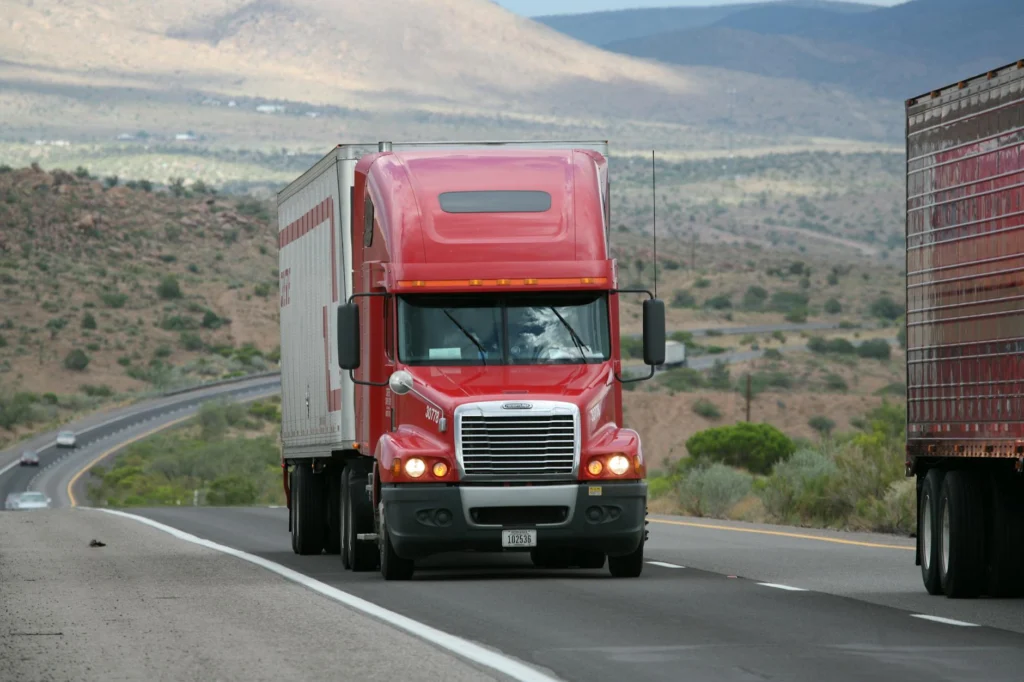
On May 14, 2026, the Supreme Court unanimously ruled that federal law does not preempt state negligent-hiring claims against freight brokers who allegedly select unsafe motor carriers, rejecting a preemption defense based on the Federal Aviation Administration Authorization Act of 1994.[s] The decision in Montgomery v. Caribe Transport II arrived as federal data show deaths from large truck crashes reached 4,354 in 2023, a figure 38% higher than the 2009 low.[s] Truck driver fatigue is a documented crash risk, and the industry’s pay structures, scheduling demands, and regulatory evasion schemes can increase that risk.
The Economics That Create Truck Driver Fatigue
The dominant pay model in American trucking is cents-per-mile. Drivers earn between $0.50 and $0.70 per mile traveled, but only when the truck is moving.[s] Loading, unloading, traffic delays, and detention at customer facilities often go unpaid. The practical consequence is that drivers can work without mileage pay while waiting, then face pressure to recover lost income before their 11-hour federally permitted driving window expires.[s]
American Transportation Research Institute data from 2024 documents the behavioral result: commercial drivers detained at customer facilities drove 14.6% faster on average than those who were not detained.[s] A 2018 Department of Transportation Office of Inspector General report estimated that a 15-minute increase in average dwell time increases the average expected crash rate by 6.2%.[s]
Detention is not a rare occurrence. Drivers reported being detained at 39.3% of their stops in 2023.[s] The arithmetic is straightforward: a driver who sits unpaid for four hours can face pressure to drive faster, longer, or both to meet earnings targets. Truck driver fatigue can accumulate through this cycle of waiting and racing, especially when the pay model provides no compensation for lost time.
The just-in-time logistics model amplifies the pressure. Retail and food sectors demand strict delivery windows, and when delays occur from weather, traffic, or dock detention, drivers scramble to make up lost time.[s] This urgency can lead to speeding and skipped rest breaks.[s]
Ghost Drivers and the ELD Fraud Industry
Electronic logging devices were mandated in 2017 to reduce the paper logbook falsification that could conceal excessive driving hours. The devices automatically record driving time and were intended to make hours-of-service violations harder to hide. They have not eliminated the problem.
A December 2022 fatal crash in Virginia exposed one scheme. The driver of a tractor-trailer for Illinois-based Triton Logistics told National Transportation Safety Board investigators that whenever he reached his 11-hour limit, he could call the carrier’s hours-of-service department, which was based in Lithuania, and add the name of a fictitious or former co-driver to the ELD, opening up another 11-hour driving window.[s] Three people died in the resulting crash, and nine sustained serious injuries. NTSB cited fatigue from excess driving time and lack of sleep opportunity, and said Triton’s fictitious driver accounts enabled drivers to operate beyond federal regulations, creating an opportunity for fatigued driving.[s]
The Triton case was not isolated. Jeremy Disbrow, a Commercial Vehicle Safety Alliance roadside inspection specialist, stated that inspectors encounter false ELD log entries “all day, every day,” and that “the average inspector is seeing this every shift, at least once or twice.”[s] JBA Telematics reported that log falsification was the second most common violation found during audits in the prior year.[s]
Inspectors in multiple states now report a more sophisticated method: entire electronic driving files are fabricated, with data manipulation routed through overseas third parties. Oregon conducted a weigh station operation in March 2025 and inspected 464 commercial vehicles. Twenty-three percent were placed out of service. Inspectors found evidence of 65 truckers with ELD logs that had been altered and scrubbed, with no indication the records had been edited, despite federal regulations requiring edit markers.[s]
The Sleep Deficit Before the Crash
Recent fatal-crash investigations show how sleep opportunity and attention problems can emerge in the days or moments before impact. In the agency’s ongoing investigation of the March 13, 2025 Interstate 35 pileup in Texas, which killed five people and injured 17 others in a 16-vehicle collision, NTSB records identified limited sleep opportunities in the days before the crash, while noting that it remained unclear whether the driver obtained adequate sleep.[s]
On March 10, the driver’s sleep opportunity was four hours. On March 11, it increased to seven hours and 15 minutes, then dropped to five and a half hours on March 12 and four hours and 45 minutes on March 13, the day of the crash.[s] Toxicology was clean, and investigators reported no evidence of alcohol or drugs. The docket did not determine whether he actually slept during those opportunities, but the available windows were short.
Zach Cahalan, executive director of the Truck Safety Coalition, told CBS Austin that “the National Transportation Safety Board regularly cites fatigue as a major contributor to large truck crashes. We have known for the longest time that driving drowsy leads to horrific and catastrophic outcomes.”[s] The I-35 case shows how fatigue risk can develop over days, not hours.
A September 2025 NTSB report on a November 2023 crash on Interstate 70 in Ohio documented a different safety failure: driver inattention, not fatigue. A Freightliner combination vehicle loaded to 56,652 pounds and registered for a maximum weight of 80,000 pounds struck a traffic queue at about 72 mph while the other vehicles were traveling between 3 and 15 mph.[s] Six people died in the resulting chain-reaction collision and fire. NTSB identified driver inattention and the absence of collision avoidance technology standards for heavy vehicles as safety issues.[s]
The Liability Shield That Just Collapsed
For decades, freight brokers argued they were shielded from negligent hiring claims by the Federal Aviation Administration Authorization Act of 1994. The FAAAA preempts state laws “related to a price, route, or service” of motor carriers or brokers. Brokers contended this language blocked any state tort suit against them, regardless of how recklessly they selected carriers.
The Supreme Court disagreed. In Montgomery v. Caribe Transport II, Justice Amy Coney Barrett wrote for a unanimous nine-justice court that a safety exception in the FAAAA preserves state authority to regulate motor vehicle safety, and that requiring a broker to exercise ordinary care in selecting a carrier “concerns motor vehicles – most obviously, the trucks that will transport the goods.”[s]
The case arose from a 2017 crash on Illinois Interstate 70. Plaintiff Shawn Montgomery had pulled over with a mechanical issue when a tractor-trailer veered off the road and rear-ended his stopped vehicle, leading to the amputation of his leg. Montgomery alleged that C.H. Robinson, the freight broker that arranged the shipment, knew or should have known that the carrier, Caribe Transport II, was unsafe. Federal regulators had given Caribe II a “conditional” safety rating, finding it deficient in driver qualification, hours of service, and crash rates.[s]
Justice Brett Kavanaugh, in a concurrence joined by Justice Samuel Alito, acknowledged the case was “closer than the Court’s opinion perhaps might suggest” but stressed the policy stakes. He warned that accepting the brokers’ preemption argument would leave them in a “black hole with no meaningful safety-related regulation” because federal law does not require brokers to take substantial steps to ensure they select safe trucking companies.[s]
Kavanaugh cited the human cost. In 2022, approximately 500,000 reported truck accidents resulted in about 5,000 deaths and 114,000 injuries. “Not all truck accidents can be prevented,” he wrote. “But some can. Some carriers are known to be less safe; some truck drivers are known to be unfit.” Quoting state amici, he added that if brokers face liability for disregarding poor safety records, “they have a strong incentive to do business only with safe and reliable motor carriers.”[s]
What Changes Now
The ruling does not mean every broker involved in a crash faces automatic liability. Both the majority and Kavanaugh emphasized that brokers who exercise reasonable care and select reputable carriers should be able to defend against suits. But brokers who ignored carriers with documented safety violations will face harder questions. The question juries may now ask is whether the broker checked the carrier’s safety record, whether FMCSA data showed elevated crash rates or conditional ratings, and whether the broker had a documented vetting process.[s]
The discovery requests will seek carrier vetting policies, screening criteria, and communications prior to dispatch. If a broker has no documented carrier vetting process, that absence can become evidence.
Federal crash data remain the backdrop. From 2016 to 2022, fatal crashes involving large trucks and buses increased 26.4%.[s] Seventy percent of large trucks involved in fatal crashes are heavy-duty Class 7 and Class 8 vehicles.[s] FMCSA’s Crash Causal Factors Program has a heavy-duty truck study with a target start date of early 2026, aiming to collect data on 2,000 fatal crashes involving heavy-duty trucks from about 30 states and analyze driver, vehicle, motor carrier, and environmental factors.[s]
The industry that produces these crashes has operated on a model where drivers can absorb the risk of unpaid time, face incentives to evade logging requirements, and work through truck driver fatigue because the alternative is lost income. Freight brokers that selected carriers based on price rather than safety could invoke federal preemption as a shield. The specific shield rejected in Montgomery is now gone.