Renaissance historiography has a problem that few outside academia notice: nobody can agree when the Renaissance happened. Ask an English professor and they may tell you the Renaissance peaked around 1600, when Hamlet debuted. Walk down the hall to Romance Languages and the Italianists may say it was already fading by 1450, roughly 150 years before Hamlet’s debut.[s]
This is not a minor dispute. It reveals something fundamental about the Renaissance as a concept: it is not a real historical era in the way the French Revolution is a real historical event. The Renaissance is an idea about ourselves, projected backward onto centuries that experienced nothing of the sort.[s]
Renaissance Historiography Before Burckhardt
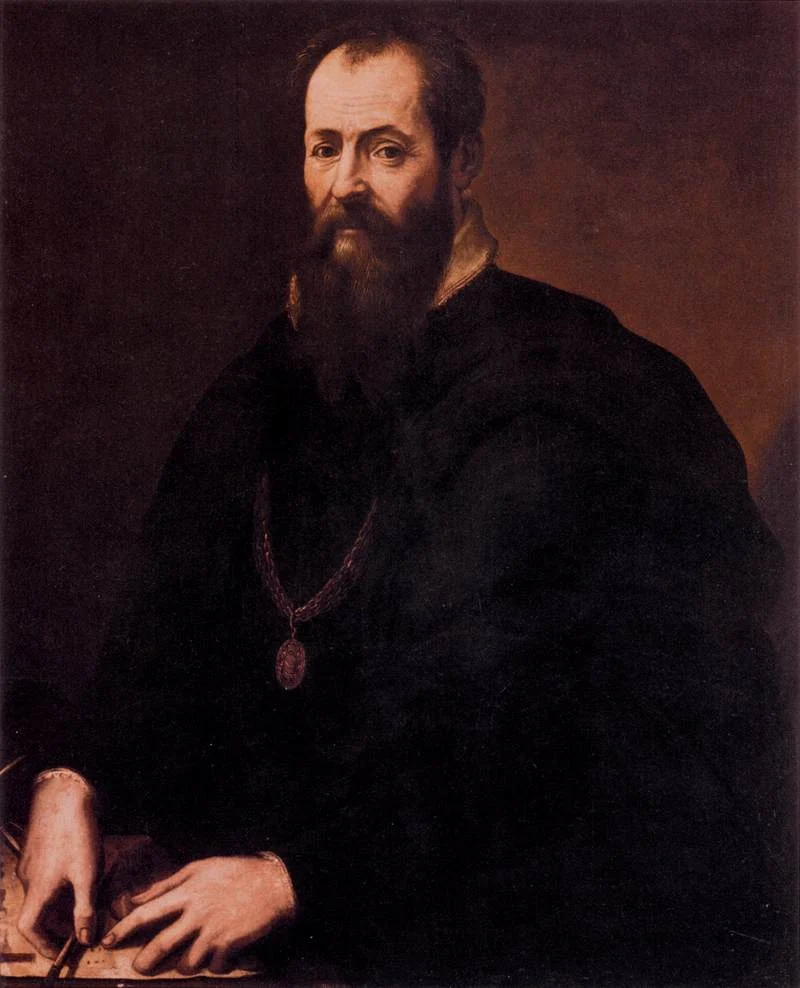
The historical idea of the Renaissance traces back to the Italian rinascita, meaning rebirth. Giorgio Vasari, a Florentine painter and architect, used rinascita in 1550 in his Lives of the Artists.[s] But Vasari did not mean what we mean. For him, rinascita described a moment in art history: the point when Tuscan painters rescued art from centuries of decline and brought it back to classical perfection.
Vasari’s framework was a Whig theory of art: painting, sculpture, and architecture progressed out of Gothic darkness into light, with Michelangelo as the culmination.[s] He was not describing a historical period. He was making an argument about artistic progress, and specifically about Tuscan superiority.
Renaissance historiography in its modern form began elsewhere. In 1855, Jules Michelet published the seventh volume of his Histoire de France, titled La Renaissance. Michelet saw the Renaissance as a secular liberation movement, freeing humanity from medieval feudalism and religious chains.[s] Five years later, Jacob Burckhardt systematized this into a comprehensive theory in Die Kultur der Renaissance in Italien (1860).[s]
From that moment, the Renaissance became a historical period. Burckhardt drew on Hegel and Michelet to present the Middle Ages and the Renaissance as antithetical: medieval stagnation versus Renaissance liberation.[s]
The Dark Ages Had to Be Invented First
“Renaissance” means rebirth. But rebirth implies death. To celebrate a Golden Age, you must first invent a Dark Age.[s]
The poet Petrarch (1304-1374) is commonly credited with developing the concept of “Dark Ages” for the period after Rome’s fall.[s] Fifteenth-century humanists such as Leonardo Bruni and Flavio Biondo then helped formalize a tripartite ancient-middle-modern periodization.[s] These were not neutral descriptions. They were rhetorical tools, created to legitimize the humanists’ own present by reshaping the past.[s]
The labels stuck. We still use them. But the clean-break story has weakened: the Renaissance can be read as a continuation or culmination of medieval trends, not a sudden transformation.[s] In many ways, it makes more sense to think of the Renaissance as a culmination of medieval tendencies rather than a rebuttal of them.[s]
Who Claimed the Renaissance, and Why
In the 19th century, Renaissance historiography became a battleground for nationalist legitimacy. Protestant Northern Europe, especially Germany and the Anglosphere, worked to claim the good parts of the Renaissance for themselves.[s]
This is where the myth of a secular, anti-Catholic Renaissance originated. The argument went: Catholicism poisoned Mediterranean Europe, which is why the true successors of Renaissance values were found in Protestant Northern Europe. Free thinking, the dignity of man, intellectual liberation: these flourished in the north, not the Catholic south.[s]
The Cold War added another layer. Mid-20th-century scholars promoted the theory that proto-capitalism, the birth of modern banking and finance in late medieval Italy, caused the Renaissance. This allowed the capitalist West to claim direct descent from the Golden Age, while communist enemies represented the backward medieval darkness.[s]
Whatever X is when X caused the Renaissance, if you can claim to be the continuation of X, this is useful to you.[s]
Survivorship Bias and the Art We Kept
A disproportionate amount of Renaissance art survived because we decided that having Renaissance art was proof of legitimacy.[s] The Renaissance invented itself as a golden age. Immediately afterward, in the 17th and 18th centuries, possessing Renaissance objects became a marker of cultural capital. If you had Renaissance stuff, you kept it. If you had medieval stuff, you knocked down the church and built something new.[s]
This creates a feedback loop. We have more Renaissance art because we valued Renaissance art. We value Renaissance art partly because we have so much of it. Museums place Renaissance collections at their centers. The footprint seems enormous, but much of it is survivorship bias, not evidence of superior production.[s]
History rarely works as a single dramatic event that changes everything overnight. We prefer those narratives because they are easier to tell. But the Renaissance, like so many historical myths, obscures gradual processes behind a clean transformation story.
What This Means for Renaissance Historiography Today
The actual Renaissance was violent, unstable, and deeply unequal, even as it produced extraordinary art and ideas. It was neither purely Golden nor purely Dark. It was human.[s]
Modern Renaissance historiography has spent decades complicating Burckhardt’s synthesis. As W.K. Ferguson noted in 1948, Burckhardt’s picture was too static, too sharply delimited, limited to Italy’s upper classes, and omitted economic life almost entirely.[s] Yet in popular imagination, Burckhardt’s framework persists. Four and a half centuries after Vasari’s death, the Renaissance as we see it today is still the one Vasari bequeathed us.[s]
The Renaissance is not a specific set of events. It is the idea that there is a transitional phase between a pre-modern world and our own, in which some change propelled modernity.[s] Different scholars locate that transition differently because the concept exists to explain modernity, not the past.
Renaissance Historiography: The Academic Construction
Vasari’s rinascita and Michelet’s “Renaissance” meant fundamentally different things.[s] For Vasari, rebirth described a moment in art: the point when Tuscan painters rescued artistic practice from medieval decline. It was not a periodization. Rebirth, properly conceived, can only be a moment.[s]
When 19th-century historians coined the term “Renaissance” to define the first period of modernity, they aimed at a flattering self-interpretation that escaped all doubt.[s] The strategic power of the term lies partly in its apparent quotation of Vasari. But the quotation is a simulation: the 19th-century meaning only pretends to continue Vasari’s discussion. This semantic alienation transformed a moment into a period, and a claim about art into a claim about civilization.[s]
Burckhardt’s 1860 synthesis built on Hegel’s teleological philosophy of history and Michelet’s secular liberation narrative. Both saw the Middle Ages and Renaissance as antithetical.[s] Burckhardt borrowed from Michelet the phrase characterizing the Renaissance as having effected “the discovery of the world and the discovery of man.”[s]
The Invention of the Dark Ages
Petrarch (1304-1374) is commonly credited with deploying the “Dark Ages” concept to denigrate the centuries between Rome’s fall and his own era.[s] Leonardo Bruni and Flavio Biondo helped formalize a tripartite ancient-middle-modern periodization; Bruni’s dates were not exactly the same as modern ones.[s] These were rhetorical tools for legitimizing the humanists’ present.[s]
The periodization is contested. One critique argues that a distinct medieval culture only emerged around 1000 CE, and that the centuries from 500 to 1000 remained in Rome’s shadow: the Catholic Church preserved continuity through Latin and Roman texts, and Charlemagne’s 800 coronation as Roman Emperor invoked Roman legitimacy rather than creating something new.[s]
On that view, the 1500 end-date cuts off medieval civilization just as its investments began showing results. We deny the medievals credit for progress they themselves started.[s]
Nationalist Appropriations
19th-century Renaissance historiography became a field of nationalist contest. Protestant Northern Europe, especially German and Anglophone scholars, worked to claim Renaissance achievements. The myth of a secular, anti-Catholic Renaissance originated here: it distanced the Renaissance from Catholicism, allowing Protestant nations to claim its intellectual heritage.[s]
Cold War scholarship added another appropriation. The theory that proto-capitalism caused the Renaissance became popular because it allowed the capitalist West to claim descent from the Golden Age while casting communist adversaries as heirs to medieval darkness.[s]
The Survivorship Problem
The Renaissance invented itself as a golden age. By the 17th century, possessing Renaissance objects conferred legitimacy. Those who had Renaissance art kept it; medieval works were more casually destroyed or replaced.[s] A disproportionate amount of Renaissance art survived because we decided that having it was proof of legitimacy.[s]
This survivorship bias inflates the Renaissance’s apparent footprint. Museums center Renaissance collections not because more was produced, but because more survived, and more survived because we valued it.[s]
We prefer histories that work as a single dramatic event, clean breaks that transform everything. But gradual processes do not make satisfying narratives. Renaissance historiography flattened centuries of continuity into a transformation myth.
Ferguson’s Critique and Beyond
W.K. Ferguson’s 1948 critique of Burckhardt identified core flaws: the synthesis was too static, too sharply delimited in time and space, with too strong a contrast against the Middle Ages. It was limited to Italy’s upper classes and omitted economic life almost entirely. It overstressed individualism, immorality, and irreligion.[s]
Yet Burckhardt’s framework persists in popular consciousness. Art historian Andrew Graham-Dixon notes that the Renaissance, as a term of neutral historical description, conceals much error mingled deceptively with some truth.[s] It cannot be done away with, but it must be redefined.
The actual period was violent, unstable, and deeply unequal.[s] The Renaissance itself was neither purely Golden nor purely Dark. Modern Renaissance historiography has complicated Burckhardt for decades. But 166 years after his synthesis, the myth persists.