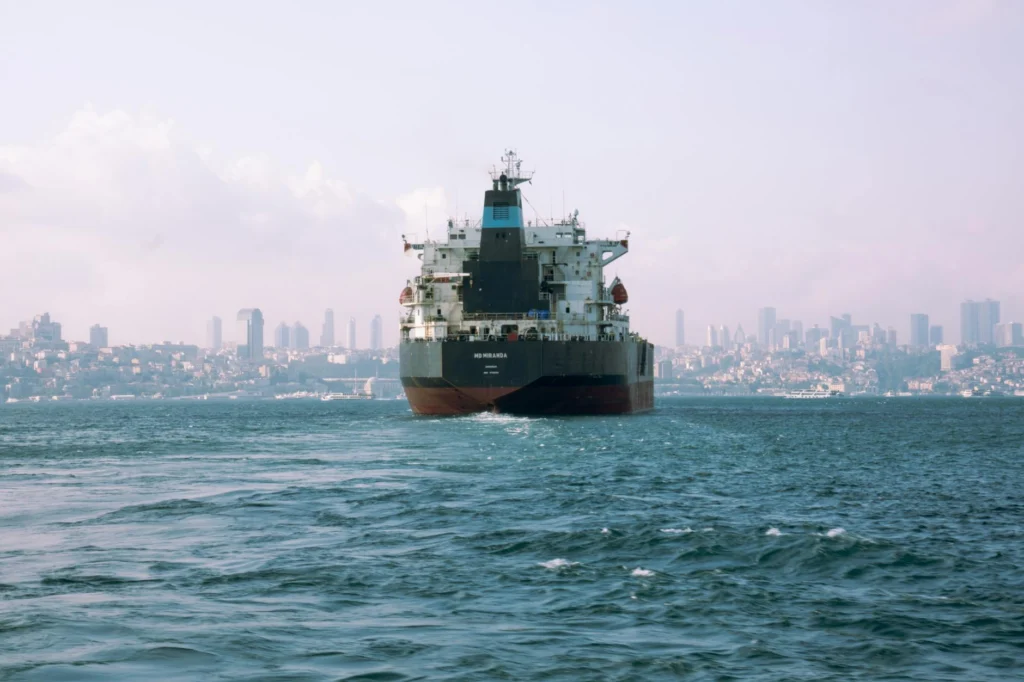
The Strait of Malacca has become the world’s largest oil transit chokepoint by volume, surpassing the Strait of Hormuz[s]. In the first half of 2025, some 23.2 million barrels of oil per day flowed through this narrow passage between Malaysia and Indonesia, accounting for 29 percent of total maritime oil flows[s]. With Iran’s closure of Hormuz redirecting global attention toward alternative routes, the Strait of Malacca now stands at the intersection of great-power competition, energy security, and the fragility of globalized trade.
The Geography of Constraint
The Strait of Malacca stretches roughly 900 kilometers from the Malay Peninsula to the Indonesian island of Sumatra. At its narrowest point, the Phillips Channel near Singapore, the waterway is barely 2.8 kilometers wide[s]. This geographic pinch point creates a natural bottleneck through which nearly a quarter of all global seaborne trade must pass.
The numbers illustrate why the Strait of Malacca matters in any discussion of maritime chokepoints. Almost 24% of global seaborne trade by volume flows through the strait, carrying 45% of the world’s seaborne oil, over 25% of all internationally traded cars, and 23% of dry bulk cargo including grains and soybeans[s]. More than 102,500 ships transited the strait in 2025, up from around 94,300 in 2024[s].
Singapore, positioned at the strait’s southern entrance, is one of the world’s leading container ports and ship refueling hubs. The city-state handled 44.66 million TEUs of container throughput in 2025, while marine fuel sales reached 56.77 million tonnes[s]. This concentration of infrastructure makes the strait difficult to replace in ways that other maritime passages are not.
No Alternatives at Scale
Unlike the Suez Canal, which ships can bypass via the Cape of Good Hope at significant but manageable cost, the Strait of Malacca has no practical substitute. The most commonly cited detours, the Sunda and Lombok Straits, both lie within Indonesian territory and neither offers a straightforward replacement. Rerouting through either passage adds roughly 1,000 to 1,500 nautical miles to a voyage, translating to three to five extra days at sea[s]. Ships would also lose access to Singapore’s refueling infrastructure and transshipment networks.
The Torres Strait near Papua New Guinea is too shallow for large commercial vessels with drafts over 12 meters. Ships avoiding all Indonesian routes would face a detour around the entire Australian continent, adding 10 to 15 additional days of transit time[s]. These geographical facts explain why naval strategists have long viewed Malacca as a decisive node in global trade architecture.
China’s Malacca Dilemma
China has an especially large stake in the Strait of Malacca. In 2003, then-President Hu Jintao coined the phrase “Malacca dilemma” to describe his country’s strategic vulnerability to disruption of this single maritime corridor[s]. That vulnerability remains significant. Around 75 percent of China’s seaborne crude oil imports still pass through the strait from the Middle East and Africa[s].
In value terms, roughly one-fifth of global maritime trade transits the Taiwan Strait and the Strait of Malacca combined, underscoring their central role in linking East Asia to Europe and the Middle East[s]. For Malacca specifically, 24% of China’s maritime exports and 37% of its maritime imports pass through the strait[s]. China’s energy security depends heavily on this single passage.
Beijing has invested heavily in alternatives. Pipelines running from Kyaukpyu in Myanmar into Yunnan province bypass the strait entirely, but their capacity is only around 440,000 barrels per day, a small fraction of China’s roughly 11 million barrels of daily oil imports[s]. The China-Pakistan Economic Corridor plans to link Gwadar Port on the Arabian Sea to Xinjiang through road, rail, and energy infrastructure, but it remains only partially developed. Arctic shipping routes along Russia’s northern coast offer a longer-term hedge but remain seasonal and marginal in global trade terms[s].
US-China Competition Moves Southeast
The current crisis in the Middle East has accelerated US strategic positioning around the Strait of Malacca. On April 13, 2026, the United States and Indonesia announced a major defense cooperation partnership[s], strengthening military ties, while separate reports said Washington was seeking overflight access to Indonesian airspace[s].
“The U.S. is applying pressure, and it’s clearly addressing the weak spots that are reflected in these various nodes, or straits, of global supply chain transit,” said Thierry Wizman, a strategist at Macquarie Group. “They’re the sea lanes that China depends on to uphold its economic preeminence.”[s]
American naval forces have expanded interdiction operations beyond the Persian Gulf into the wider Indian Ocean along established commercial shipping routes[s]. Recent tanker seizures have occurred in waters between Sri Lanka and Indonesia, along corridors feeding East Asian energy markets. This pattern of expanded naval power projection suggests a working precedent for extended interdiction beyond regional containment into pressure on long-range supply chains.
Singapore’s Foreign Minister Vivian Balakrishnan warned that the war in the Middle East may prove to be a “dry run” for a potential conflict between the United States and China in the Pacific[s]. Singapore has told both Beijing and Washington that the right of passage through the strait is guaranteed for all and that it would not participate in efforts to block the waterway or impose tolls[s].
Piracy: A Persistent Security Risk
Beyond great-power competition, the Strait of Malacca faces localized security challenges that complicate transit. The ReCAAP Information Sharing Centre reported 108 sea robbery incidents in the straits of Malacca and Singapore in 2025, the highest number recorded in the 19-year period from 2007 to 2025[s]. This represented a 74% increase over the 62 incidents reported in 2024.
The incidents were largely opportunistic theft committed during nighttime hours, and in most cases crew members were not injured. Over half the incidents involved bulk carriers, with tankers and container ships making up much of the remainder. Incidents declined sharply from August to December 2025 following arrests by Indonesian authorities in July and August[s].
“The sharp increase in number of incidents in the SOMS in 2025 does not indicate a corresponding increase in threat to maritime trade passing through the SOMS,” said ReCAAP ISC Executive Director Vijay D Chafekar. “The higher number of incidents largely corresponds to minor petty theft cases.”[s]
China’s Strategic Buffers
China has not been passive in the face of its Malacca vulnerability. Published estimates put China’s onshore oil stocks at about 1.2 billion barrels in early 2026, enough for roughly 104 days of net crude imports at 2025 levels; broader strategic and commercial inventory estimates run near 1.4 billion barrels[s][s]. That level of storage is above the International Energy Agency’s 90-day emergency-stock benchmark.
Russia remained China’s top crude supplier in 2025, with estimates generally putting Russian crude around 15-20% of imports[s][s]. A significant portion arrives via the ESPO pipeline, which bypasses both the Strait of Malacca and the Strait of Hormuz entirely. Central Asian pipelines provide additional overland capacity. In a Malacca blockade scenario, increased Russian and Central Asian overland flows could provide a partial hedge over several months[s].
China’s preparations over the past two decades, including diversification of suppliers, stockpiling, electrification of transport, and renewable energy deployment, have reduced its exposure[s]. Under one vulnerability calculation, a complete loss of Persian Gulf oil would directly affect roughly 5-7% of China’s primary energy supply, and large inventories would likely limit the impact to short-term price volatility and refinery adjustments rather than systemic economic damage.
Regional Stakes
For the nations bordering the Strait of Malacca, stability depends on maintaining open passage for all. Malaysia, Indonesia, Singapore, and Thailand conduct joint patrols to ensure the waterway remains open. Malaysian Foreign Minister Mohamad Hasan stated that no unilateral decisions can be made about the strait and that Malaysia remained aligned with Singapore, Indonesia, and Thailand[s].
Indonesia sits at the western entrance to the strait, with Malaysia and Singapore forming the remaining structural boundaries. Any disruption could produce rapid economic transmission effects across interconnected regional systems and supply chains[s]. States increasingly seek to secure their access to maritime trade routes and energy corridors through naval modernization, maritime partnerships, and strategic infrastructure initiatives[s].
The Hormuz crisis has shown how quickly maritime disruption can transmit into regional economies. The Strait of Malacca, carrying more oil than any other passage and funneling a quarter of global trade through a corridor only 2.8 kilometers wide at its narrowest point, represents a highly concentrated point of vulnerability in the modern trading system.