In 1962, a newspaper editor in John Ford’s The Man Who Shot Liberty Valance delivered a line that captured Hollywood’s relationship with American history: “This is the West, sir. When the legend becomes fact, print the legend.”[s] For 123 years, that principle defined the Western film. The western genre mythology that Hollywood constructed did not simply romanticize the past; it actively rewrote colonial violence as heroic nation-building, transforming genocide into entertainment.
The Western became one of America’s foundational storytelling forms, often invoked as a symbol of national identity. From its birth in 1903 to its decline in the 1970s, the genre served as propaganda for Manifest Destiny, the belief that white settlers had a divine right to conquer the continent.[s] Understanding how this western genre mythology operated reveals uncomfortable truths about how nations construct their origin stories.
The Academic Blueprint: Turner’s Frontier Thesis
Before Hollywood could mythologize the West, academia had to provide the script. In 1893, historian Frederick Jackson Turner delivered his “Frontier Thesis” to the American Historical Association, arguing that the colonization of the western frontier “was decisive in forming the culture of American democracy.”[s] Turner’s theory claimed that American character, from individualism to democracy itself, emerged from the struggle to tame the wilderness.
The thesis became wildly influential. By the time Turner died in 1932, 60% of leading American history departments were teaching courses built on his framework.[s] Turner defined the frontier as “the meeting point of savagery and civilization,” a formulation that cast Indigenous peoples as obstacles to progress rather than victims of conquest. This binary thinking would become the foundation of western genre mythology in cinema.
Building the Machine: Early Westerns and Native Erasure
The Western film was born with cinema itself. Edwin S. Porter’s The Great Train Robbery (1903) “established the basic grammar of the genre: the chase, the shootout, the conflict between lawmen and outlaws.”[s] The Britannica recognizes it as “the first narrative film to successfully establish continuity of action.”[s]
The portrayal of Native Americans in these early films “employed harmful stereotypes, especially the archetypes of Native Americans as violent barbarians or noble savages.”[s] This was not accidental. The industry drew directly from Buffalo Bill’s Wild West shows, which “employed Sitting Bull and brought him and other Native Americans, along with horses and buffalo, to Europe” as spectacle.[s]
The government actively participated in shaping this western genre mythology. In 1914, The Indian War Refought “romanticized multiple battles including the 1890 Wounded Knee Massacre, wherein U.S. Army soldiers killed over 250 Lakota Indians.” AFI credits Theodore W. Wharton (with Vernon Day) as director; the U.S. War Department supplied troops and the Department of the Interior authorized Sioux participation, with contemporary publicity describing the film as made “under the direction” of the War Department.[s] A propaganda film depicting mass murder of civilians as a noble military victory set the template for decades to come.
John Ford and Western Genre Mythology at Its Peak
No filmmaker embodied western genre mythology more completely than John Ford. His 1939 film Stagecoach “created the template for the classical Western,” while his cavalry trilogy and The Searchers (1956) “celebrated the institutions that carved civilization out of chaos.”[s]
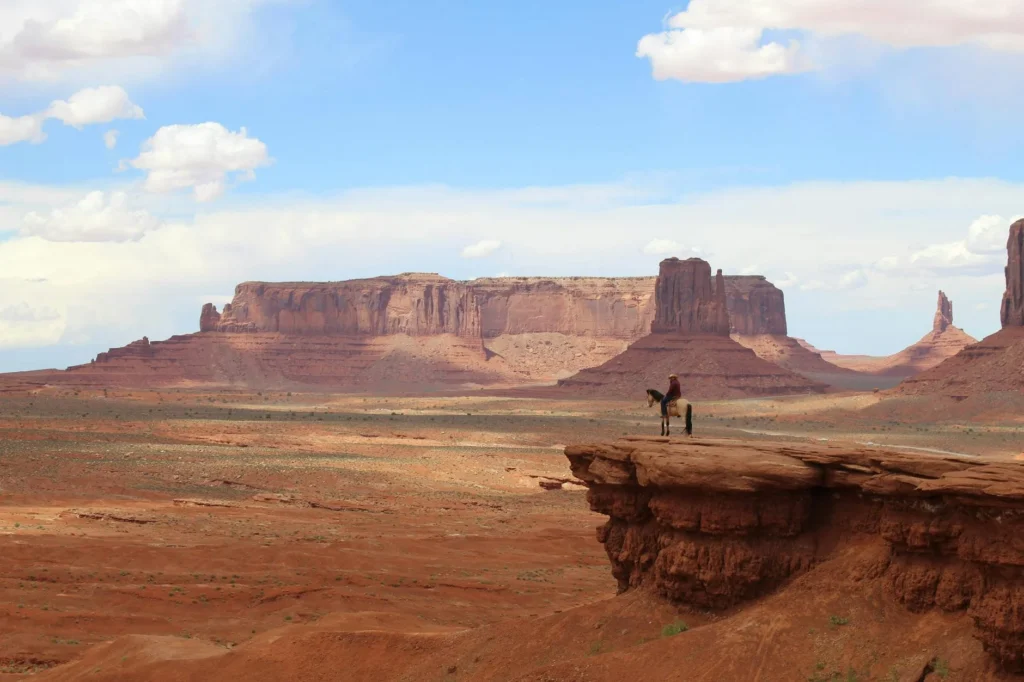
Ford’s Monument Valley landscapes became synonymous with America itself. The American Film Institute named The Searchers “the greatest American Western” in 2008.[s] Yet this vision “was built upon a deeply problematic foundation: the erasure and demonization of Native Americans. In Ford’s early works, they are often a faceless, savage threat, a narrative obstacle to be overcome by the forces of civilization, thus providing a moral justification for Manifest Destiny.”[s]
Film critic Chris Dashiell observed that “the Indians were most often a backdrop to the drama of the white frontier people trying to make a new life. The attack of the Indians was a scary and exciting spectacle for audiences.”[s] Native Americans existed in these films only to threaten, attack, and die, their humanity irrelevant to narratives centered entirely on white experience.
Vietnam Shatters the Myth
The western genre mythology that had served Cold War America began to collapse under the weight of Vietnam. A new generation of filmmakers turned the genre against itself. “The early 1970s cycle of ‘Vietnam westerns’ such as Little Big Man (1970) and Soldier Blue (1970) challenged these mythologies and inverted the frontier narratives of the classic Hollywood western.”[s]
Little Big Man, directed by Arthur Penn, became “an anti-establishment film of the period, indirectly protesting America’s involvement in the Vietnam War by portraying the United States Armed Forces negatively.”[s] Chief Dan George became “the first Indigenous North American actor to be nominated for an Oscar” for his role.[s]
Soldier Blue, depicting the 1864 Sand Creek massacre, went further. Director Ralph Nelson’s portrayal of cavalry soldiers “as blood crazed maniacs who blow children’s brains out” and massacre women “shattered forever one of America’s most enduring movie myths, that of the cavalry as good guys riding to the rescue.”[s] “For counterculture youth audiences, the analogy between historical settler violence and contemporary US aggression overseas was unmistakable.”[s]
The Myth Persists
The revisionist Western genre “subverts the myth and romance of the traditional by means of character development and realism to present a less simplistic view of life in the ‘Old West.'”[s] Films like Clint Eastwood’s Unforgiven (1992) attempted to “systematically dismantle” the myths the director himself had helped create.[s]
Yet even “progressive” Westerns often reinforce colonial frameworks. Smithsonian curator Cass Gardiner, of the Native Cinema Showcase, stated: “I have been personally victimized by Dances with Wolves. The inaccurate perceptions films like that have created are something that we, as contemporary Indigenous peoples, have to live with and fight against.”[s] Films that center white protagonists “discovering” Indigenous humanity still position Native Americans as objects of white redemption rather than subjects of their own stories.
The western genre mythology constructed over 123 years cannot be corrected by better representations alone. The genre itself was designed to justify conquest, and that design remains embedded in its DNA. Recognizing this history is the first step toward understanding how popular culture shapes what societies remember and what they choose to forget.
In 1962, a newspaper editor in John Ford’s The Man Who Shot Liberty Valance delivered a line that captured Hollywood’s relationship with American history: “This is the West, sir. When the legend becomes fact, print the legend.”[s] For 123 years, that principle defined the Western film. The western genre mythology that Hollywood constructed did not simply romanticize the past; it actively rewrote colonial violence as heroic nation-building, functioning as what film scholar Arthur Redding calls “the media’s complicity in defining and perpetuating the myth of the American frontier.”
The Western became one of America’s foundational storytelling forms, often invoked as a symbol of national identity. From its birth in 1903 to its decline in the 1970s, the genre served as propaganda for Manifest Destiny, the belief that white settlers had a divine right to conquer the continent.[s] Understanding how this western genre mythology operated reveals the mechanisms by which cinema constructs national consciousness.
The Academic Blueprint: Turner’s Frontier Thesis
Before Hollywood could mythologize the West, academia had to provide the ideological framework. In 1893, historian Frederick Jackson Turner delivered his “Frontier Thesis” to the American Historical Association, arguing that the colonization of the western frontier “was decisive in forming the culture of American democracy.”[s] Turner applied Darwinian evolutionary logic to American history, framing westward expansion as a process of natural selection that produced a uniquely American species of democratic citizen.
The thesis became hegemonic in American historiography. By the time Turner died in 1932, 60% of leading American history departments were teaching courses built on his framework.[s] Turner defined the frontier as “the meeting point of savagery and civilization,” a binary that positioned Indigenous peoples as environmental obstacles rather than sovereign nations with complex societies. This ideological structure would become the narrative grammar of western genre mythology in cinema.
Constructing the Apparatus: Early Westerns and Native Erasure
The Western film emerged simultaneously with narrative cinema itself. Edwin S. Porter’s The Great Train Robbery (1903) “established the basic grammar of the genre: the chase, the shootout, the conflict between lawmen and outlaws.”[s] The Britannica recognizes it as “the first narrative film to successfully establish continuity of action,” pioneering techniques like cross-cutting and location shooting.[s]
The representational strategies for Indigenous peoples were established early. “The portrayal of Native Americans in cinema has, since the beginning of the motion picture industry, employed harmful stereotypes, especially the archetypes of Native Americans as violent barbarians or noble savages.”[s] These stereotypes were not inventions of cinema but adaptations from Buffalo Bill’s Wild West shows, which “employed Sitting Bull and brought him and other Native Americans, along with horses and buffalo, to Europe” as ethnographic spectacle.[s]
The state apparatus actively participated in constructing western genre mythology. In 1914, The Indian War Refought “romanticized multiple battles including the 1890 Wounded Knee Massacre, wherein U.S. Army soldiers killed over 250 Lakota Indians.” AFI credits Theodore W. Wharton (with Vernon Day) as director; the U.S. War Department supplied troops and the Department of the Interior authorized Sioux participation, with contemporary publicity describing the film as made “under the direction” of the War Department.[s] This explicit government propaganda, depicting the massacre of civilians as heroic military action, established the representational template that commercial cinema would reproduce for decades.
John Ford and Western Genre Mythology at Its Apex
No filmmaker embodied western genre mythology more completely than John Ford, whom film scholar Arthur Redding identifies as “perhaps the purest proponent of frontier mythologies.”[s] His 1939 film Stagecoach “created the template for the classical Western,” while his cavalry trilogy and The Searchers (1956) “celebrated the institutions that carved civilization out of chaos.”[s]
Ford’s Monument Valley cinematography transformed a specific geography into an abstract signifier of American national identity. The American Film Institute named The Searchers “the greatest American Western” in 2008, placing it 12th among the greatest American films of all time.[s] Yet this canonical achievement “was built upon a deeply problematic foundation: the erasure and demonization of Native Americans. In Ford’s early works, they are often a faceless, savage threat, a narrative obstacle to be overcome by the forces of civilization, thus providing a moral justification for Manifest Destiny.”[s]
Film critic Chris Dashiell articulated the structural function of Native Americans in classical Westerns: “the Indians were most often a backdrop to the drama of the white frontier people trying to make a new life. The attack of the Indians was a scary and exciting spectacle for audiences.”[s] Indigenous peoples existed within this narrative apparatus solely to threaten, attack, and die, their humanity subordinated to narratives centered entirely on white subjectivity.
Vietnam and the Collapse of Consensus
The western genre mythology that had buttressed Cold War American identity could not survive the contradictions exposed by Vietnam. “The early 1970s cycle of ‘Vietnam westerns’ such as Little Big Man (1970) and Soldier Blue (1970) challenged these mythologies and inverted the frontier narratives of the classic Hollywood western. These movies placed Native Americans, the principal victims of ‘manifest destiny,’ at their centre and presented US cavalrymen as mass murderers.”[s]
Arthur Penn’s Little Big Man deployed picaresque satire to systematically invert every Western convention, becoming “an anti-establishment film of the period, indirectly protesting America’s involvement in the Vietnam War by portraying the United States Armed Forces negatively.”[s] Chief Dan George became “the first Indigenous North American actor to be nominated for an Oscar” for his portrayal of Old Lodge Skins.[s]
Ralph Nelson’s Soldier Blue, depicting the 1864 Sand Creek massacre, represented a more radical intervention. Nelson’s portrayal of cavalry soldiers “as blood crazed maniacs who blow children’s brains out” and massacre women “shattered forever one of America’s most enduring movie myths, that of the cavalry as good guys riding to the rescue, and rendered Soldier Blue one of the most radical films in the history of American cinema.”[s] “For counterculture youth audiences, the analogy between historical settler violence and contemporary US aggression overseas was unmistakable.”[s]
Revision and Persistence
The revisionist Western emerged as the dominant mode, defined by its effort to “subvert the myth and romance of the traditional by means of character development and realism to present a less simplistic view of life in the ‘Old West.'”[s] Films like Clint Eastwood’s Unforgiven (1992) attempted to “systematically dismantle” the myths that Eastwood himself, through his “Man with No Name” persona, had helped construct.[s]
Yet even ostensibly progressive Westerns often reproduce colonial narrative structures. Smithsonian curator Cass Gardiner, of the Native Cinema Showcase at the National Museum of the American Indian, stated: “I have been personally victimized by Dances with Wolves. The inaccurate perceptions films like that have created are something that we, as contemporary Indigenous peoples, have to live with and fight against.”[s] Films that center white protagonists “discovering” Indigenous humanity reproduce the subject-object relations of colonial discourse, positioning Native Americans as objects of white redemption rather than subjects of their own narratives.
The western genre mythology constructed over 123 years resists correction through representational reform alone. The genre was architecturally designed to justify conquest, and that design remains embedded in its formal conventions, narrative structures, and visual grammar. Contemporary filmmakers working within or against the genre must contend with this inheritance. Recognizing this history illuminates how popular culture shapes what societies remember, what they choose to forget, and how colonial violence becomes normalized through repetition until it feels like nature rather than ideology.