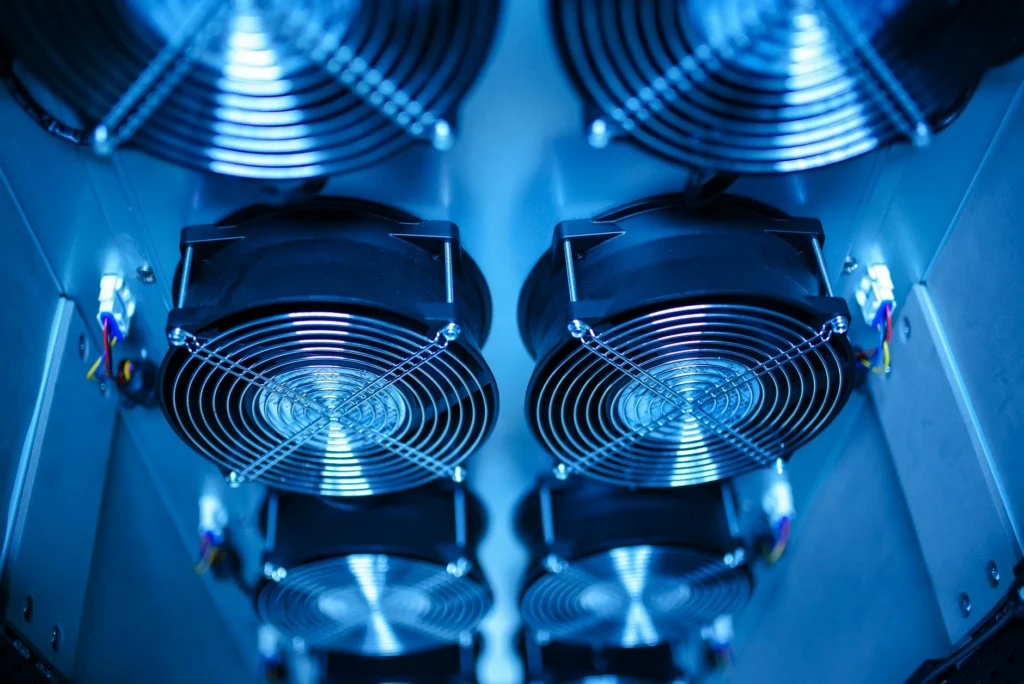
Liquid cooling is no longer experimental at the high end of AI infrastructure. It is increasingly required for the densest AI chips that major tech companies are deploying. But liquid cooling is a category, not a synonym for immersion: Nvidia’s GB200 NVL72 uses cold plates and direct-liquid-cooling manifolds while other components remain air-cooled.[s]
For four decades, data centers cooled their servers with air. Fans pushed cold air through rows of equipment, and that was enough when a full rack of servers drew 5 to 8 kilowatts. Nvidia’s A100 GPU, released in 2020, drew 400 watts. The H100 pushed that to 700 watts. The B200 hit 1,000 watts. The GB200 Superchip draws approximately 2,700 watts, and a single GB200 NVL72 rack pulls 120 to 130 kilowatts total.[s]
Air cooling was designed for a world where racks drew 8 to 12 kilowatts. It has no answer for 120.
Why Liquid Cooling Wins on Physics
The core problem is heat transfer. Water conducts heat far better than air, and liquid cold plates can handle much higher heat flux than conventional forced-air heat sinks. Figures such as 50 W/m²·K for forced air and 15,000 W/m²·K for a microchannel cold plate are illustrative operating values, not universal ceilings: the coefficient depends on velocity, geometry, turbulence, temperature and system design.[s]
Think of it as the difference between blowing on a hot pan and dropping it into cold water. Both move heat. Only one keeps up with a chip producing a kilowatt.
Industry estimates place conventional air cooling near its practical limits as rack density climbs, with rear-door heat exchangers and direct-to-chip systems extending the range. At the highest densities, operators may choose direct-to-chip cooling or immersion depending on hardware, facility and service requirements; no single rack-density threshold makes immersion universally mandatory.[s] AI training racks already exceed 120 kilowatts, and Dell’Oro Group projects that leading GPU thermal design power will exceed 4,000 watts by 2029.[s]
Three Approaches to Liquid Cooling
Not all liquid cooling is the same. Three architectures compete, each with distinct tradeoffs.
Direct-to-chip cold plates mount metal blocks with tiny channels directly onto GPUs and CPUs. Coolant flows through these channels and carries heat to a facility-level heat exchanger. This is what Nvidia specifies for the GB200: the compute processors are liquid-cooled while storage, power distribution, and networking remain air-cooled.[s] Direct-to-chip cooling deploys rack by rack without rebuilding a facility, which is why it commands roughly 47% of the AI data center liquid cooling segment.
Single-phase immersion submerges entire servers in tanks of dielectric fluid that stays liquid throughout the process. No fans, no moving air. The fluid absorbs heat through direct contact and circulates to a heat exchanger. PUE (power usage effectiveness, where 1.0 is perfect) reaches around 1.03.[s] Single-phase systems held 80.9% of the immersion cooling market in 2024.[s]
Two-phase immersion uses a fluid that boils at low temperatures (around 61°C). The liquid boils off the chip surface, absorbs massive amounts of heat during the phase change, rises as vapor, condenses on a cold coil above, and drips back down. No pumps needed for the primary loop. PUE can reach 1.02, and the approach supports rack densities above 250 kilowatts. It can offer very high heat-transfer capacity, but actual performance depends on the fluid and system design.
The Chemistry Problem That Changed Everything
Two-phase immersion relied on fluorocarbon fluids containing PFAS, per- and polyfluoroalkyl substances often called “forever chemicals” because they persist indefinitely in the environment. On December 20, 2022, 3M announced it would stop manufacturing all PFAS chemicals by the end of 2025. The last day to place a Novec order was March 31, 2025.[s]
3M was facing over 4,000 lawsuits and a $12.5 billion settlement with more than 11,000 U.S. public water systems alleging PFAS contamination in drinking water.[s] The EPA designated PFOA and PFOS as hazardous substances under Superfund law.[s]
PFAS concerns pushed some hyperscalers away from deployment, but they did not end the research field. Microsoft-backed work published in 2025 still compared cold plates with single- and two-phase immersion; Microsoft said it had investigated immersion but was not using it in data center operations.[s] Alternative fluids are in development, including Chemours’ HFO-based Opteon 2P50, while the EU’s broad PFAS restriction proposal could further constrain fluorinated cooling fluids.
Water, Power, and the Case for Liquid Cooling
Conventional cooling towers evaporate water to dissipate heat. Large data centers consume up to 5 million gallons of water per day, equivalent to the daily use of a town of 10,000 to 50,000 people.[s] Lawrence Berkeley National Laboratory estimated that U.S. data centers directly consumed roughly 17.5 billion gallons of water in 2023, and that figure could quadruple by 2028.[s]
Closed-loop liquid cooling can avoid evaporating water on site, but Microsoft’s cited design is chip-level rather than immersion cooling. Beginning in August 2024, Microsoft adopted a closed-loop chip-level design for all new data centers that is expected to avoid more than 125 million liters of water use per facility each year.[s]
The Market Has Already Decided
The liquid cooling market nearly doubled in 2025, reaching close to $3 billion, and is forecast to reach $7 billion by 2029.[s] Google has run liquid cooling across more than 2,000 TPU pod deployments at gigawatt scale for seven years, achieving twice the chip density of air-cooled configurations.[s]
Nvidia’s next-generation Vera Rubin platform, announced at CES in January 2026, supports liquid cooling at a 45°C supply temperature, warm enough to reject heat through dry coolers using ambient air rather than energy-intensive chillers.[s] The direction is clear: each generation of AI hardware makes liquid cooling more important, while the choice between cold plates and immersion remains architecture-specific.
Liquid cooling has moved from a niche efficiency measure toward a structural requirement for the densest current-generation AI accelerators. Liquid cold plates can achieve far higher heat-transfer coefficients and heat-flux capacity than conventional forced-air heat sinks, but comparisons such as 50 versus 15,000 W/m²·K are illustrative and architecture-specific—not a universal ceiling or fixed 300x law.[s]
The Thermal Density Escalation
GPU thermal design power has followed a steep curve. Nvidia’s A100 (2020) operated at 400W TDP. The H100 (2022) reached 700W. The B200 Blackwell GPU draws 1,000W air-cooled, delivering 18 petaFLOPS of FP4. The full 20 petaFLOPS FP4 performance requires liquid cooling at 1,200W, as configured in the GB200.[s] The GB200 Grace-Blackwell Superchip, pairing two 1,200W GPUs with a 300W Grace CPU, draws approximately 2,700W.[s]
At the rack level, the GB200 NVL72 (36 Superchips with 72 Blackwell accelerators interconnected via NVLink switch appliances) consumes 120 to 140 kilowatts.[s] Average rack power density has more than doubled in two years, from 8 kW to 17 kW, with McKinsey projecting 30 kW average by 2027; AI training racks already exceed that figure.[s] Dell’Oro Group projects leading-edge GPU TDPs will exceed 4,000W by 2029.[s]
Industry density estimates map a transition from conventional air cooling to rear-door heat exchangers and then to direct liquid cooling as rack loads rise. At very high densities, direct-to-chip and immersion are alternative liquid-cooling architectures; no universal threshold makes immersion the only viable design.[s]
Liquid Cooling Architectures Compared
Direct-to-chip (DTC) cold plate cooling
DTC commands roughly 47% of the AI data center liquid cooling market. Cold plates with copper or aluminum microchannels mount directly to GPUs and CPUs, while remaining components (storage, power distribution, ancillary networking) retain air cooling. Nvidia’s GB200 NVL72 is a DTC-hybrid design by specification.[s] DTC retrofits into existing chilled-water infrastructure, deploys rack by rack, and requires no purpose-built tanks or modified server form factors. It is the path of least resistance for brownfield deployments.
Single-phase immersion
Entire servers submerge in tanks of dielectric fluid (typically synthetic hydrocarbons or gas-to-liquid fluids) that remain in liquid phase throughout. Heat capture approaches 100% of IT load with zero fan energy. PUE reaches around 1.03.[s] Single-phase systems held 80.9% of the immersion cooling market in 2024, and that share is growing.[s]
Key vendors include Submer (synthetic hydrocarbon fluids co-developed with Castrol), Green Revolution Cooling (hydrocarbon-based dielectrics), and Asperitas (Shell gas-to-liquid fluid). All use PFAS-free chemistries. The deployment tradeoff: immersion requires purpose-built tanks, fanless server variants, and dedicated floor space, making it primarily a greenfield play.
Two-phase immersion
Two-phase systems exploit latent heat of vaporization: fluid boils at the chip surface (typically 49 to 61°C for fluorinated fluids), absorbing substantially more energy per unit mass than sensible heating alone. The vapor rises, condenses on a coil, and returns by gravity. No primary-loop pumps. PUE reaches 1.02, and rack densities above 250 kW are supported.[s]
Two-phase immersion can use latent heat of vaporization efficiently, but its performance depends on the fluid and system design. It is also the architecture most affected by 3M’s PFAS exit.
The PFAS Crisis and Its Consequences
Two-phase immersion depended on fluorocarbon fluids: 3M’s Novec 7100, Novec 649, and Fluorinert FC-72. The carbon-fluorine bond that made these fluids thermally stable, chemically inert, and electrically nonconductive also made them environmentally persistent, bioaccumulative, and linked to liver damage, immune disruption, and elevated cancer rates.
On December 20, 2022, 3M announced it would exit all PFAS manufacturing by end of 2025, facing over 4,000 lawsuits and a $12.5 billion settlement with more than 11,000 U.S. public water systems.[s] The EPA designated PFOA and PFOS as hazardous substances under CERCLA (Superfund), a classification retained even under the current administration.[s]
PFAS concerns have discouraged deployment of some two-phase immersion systems, but the evidence does not show that Microsoft, Meta and Google all abandoned the research field. Microsoft-backed work published in 2025 still evaluated cold plates, single-phase immersion and two-phase immersion.[s] EPA’s CERCLA designation is narrower than the PFAS family: it covers PFOA and PFOS, including their salts and structural isomers. Whether a cooling fluid contains a designated substance—and whether a release creates reporting or liability consequences—depends on its composition and the circumstances of an actual release.[s][s]
Chemours developed Opteon 2P50, an HFO-based replacement with zero ODP and GWP of 10, targeted for commercial production in 2026 via Navin Fluorine.[s] The EU’s PFAS restriction proposal under REACH, covering over 10,000 substances with ECHA final opinions expected by end of 2026, could further constrain fluorinated cooling fluids. General data center cooling fluids are not explicitly carved out with a long derogation.
Water and Energy Economics
Evaporative cooling towers consume enormous quantities of water. Large data centers use up to 5 million gallons per day.[s] Lawrence Berkeley National Laboratory estimated U.S. data center direct water consumption at 17.5 billion gallons in 2023, with projections of doubling to quadrupling by 2028.[s] About two-thirds of U.S. data centers built since 2022 are in high water-stress areas.[s]
Closed-loop liquid cooling can avoid evaporating water on site, but Microsoft’s August 2024 design is chip-level cooling rather than immersion. Microsoft says all new data center designs adopted this approach, which is expected to avoid more than 125 million liters of water use per facility each year.[s]
Nvidia’s Vera Rubin platform (CES January 2026) raises the supply temperature to 45°C, enabling heat rejection through dry coolers with ambient air rather than mechanical chillers, which are among the largest energy consumers in any liquid-cooled facility.[s]
Market Trajectory
The liquid cooling market nearly doubled in 2025 to approximately $3 billion, with a forecast of $7 billion by 2029.[s] Google has operated liquid cooling across more than 2,000 TPU pod deployments at gigawatt scale for seven years, achieving 2x the chip density of equivalent air-cooled configurations.[s]
Direct-to-chip liquid cooling has absorbed much of the momentum that two-phase systems lost. Cold plates are commercially mature, widely compatible with existing server designs and use water-glycol loops that avoid the same PFAS concerns. Single-phase immersion continues to grow in greenfield deployments where zero fan energy, high density and simplified mechanical infrastructure justify the operational complexity. Two-phase immersion may remain useful in specialized ultra-high-density applications if suitable fluids reach commercial scale, but it is not the dominant architecture.
The physics of heat transfer increasingly limits conventional air cooling as rack density rises. Every generation of AI hardware widens the design challenge. For many high-density data centers, the question is which liquid-cooling architecture—direct-to-chip, single-phase immersion or another design—best fits the workload and facility.