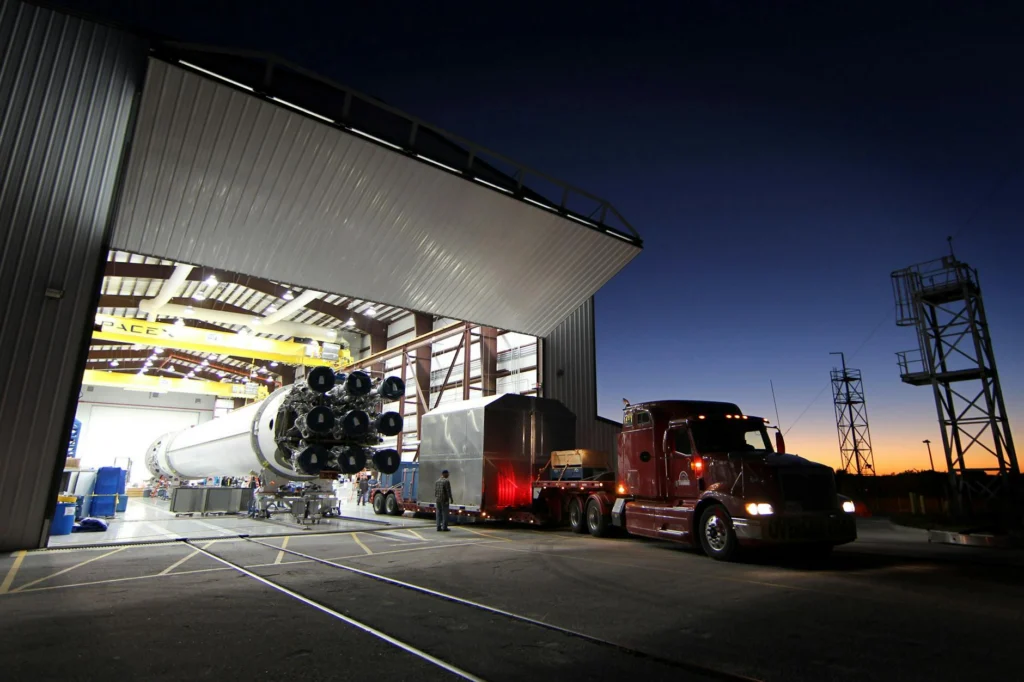
Rocket cargo logistics is the military’s attempt to answer a narrow question: if a commander needs critical materiel across the planet in about 90 minutes, can a commercial rocket carry it without turning delivery into a launch campaign? AFRL’s fact sheet says Rocket Cargo is exploring commercial rocket transportation for DOD logistics and aims to enable up to 100 tons of cargo within tactical timelines[s]. Program officials have framed the basic speed argument around planetary reach in roughly 90 minutes[s]. That does not make rockets a replacement for cargo aircraft, ships, trucks, or prepositioned supplies. It makes them a possible emergency option when time is more valuable than cost.
Why rocket cargo logistics exists
The Department of the Air Force designated Rocket Cargo as its fourth Vanguard program, with the Air Force Research Laboratory leading the science and technology work and the Space Force named as the lead service[s]. The policy choice matters. AFRL is not saying it will build a new government rocket. Its own fact sheet says the program is focused on leasing commercial rocket capability as a service and that no funding will be invested in developing commercial rockets[s].
That is why launch companies and space contractors are paying attention. U.S. Transportation Command signed a March 2020 cooperative research and development agreement with SpaceX, another in April 2020 with Exploration Architecture Corporation, and a December 2021 agreement with Blue Origin to study rockets for cargo and people[s]. In 2022, the command added agreements with Sierra Space Corporation, Virgin Orbit National Systems, and Rocket Lab USA, expanding the study beyond one launch provider[s]. These are research agreements, not proof that rocket cargo logistics is ready for wartime use.
How the trip would actually work
The simple version is launch, coast, reenter, land, and unload. A Joint Forces Staff College paper described the concept as cargo loaded onto an autonomous rocket, launched above 100 kilometers, carried across Earth, then delivered through an autonomous controlled descentA landing phase in which the vehicle guides itself back through the atmosphere and down to the delivery area without a pilot onboard.[s]. The flight is fast because the vehicle is not following the same route constraints as an aircraft flying through national airspace for the whole trip.
The hidden work happens before and after that flight. AFRL says demonstrations must include responsive mission planning, rapid cargo logistics, ground launch operations, and coordination with commercial airspace[s]. A 90 minute crossing is less useful if the cargo takes many hours to package, certify, move to a launch site, fuel, launch, recover, and move onward. Rocket cargo logistics only works if the whole chain gets faster, not just the part above the atmosphere.
What contractors are really selling
SpaceX won a $102 million, five year Air Force contract to demonstrate technologies for moving military cargo and humanitarian aid around the world on a heavy rocket[s]. The work includes access to commercial orbital launches and booster landings for data, cargo bay designs for rapid loading and unloading, compatibility with USTRANSCOM intermodal containersStandardized military shipping containers used across transport modes, so cargo can move between trucks, ships, aircraft, and potentially rockets with less repacking., and an option for a heavy cargo transport and landing demonstration[s].
Rocket Lab’s agreement with USTRANSCOM looks different. The company said it would explore Neutron and Electron launch vehicles, Photon spacecraft, possible on orbit cargo depots, and reentry capability[s]. Outpost Space is working on another piece of the problem: it received a $1.8 million SpaceWERX SBIR contract for a deployable heat shieldA protective structure that unfolds or expands before atmospheric reentry to absorb and deflect heat, helping the payload survive the return from space. program meant to improve payload survivability during reentry[s]. The contractor bet is broad because the military problem is broad: rockets, cargo bays, depots, heat shields, landing systems, and supply software all matter.
The hard problems are on the ground
AFRL’s own announcement lists the problems that make rocket cargo logistics difficult: landing rockets on nontraditional materials and surfaces, landing near personnel and structures, engineering cargo bays for rapid loading and unloading, and dropping cargo after reentry where no rocket or aircraft can land[s]. Those are not small add ons. They decide whether rocket delivery is a useful logistics tool or a spectacular one time stunt.
The regulatory test is also real. A March 2025 Federal Register notice said the Air Force planned an environmental assessmentA formal review of how a proposed project, such as rocket landing pads, could affect the environment before agencies decide whether it can proceed. for two landing pads at Johnston Atoll, with up to 10 reentry vehicle landings per year over four consecutive years, and named the FAA and U.S. Fish and Wildlife Service as cooperating agencies[s]. In July 2025, a later Federal Register notice said the Air Force had elected to hold that environmental assessment in abeyance[s]. Together, the notices show why suborbital delivery is not only an engineering question. The place where a rocket lands is also an environmental, aviation, diplomatic, and local access question.
Where rocket cargo logistics could matter
The strongest case is not routine shipping. It is a small set of urgent missions where the cargo is valuable enough, the destination is distant enough, and the alternatives are slow enough. AFRL lists possible uses such as special airlift to restore lost mission operations and humanitarian assistance or disaster relief payloads to stricken areas[s]. USTRANSCOM has described space transportation as a possible complement to traditional global mobility rather than something every operation would need[s].
The real rise of rocket cargo logistics is therefore not a claim that armies will soon ship everything by rocket. It is the military noticing that commercial launch companies are already spending private money on heavy, reusable systems, then asking whether a fraction of that capability can be rented for rare missions where hours matter. The bet will pay off only if the boring parts of logistics become as engineered as the launch.
Rocket cargo logistics is best understood as a point to point space transportation architecture, not a faster cargo aircraft. The Air Force Research Laboratory defines the program around commercial rocket transportation for DOD logistics, while USTRANSCOM is studying how industry provided space transportation could become a new mode for moving cargo and personnel[s][s]. The useful question is not whether a rocket can fly quickly. It is whether the whole system can move a military payload from origin custody to destination custody faster than airlift, with acceptable risk and cost.
Rocket cargo logistics as an architecture
A working system needs at least six segments: cargo selection, containerization, launch site processing, ascent, entry and descent, and final handoff. AFRL’s fact sheet says demonstrations have to cover integrated work with the DOD logistics train, including responsive mission planning, rapid cargo logistics, ground launch operations, and commercial airspace coordination[s]. That is the right framing. A rocket that flies in 90 minutes but waits a day for hazardous cargo review, range approval, fueling, or ground transport is not a 90 minute logistics system.
The flight profile is straightforward in outline. One defense academic study describes cargo loaded onto an autonomous rocket, launched above 100 kilometers, moved to the destination region, and delivered through autonomous controlled descentA landing phase in which the vehicle guides itself back through the atmosphere and down to the delivery area without a pilot onboard.[s]. That profile explains the appeal of suborbital delivery. The vehicle spends most of the trip outside ordinary air routes, then returns through the atmosphere near the destination.
The 90 minute number can mislead
The advertised speed is real in the narrow flight sense, but it is incomplete as a logistics metric. The same defense study notes that the sub 90 minute deployment speed does not include cargo loading or fuel loading time, and that rocket cargo missions to austere locations may be one way because boosters do not continue to the destination[s]. That means planners must count the entire chain: packaging, security, launch scheduling, propellant, trajectory approval, reentry, landing, offload, and onward movement.
This is why the cargo interface may matter as much as the rocket. SpaceX’s Air Force contract includes cargo bay designs for rapid load and unload, compatibility with USTRANSCOM intermodal containersStandardized military shipping containers used across transport modes, so cargo can move between trucks, ships, aircraft, and potentially rockets with less repacking., and data collection from commercial orbital launches and booster landings[s]. Those tasks point to a practical requirement: rocket cargo logistics has to accept ordinary military cargo processes, or it will create a special supply channel that only works for carefully rehearsed demonstrations.
Why contractors see room to compete
The contractor market is not one market. Heavy launch providers can sell lift and landing data. Smaller launch companies can test different routes, staging models, and cargo classes. Space infrastructure companies can offer depots, reentry vehicles, or payload return. USTRANSCOM’s 2022 expansion to Sierra Space, Virgin Orbit National Systems, and Rocket Lab USA shows that the command wanted a wider sample of architectures, not only one heavy rocket concept[s].
Rocket Lab’s own announcement illustrates the spread. Its CRADA covered Neutron, Electron, Photon spacecraft, possible on orbit cargo depots, and reentry capability[s]. Outpost Space sits at another layer of the stack: its SpaceWERX award funds work on deployable heat shieldA protective structure that unfolds or expands before atmospheric reentry to absorb and deflect heat, helping the payload survive the return from space. technology for payloads reentering Earth’s atmosphere, including design, analysis, and subscale prototype testing[s]. The rise of rocket cargo logistics is therefore partly a supply chain story inside the space industry.
Landing is the decisive subsystem
AFRL’s first public description of Rocket Cargo put unusual weight on landing. The lab said it would study landing on nontraditional surfaces, landing near personnel and structures, rapid loading and unloading, and airdrop after reentry for places where a rocket or aircraft cannot land[s]. That is a different problem from launching a satellite. The destination is part of the system, and it may be damaged, politically sensitive, remote, or short of support equipment.
The Johnston Atoll notices make that visible. In March 2025, the Air Force said an environmental assessmentA formal review of how a proposed project, such as rocket landing pads, could affect the environment before agencies decide whether it can proceed. would evaluate construction and operation of two landing pads for up to 10 reentry vehicle landings per year over four years, with FAA and U.S. Fish and Wildlife Service involvement[s]. In July 2025, the Air Force said it had elected to hold that environmental assessment in abeyance[s]. Even a test site has to clear environmental review and aviation coordination. Operational sites would add host nation approval, range safety, debris risk, noise, fire risk, and recovery access.
The likely niche for rocket cargo logistics
Rocket cargo logistics makes the most sense where three conditions line up. The payload must be urgent, because the cost and preparation burden need a reason. The destination must be hard to reach quickly by aircraft or ship. The receiving force must be able to take custody of the payload without building a spaceport at the point of need. AFRL’s listed mission examples, special airlift to restore operational capability and humanitarian or disaster relief payloads, fit that profile better than routine resupply[s].
The military contractor bet is rational, but narrow. If reusable commercial rockets keep improving, the government can test a leased service without paying for the whole launch vehicle. If cargo bays, heat shields, landing zones, and permissions lag behind, the 90 minute flight time will remain impressive but operationally thin. Rocket cargo logistics will rise only if the industry proves that the rocket is one component in a disciplined logistics system, not the system itself.