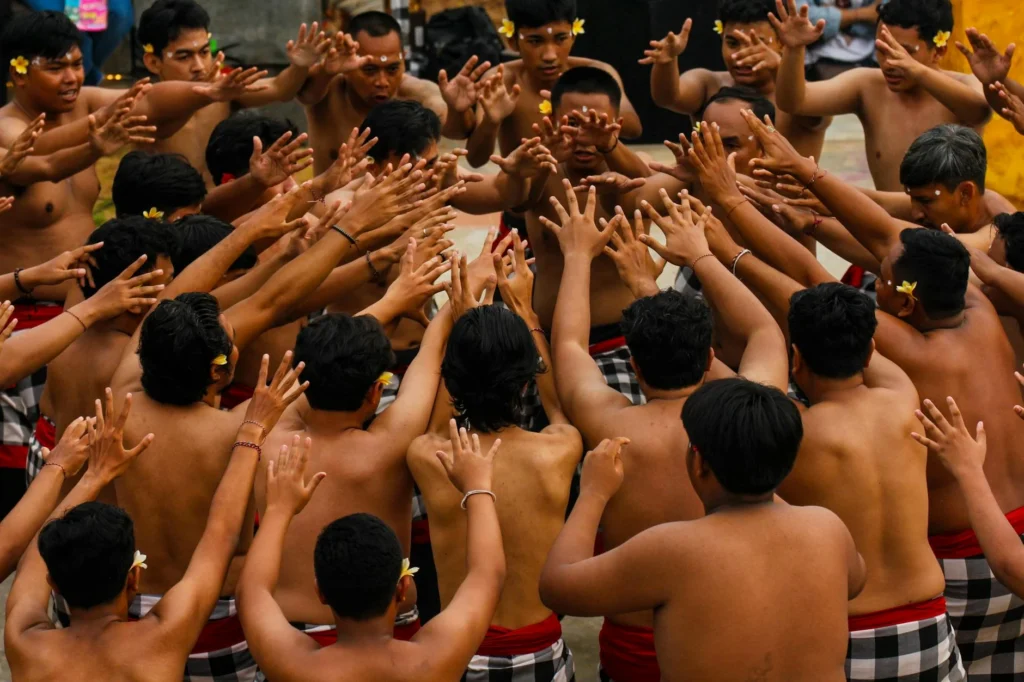
Every human society, from hunter-gatherer bands to industrialized nations, performs rituals. People gather to chant, dance, pray, march, or sing in unison. This is not mere tradition or superstition: ritual social cohesion represents one of the most powerful mechanisms our species has evolved for binding strangers into cooperative groups.[s] The question that has occupied researchers across psychology, neuroscience, and anthropology is why repetitive, synchronized behavior creates such strong bonds.
Australian rock art dating back 20,000 to 38,000 years depicts human figures beating sticks and dancing together.[s] From the Arctic to Australia, from Japanese festivals to Brazilian dance circles, synchronized ritual behavior appears in every documented culture. This universality suggests that ritual social cohesion serves a fundamental adaptive function.
What Happens in the Brain During Ritual
When you move in synchrony with others, something remarkable happens: your brain starts to blur the boundary between yourself and the people around you. Researchers call this “self-other merging.” Your neural systems for perceiving someone else’s movement and for controlling your own movement overlap, and when both fire together during synchronized action, the line between “you” and “them” temporarily dissolves.[s]
This blurring creates a transient sense of connection. Studies have shown that people who tap, walk, dance, or sing in synchrony subsequently report feeling closer to each other, more trusting, and more willing to cooperate. The effect appears in children as young as 14 months.[s]
The second mechanism involves your body’s natural painkillers: endorphins. A study of 264 Brazilian high school students found that synchronized dancing raised pain thresholds, a standard proxy for endorphin release, independent of physical exertion.[s] Even gentle synchronized movement triggers the endogenous opioid system. This chemical reward, experienced in a social setting, creates positive associations with the people present.
The third mechanism operates at the level of brainwaves themselves. When people watch emotionally arousing rituals together, their brains show enhanced theta-band phase synchronization, meaning their neural oscillations align.[s] This “neural synchrony” correlates with increased agreement in how participants perceive the ritual’s significance. Simply being in a group while watching the same event tunes people toward a common perspective.
Two Modes of Building Ritual Social Cohesion
Anthropologist Harvey Whitehouse, leading research at Oxford’s Centre for the Study of Social Cohesion, identified two distinct patterns in how ritual social cohesion operates.[s]
The first pattern, the “imagistic mode,” involves infrequent, high-intensity rituals like initiation rites, hazing, or collective ordeals. These experiences burn into episodic memory, creating vivid “flashbulb” recollections shared by all participants. The emotional intensity fuses personal identity with group identity. Studies of Libyan revolutionaries and university hazing victims found that shared dysphoric experiences produce what researchers call “identity fusion,” an extreme form of bonding where people treat fellow group members like family.[s]
The second pattern, the “doctrinal mode,” involves frequent, low-intensity rituals like daily prayers, weekly services, or routine ceremonies. These don’t create dramatic memories. Instead, they encode into procedural and semantic memory through sheer repetition. The doctrinal mode builds less intense but broader bonds, enabling cooperation among large populations who have never met.
The doctrinal mode appears to have emerged with agriculture and complex societies. Before that, for most of human prehistory, ritual social cohesion likely operated primarily through intense shared experiences in small groups.[s]
Why Repetition Is Not Optional
Repetition is not incidental to ritual; it is the mechanism that makes ritual work. For doctrinal rituals, repetition is what transfers information from conscious attention into automatic, procedural knowledge. The phrases become familiar. The movements become second nature. This shared procedural knowledge functions as an identity marker: I know the words; therefore, I belong.
Even imagistic rituals rely on a kind of repetition across generations. The specific ordeal may happen once per lifetime, but the cultural knowledge that this ordeal binds people together gets transmitted from cohort to cohort. The expectation that shared suffering creates shared identity becomes a self-fulfilling prophecy.
Research on Japan’s Bon Festival found that active participation, not merely observation, predicted increased feelings of social cohesion toward other participants and even toward the nation as a whole.[s] The physical act of repetition, moving your body in the prescribed way, activates the bonding mechanisms that passive watching does not.
The Trade-Off
Ritual social cohesion is not without costs. The same synchrony that binds groups together can increase conformity, decrease creativity, and promote obedience to authority, even harmful obedience.[s] Experiments found that people who marched in synchrony wrote less creative stories afterward. Other studies found synchronized movement increased willingness to harm strangers when instructed to do so.
Groups face a trade-off: tight cohesion enables collective action but can suppress the dissent and innovation that groups also need. Societies that only practice high-intensity imagistic rituals may bond fiercely but struggle to scale. Societies that only practice low-intensity doctrinal rituals may scale widely but lack the intense loyalty that survives crisis.
Neural Mechanisms of Ritual Social Cohesion
Three primary mechanisms underlie ritual social cohesion at the neural level: action-perception coupling, endogenous opioid release, and inter-brain synchronization.
Action-perception coupling refers to the activation of motor regions during observation of others’ movements. When an individual performs movements simultaneously with others, overlapping activation occurs in neural networks that code for both action generation and action perception.[s] This overlap creates what researchers term “self-other merging,” a transient reduction in the neural distinctiveness of self versus other. The effect is measurable: synchronized participants show increased prosocial behavior, elevated trust ratings, and heightened perception of similarity to co-actors. These effects replicate across finger-tapping, walking, rocking, and dancing paradigms.
The second mechanism involves the endogenous opioid system (EOS). Tarr et al. demonstrated in a 2×2 factorial design (synchrony × exertion) with 264 participants that both synchrony and physical exertion independently elevated pain thresholds, the standard proxy for β-endorphin release.[s] Critically, even low-exertion synchronized movement raised pain thresholds significantly above baseline. This suggests that synchrony activates the EOS through mechanisms distinct from exercise-induced release. Given the established role of endorphins in primate social bonding, this pathway likely mediates at least part of the affective component of ritual social cohesion.
The third mechanism operates at the oscillatory level. Cho et al. recorded simultaneous EEG from groups and individuals viewing spirit-medium rituals and found that group co-presence enhanced between-participant theta-band (4-8 Hz) phase synchronization.[s] Theta synchrony correlated with convergence in efficacy ratings, a “social tuning” effect whereby co-presence brings individual judgments toward consensus. This neural synchrony emerged beyond what could be explained by stimulus-locked responses alone, indicating genuine inter-brain coordination.
Divergent Modes of Religiosity and Memory Systems
Whitehouse’s Divergent Modes of Religiosity (DMR) theory proposes that ritual social cohesion exploits distinct memory systems depending on ritual parameters.[s]
The imagistic mode involves infrequent, high-arousal rituals (initiation rites, painful ordeals, collective traumas). High emotional arousal activates the amygdala-hippocampal circuit, encoding events as vivid episodic memories with flashbulb-like properties. DMR testing against 645 rituals in the HRAF ethnographic database confirmed clustering around imagistic and doctrinal poles. Imagistic rituals predict identity fusion, an extreme form of group bonding where personal and social identities become functionally interchangeable.[s] Fused individuals endorse self-sacrifice for the group at rates comparable to kin altruism.
The doctrinal mode involves frequent, low-arousal rituals (daily prayers, weekly services, calendrical observances). Repetition without strong affect encodes ritual content in semantic and procedural memory systems rather than episodic stores. This produces less intense but more scalable bonds: categorical identification with abstract groups (“Christians,” “Americans”) rather than relational bonds with specific known individuals. The doctrinal mode appears archaeologically correlated with the Neolithic transition and the emergence of large-scale sedentary societies.[s]
Repetition as Mechanism
Repetition is mechanistically essential, not merely traditional. For doctrinal rituals, repeated exposure drives procedural consolidation. Semantic memory for ritual content becomes a tribal marker: implicit knowledge of “how we do things” functions as an in-group signal, detectable through coordination quality. High-fidelity imitation of ritual sequences inhibits individual innovation, a feature that stabilizes cultural transmission across generations.[s]
For imagistic rituals, repetition operates intergenerationally. Each cohort experiences the ordeal once, but the metacognitive belief that shared suffering creates bonds transmits continuously. Field research on the Bon Festival in Japan confirmed that active participation (performing the dance) predicted social cohesion measures more strongly than passive observation, consistent with the motor-engagement hypothesis.[s] Emotional synchronization during participation predicted cohesion effects persisting up to four months post-ritual.[s]
Costs and Trade-Offs
Ritual social cohesion carries fitness trade-offs. Gelfand et al. demonstrated that synchrony increases conformity to majority opinion, decreases creative output in group tasks, and elevates compliance with harmful instructions.[s] Groups that marched in step subsequently wrote less creative collaborative stories than groups that walked at individual paces. Synchrony-induced obedience extends to destructive commands: synchronized participants showed increased willingness to administer painful stimuli to strangers.
These findings suggest that ritual social cohesion represents an evolutionary trade-off between group coordination capacity and adaptive flexibility. Tight cohesion benefits collective action problems (warfare, resource defense, large-scale construction) while potentially suppressing the variation and dissent that enables groups to adapt to changing conditions. The dual-mode structure of ritual systems may represent a cultural-evolutionary solution: imagistic rituals for crisis-level solidarity in small groups, doctrinal rituals for baseline cooperation at scale.