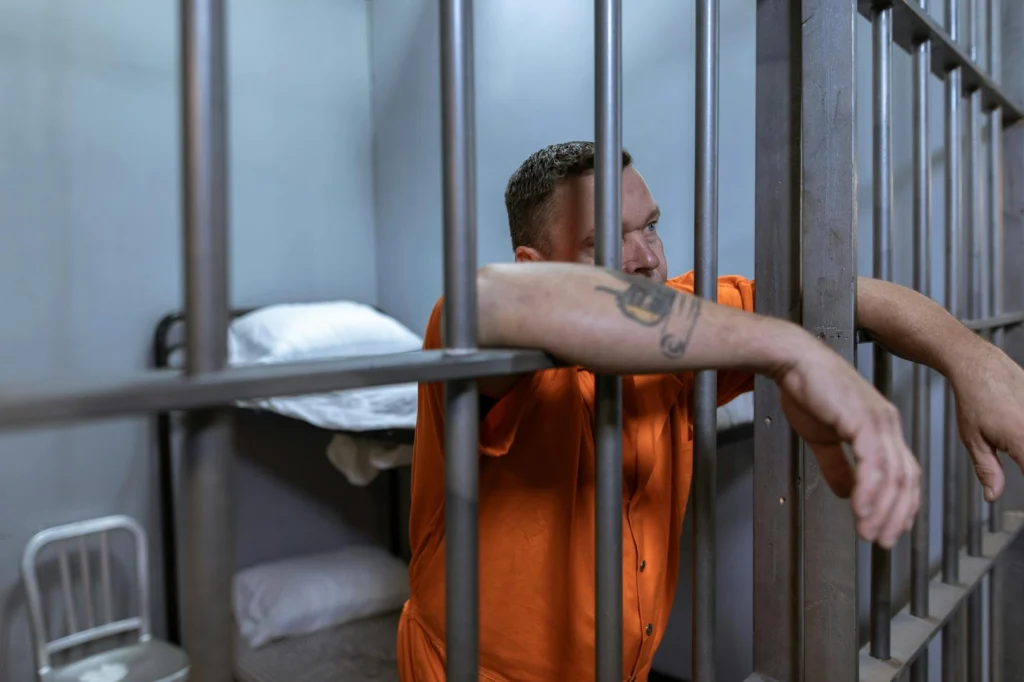
The United States spends $445 billion every year on its criminal justice system[s]. When you add in lost wages, damaged families, and ruined health, researchers at Washington University in St. Louis put the total societal burden at $1.2 trillion[s]. The mass incarceration cost is staggering, and the returns on that investment are dismal. This is not a policy debate. It is an accounting failure.
The Mass Incarceration Cost Per Person
The median state spends $60,989 per year to house a single prisoner[s]. That figure varies more than tenfold: Mississippi pays just under $20,000 per prisoner, while Massachusetts spends $284,976[s]. California’s Legislative Analyst’s Office breaks the per-person cost into components: $52,194 for security, $41,834 for healthcare alone[s]. Healthcare now eats roughly a third of California’s per-prisoner budget.
These numbers should provoke a simple question from legislators: what are taxpayers getting for this money?
What We Get Back: Almost Nothing
Researchers at the American Action Forum found that a 10 percent increase in incarceration produces only a 2 percent decrease in crime[s]. In California, a study found that one additional year of incarceration had no measurable effect on violent crime and yielded a net loss of $40,000 per prisoner when weighed against the marginal reduction in property crime[s].
The recidivism numbers confirm the futility. Nearly half of federal prisoners are rearrested within eight years of release[s]. For state prisoners, the numbers are worse. The system does not rehabilitate; it warehouses people and releases them with fewer prospects than when they entered.
A System Built on Sentencing, Not on Crime
The U.S. imprisonment rate was 93 per 100,000 in 1972. By 2009, it had increased sevenfold[s]. That explosion was not driven by a proportional rise in crime. The Sentencing Project concluded plainly: “Misguided changes in sentencing law and policy, not crime, account for the majority of the increase in correctional supervision.”[s]
Today, 460 of every 100,000 American adults sit in prison[s]. Forty-five percent of federal prisoners are serving sentences for drug offenses[s], and the National Institute on Drug Abuse estimates that 65 percent of the entire prison population has an active substance use disorder[s]. The mass incarceration cost rises every year in part because we keep locking up people who need treatment, not cells.
The Money That Disappears After Release
The cost does not end at the prison gate. Lost wages during incarceration and the lifetime reduction in earnings after release are estimated at more than $300 billion collectively[s]. Over 70 percent of employers run criminal background checks, and people convicted of felonies are barred from roughly 3,000 occupational licenses nationwide[s].
Children of incarcerated parents pay too. They are five times more likely to go to prison themselves[s], and the Prison Policy Initiative estimates that lost income for children of incarcerated parents during their working years reaches $215 billion per year[s]. The mass incarceration cost cascades across generations.
Alternatives That Actually Save Money
The math on alternatives is not ambiguous. Drug courts cost between $2,500 and $4,000 per offender per year, compared to $20,000 to $50,000 to incarcerate that same person[s]. Every dollar spent on drug courts saves roughly $4 in avoided incarceration and healthcare costs[s]. A review of 154 evaluations found that drug courts reduce recidivism by 38 to 50 percent[s].
Education programs behind bars deliver similar returns. A RAND Corporation study found that prisoners who participate in educational programs are 43 percent less likely to return to prison[s]. For every dollar spent on prison education, taxpayers save four to five dollars on reincarceration[s].
These are not theoretical projections from advocacy groups. This is the math. And legislators refuse to run it.
Why the Math Never Gets Done
Corrections spending rose 27 percent between 2017 and 2025, even as correctional populations shrank by over one million people[s]. Over three decades, state and local spending on prisons grew at three times the rate of spending on public education[s]. The mass incarceration cost keeps climbing because powerful interests benefit from the status quo.
Almost half the money spent on corrections goes to staff salaries, creating a workforce that lobbies against reform[s]. Bail bond companies collect $1.65 billion annually in nonrefundable fees and actively work to block reforms[s]. Commissary vendors and telecommunications companies extract $5.6 billion a year from incarcerated people and their families[s].
The political incentive structure rewards toughness, not arithmetic. No legislator ever lost a seat by spending too much on prisons. Plenty have lost by being labeled “soft on crime.” The mass incarceration cost is an orphan expense: everyone contributes to it, nobody owns it.
The Position
If a private company spent $445 billion a year on a system that failed by its own metrics, shareholders would replace management. If a hospital readmitted half its patients within eight years, it would be investigated. Prisons operate by a different standard because the people paying the bill never see the balance sheet, and the people inside it have no political voice.
One in five Black men born in 2001 faces imprisonment at some point in their lifetime[s]. Criminal careers typically last about 10 years, meaning that incarceration beyond that window produces diminishing returns on public safety[s]. Yet 56,245 people now serve life without parole, an all-time high[s].
The mass incarceration cost is not a mystery. It is documented, quantified, and ignored. Legislators who refuse to run the per-prisoner math are not being cautious. They are being negligent with public money while calling it public safety.
The United States criminal justice system consumed $445 billion in 2025 across federal, state, and local expenditures, according to the Prison Policy Initiative’s most recent accounting[s]. Factor in externalities (foregone wages, health deterioration, intergenerational effects), and the American Action Forum places the total societal burden at $1.2 trillion[s]. The mass incarceration cost, viewed as a policy investment, delivers returns that no rational budget process would tolerate.
Per-Unit Mass Incarceration Cost Analysis
Median per-prisoner expenditure across states was $60,989 in 2023, with a range spanning from under $20,000 in Mississippi to $284,976 in Massachusetts[s]. California’s Legislative Analyst’s Office provides the most granular cost decomposition available: $52,194 for security operations, $41,834 for healthcare (subdivided into $26,880 medical, $8,123 mental health, $4,835 pharmaceuticals, $1,997 dental), and $11,747 for facility operations[s].
Healthcare costs are the fastest-growing component. In California, they now represent roughly one-third of per-prisoner spending, driven by an aging prison population, chronic disease prevalence, and mental health treatment obligations established through federal court orders.
Marginal Returns on Incarceration Spending
The central policy question is whether the marginal dollar spent on incarceration produces a marginal reduction in crime that justifies the expenditure. The evidence is consistently negative.
A frequently cited elasticity estimate holds that a 10 percent increase in incarceration yields approximately a 2 percent decrease in crime[s]. A natural experiment in California found that an additional year of incarceration had no statistically significant effect on violent crime and produced a net fiscal loss of $40,000 per prisoner after accounting for the marginal value of reduced property crime[s]. The Sentencing Project’s analysis is direct: “Misguided changes in sentencing law and policy, not crime, account for the majority of the increase in correctional supervision.”[s]
Recidivism data further undermines the rehabilitation rationale. Federal rearrests within eight years stand at approximately 50 percent[s]. The mass incarceration cost compounds when the same individuals cycle through the system repeatedly, each time incurring the full per-prisoner expenditure while accumulating additional barriers to post-release economic participation.
Composition of the Incarcerated Population
The U.S. imprisonment rate rose from 93 per 100,000 in 1972 to a sevenfold peak in 2009[s]. As of 2023, it stands at 460 per 100,000 adults[s]. The federal prison population skews heavily toward drug offenses: 45 percent of federal prisoners are serving drug-related sentences[s]. NIDA estimates that 65 percent of the total prison population has an active substance use disorder, with an additional 20 percent having been under the influence at the time of their offense[s].
This composition matters for cost analysis. Incarcerating individuals whose primary pathology is addiction, rather than routing them through treatment infrastructure, produces the worst possible cost-to-outcome ratio. The mass incarceration cost is inflated by a population mismatch between the intervention (confinement) and the underlying condition (substance dependence).
Externality Accounting
Direct corrections spending captures only a fraction of the fiscal impact. Lost wages during incarceration plus lifetime earnings reduction exceed $300 billion[s]. Over 70 percent of employers conduct criminal background checks, and felony convictions bar individuals from approximately 3,000 occupational licenses[s].
The intergenerational costs are particularly severe. Children of incarcerated parents are five times more likely to be incarcerated themselves[s]. The Prison Policy Initiative estimates lost income for these children at $215 billion per year during their working years, with an additional $111 billion in lost income for the incarcerated individuals themselves[s]. These are costs that never appear in any corrections budget but are borne by the broader economy.
Cost-Effective Alternatives: Comparative Analysis
Two interventions have particularly strong evidence bases. Drug courts operate at $2,500 to $4,000 per offender annually, versus $20,000 to $50,000 for incarceration of a drug-involved offender[s]. The return is approximately $4 in avoided costs for every $1 spent[s]. Across 154 evaluations, drug courts reduced recidivism by 38 to 50 percent[s].
Correctional education programs show similar cost-effectiveness. RAND’s meta-analysis found a 43 percent reduction in recidivism among participants[s], with a return of $4 to $5 in avoided reincarceration for every $1 invested[s]. Evidence on criminal career length indicates that most criminal activity concentrates within a roughly 10-year window[s], which means continued incarceration beyond that horizon pays for diminishing marginal safety returns.
Why the Budget Process Fails
Between 2017 and 2025, corrections spending rose 27 percent while correctional populations fell 15 percent[s]. Over three decades, state and local prison spending grew at three times the rate of education spending[s]. The structural explanation lies in concentrated benefits and diffuse costs. Correctional employee payrolls account for nearly half of corrections spending and create a constituency with direct economic interest in maintaining capacity[s]. Bail bond companies ($1.65 billion in annual nonrefundable fees) and commissary/telecom vendors ($5.6 billion) add additional lobbying weight against reform[s].
The political economy compounds the problem. Electoral incentives punish perceived leniency and reward visible toughness, regardless of fiscal outcomes. The mass incarceration cost is structurally invisible in most state budgets, spread across corrections, health, judiciary, and welfare line items with no consolidated accounting.
The Analytical Conclusion
Viewed strictly as a fiscal question, the case against the current incarceration regime is overwhelming. The per-prisoner cost exceeds $60,000 at the median. The marginal crime reduction per additional prisoner-year is statistically negligible for many offense categories. Alternatives with proven efficacy cost a fraction and deliver superior recidivism outcomes. One in five Black men born in 2001 will experience incarceration[s], and 56,245 people serve life without parole, an all-time record[s].
The mass incarceration cost is the most thoroughly documented, least disputed, and most systematically ignored line item in American public finance. The per-prisoner math is not difficult. It is politically inconvenient, which in a democracy that claims to value fiscal responsibility, should itself be treated as a scandal.