In 1984, Jennifer Thompson studied her attacker’s face with deliberate focus, determined to memorize every detail so she could identify him later. She was certain she would never forget. Months later, she pointed at Ronald Cotton in a courtroom and declared with absolute confidence that he was the man who raped her. She was wrong. Eyewitness misidentification had just condemned an innocent man to more than a decade in prison.[s]
Thompson’s certainty illustrates the central paradox of witness testimony: confidence and accuracy are not the same thing. The American Psychological Association estimates that one in three eyewitnesses makes an erroneous identification.[s] These errors are not random glitches. They emerge from the fundamental architecture of human memory.
Eyewitness Misidentification: The Leading Cause of Wrongful Convictions
The Innocence Project has documented that eyewitness misidentification contributed to 69% of DNA exonerations in the United States.[s] That figure represents 252 innocent people out of 367 cases. No other factor comes close.
Memory is not a recording device. What we encode depends on attention, prior expectations, and emotional state.[s] What we store can be altered by conversations, news coverage, and police questions. What we retrieve is reconstructed each time, with gaps filled by inference rather than fact.
This reconstruction happens automatically, outside conscious awareness. Witnesses do not know their memories have changed. They remember the altered version as if it were the original.
How Confidence Becomes Certainty
Courts have long treated confident witnesses as reliable witnesses. Jurors find certainty compelling. But research shows that confidence can inflate independently of accuracy.[s]
Confirming feedback is one mechanism. When a police officer says “Good, you identified the suspect,” the witness becomes more confident in their choice. Repeated questioning can strengthen a memory trace, making even a wrong identification feel familiar and therefore correct. Learning that another witness made the same identification adds social proof to an unreliable foundation.
Jennifer Thompson experienced this firsthand. After initially hesitating between two photos, she chose Cotton. Her confidence grew with each subsequent identification procedure until, by trial, she was absolutely certain.[s] When the actual perpetrator, Bobby Poole, was brought into the courtroom, she rejected him without hesitation.
The Cross-Race Effect
People recognize faces from their own racial group more accurately than faces from other groups.[s] This finding, known as the cross-race effect, has been replicated across cultures and experimental conditions for over a century.
The effect is not caused by racial prejudice. Studies show that witnesses who hold no conscious bias are just as likely to make cross-racial identification errors as those who do.[s]
Among wrongful convictions overturned by DNA evidence, 36% involved white witnesses mistakenly identifying innocent Black defendants.[s] Thompson, who is white, identified Cotton, who is Black. The real perpetrator was also Black. Her brain processed both men through a less precise recognition system than it would have used for faces of her own race.
When Weapons Capture Attention
The presence of a weapon degrades memory for the person holding it.[s] This phenomenon, called the weapon focus effect, occurs because attention narrows to the threat. In the seminal study by Elizabeth Loftus, participants shown a perpetrator holding a gun fixated on the weapon and later produced more erroneous descriptions of the perpetrator compared to those who saw him holding a check.[s]
The weapon focus effect means that the most dangerous crimes, those involving firearms, are precisely the crimes where eyewitness identification is least reliable.
System Failures That Compound the Problem
Memory fallibility is one category of risk. Police practices create another. Duke University researcher Brandon Garrett found evidence of suggestive police procedures in nearly 80% of eyewitness misidentification cases.[s]
Suggestive practices include lineups where the suspect stands out, repeated exposure to the same suspect, and show-ups where only one person is presented. These procedures do not create false memories from nothing. They guide uncertain witnesses toward a particular choice and then cement that choice through repetition.
What the Courts Do Not Know
Judges surveyed on eyewitness factors averaged only 55% correct on a knowledge test about memory and identification.[s] Many did not know that confidence and accuracy are weakly correlated, or that eyewitness error is the leading contributor to wrongful convictions.
The gap between what science knows and what courts apply remains wide. Juries continue to find confident witnesses compelling. Cross-examination rarely exposes the mechanisms that produced a false identification. The innocent continue to be convicted on the word of witnesses who are certain they are telling the truth.
Reforms That Work
The Innocence Project and scientific researchers have developed evidence-based reforms. These include blind lineup administration, where the officer conducting the procedure does not know which person is the suspect; instructions that the perpetrator may not be present; and immediate documentation of witness confidence before any feedback occurs.
These reforms address system variables that police can control. Estimator variables, such as lighting, distance, stress, and cross-racial recognition, remain inherent limitations. No procedure can make human memory into a reliable recording device.
Ronald Cotton was exonerated in 1995 after DNA testing identified Bobby Poole as the actual perpetrator.[s] He had served more than ten years. Thompson, confronted with the failure of her own memory, became an advocate for reform. They wrote a book together, an unlikely partnership between a victim of crime and a victim of the justice system’s faith in eyewitness testimony.
The lesson is not that all witnesses lie. The lesson is that all witnesses are human, and human memory was never designed for the courtroom.
On July 29, 1984, a man broke into the apartment of 22-year-old Jennifer Thompson-Cannino in Burlington, North Carolina, and sexually assaulted her. During the attack, she made a deliberate effort to study her attacker’s face, believing this would help police catch him. Her identification of Ronald Cotton would become one of the most studied cases of eyewitness misidentification in forensic psychology.[s]
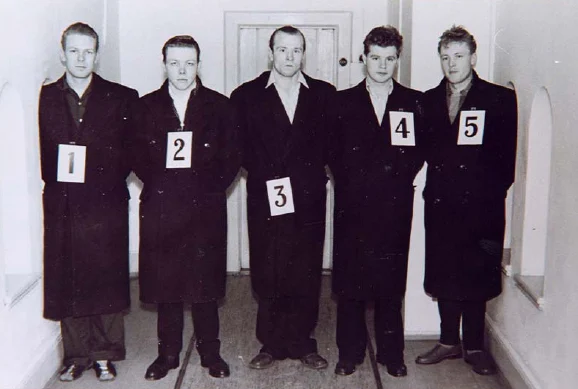
Thompson’s initial identification followed standard police procedure of the era. She worked with officers to create a composite sketch, then viewed a photographic array. On her first look, she said her choice was “between number four and number five.” After a second viewing and hearing suspects repeat certain phrases, she selected Cotton, number five. The other victim from that night viewed the same array and made no identification.[s]
The Science Behind Eyewitness Misidentification
Memory researchers have documented the mechanisms underlying identification errors for over a century. Memory does not provide a veridical representation of events. Encoding is selective, determined by attention, prior knowledge, expectations, and emotional state.[s] Consolidation integrates new information with existing memories. Retrieval reconstructs rather than replays, filling gaps with inference.
The American Psychological Association estimates that one in three eyewitnesses makes an erroneous identification.[s] Analysis of 312 DNA exonerations found eyewitness error in approximately 75% of cases.[s] The Innocence Project’s current database shows 69% of exonerations, 252 out of 367 cases, involved eyewitness misidentification.[s]
The Misinformation Effect and Memory Contamination
Post-event information can alter memories without the witness’s awareness. This phenomenon, termed the misinformation effect, was extensively documented by cognitive psychologist Elizabeth Loftus.[s]
Memory is reconstructive. Information supplied by police, prosecutors, media coverage, other witnesses, family, and friends can alter both the memory of the crime and the memory of the perpetrator.[s] Leading questions can implant details. Social confirmation can strengthen weak traces. Once altered, the original memory may be irretrievable.
Confidence Inflation: When Certainty Becomes Dangerous
Eyewitness confidence correlates weakly with accuracy at trial. Multiple factors can inflate confidence without improving underlying memory quality.[s]
Confirming feedback from investigators, such as “Good, you identified the suspect,” increases confidence. Repeated questioning strengthens the trace regardless of accuracy. Learning that another witness identified the same person provides social validation. These factors have their greatest effect on confidence for inaccurate information.[s]
Thompson’s confidence grew with each identification procedure. By Cotton’s second trial in 1987, her certainty was absolute. When Bobby Poole, the actual perpetrator, was brought into court for identification, both Thompson and the second victim stated he was not their attacker.[s] The defense was denied permission to present Poole as an alternate suspect. Cotton was convicted of both rapes.
Cross-Racial Recognition Deficits
The cross-race effect in face recognition is among the most replicated findings in cognitive psychology. People demonstrate superior recognition for faces from their own racial group relative to other groups.[s]
The effect does not stem from conscious prejudice. Studies show that witnesses without conscious racial bias are equally likely to make cross-racial identification errors.[s] Explanations focus on differential encoding: faces from familiar groups are processed along dimensions optimized for within-group differentiation, while other-group faces are processed more categorically.
Among DNA exonerations, 36% involved white witnesses mistakenly identifying innocent Black defendants.[s] At least 40% of Innocence Project exonerations involved cross-racial identifications.[s]
Weapon Focus and Attentional Narrowing
The presence of a weapon in a crime scene has been found to attract observer attention and impair memory for the person holding the weapon.[s] This weapon focus effect was demonstrated in Loftus’s seminal study: participants who saw a perpetrator holding a gun fixated more on the object, produced more erroneous perpetrator descriptions, and were less likely to make correct identifications from a photo lineup.[s]
Two hypotheses explain the effect. The arousal hypothesis holds that threat causes attentional narrowing to central cues, per Easterbrook’s cue-utilization model. The unusual object hypothesis suggests weapons draw attention because they violate contextual expectations. Evidence supports both mechanisms, with context shaping which dominates.[s]
System Variables: Suggestive Police Practices
Duke University law professor Brandon Garrett identified suggestive police practices in nearly 80% of Innocence Project eyewitness misidentification cases.[s]
System variables, those under criminal justice control, include lineup construction, administration procedures, and feedback. Lineups where the suspect stands out, repeated procedures using the same suspect, and single-person show-ups all increase misidentification risk. These practices do not create memories from nothing; they guide uncertain witnesses toward particular choices and cement those choices through repetition.
Knowledge Gaps in the Legal System
Surveys reveal that legal professionals possess limited knowledge of eyewitness factors. U.S. judges averaged 55% correct on a 14-item knowledge scale.[s] Many did not know the weak relationship between confidence and accuracy at trial, or that eyewitness error is a major factor in wrongful convictions. Prosecutors averaged 47% correct compared to 78% for defense attorneys, though the latter’s performance appeared partly attributable to greater skepticism rather than knowledge.[s]
The disconnect between scientific understanding and courtroom practice enables miscarriages of justice. Jurors continue to weight confidence heavily despite its poor predictive validity.
Evidence-Based Reforms
The National Institute of Justice published guidelines for eyewitness evidence collection in 1999, covering procedures for photo arrays and both simultaneous and sequential lineups, and recommending instructions that the perpetrator may not be present.[s] The 1999 guide stopped short of endorsing blind lineup administration or a preference for sequential over simultaneous presentation; those measures, along with immediate confidence documentation before any feedback, were promoted by later research and incorporated into subsequent best-practice guidance.[s]
Adoption remains incomplete. The Police Executive Research Forum’s nationwide assessment found U.S. law enforcement agencies lack uniformity in identification procedures, with some reforms implemented in less than half of agencies.[s]
The Cotton Case Resolution
In 1995, DNA testing of physical evidence excluded Ronald Cotton and matched Bobby Poole, who was by then serving a life sentence for other sexual assaults. Poole had admitted to other inmates that he committed both crimes. Cotton was released after serving more than ten years.[s]
Thompson-Cannino and Cotton met after his exoneration and became advocates for eyewitness identification reform. Their 2009 book, “Picking Cotton: Our Memoir of Injustice and Redemption,” documented both the psychology of false identification and the human cost of misplaced certainty.
The Cotton case exemplifies every vulnerability that makes eyewitness misidentification so dangerous: cross-racial identification, confidence inflation through repeated procedures, and system variables that guided an uncertain witness toward an innocent man. Memory, by definition, is fallible at best and unreliable at worst.[s] The criminal justice system continues to treat it as truth.