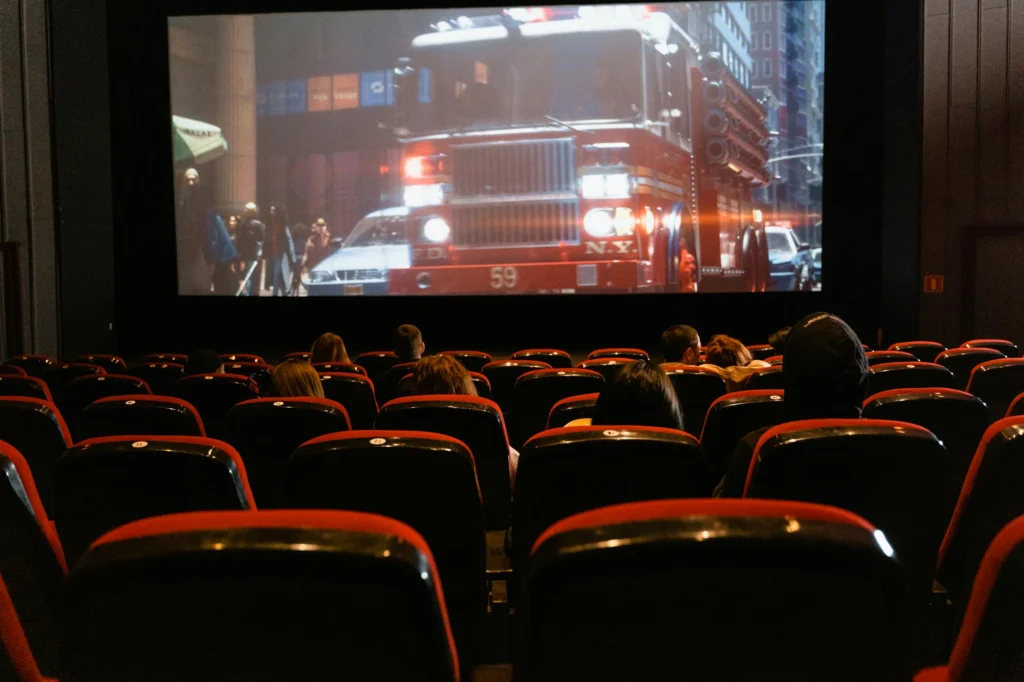
We pay money to watch cities crumble, oceans swallow coastlines, and asteroids annihilate civilization. Then we walk out into the parking lot, satisfied. The disaster film psychology that drives this behavior has fascinated critics and audiences for decades, revealing something uncomfortable about what we want from our entertainment.
The appeal runs deeper than spectacle. Disaster film psychology taps into primal fears we cannot otherwise safely explore: the collapse of order, the fragility of everything we have built, the thin membrane between routine life and total catastrophe. Susan Sontag identified a related dynamic in her landmark 1965 essay “The Imagination of Disaster,” writing, “Science fiction films are not about science. They are about disaster, which is one of the oldest subjects of art.”[s]
Disaster Film Psychology and the 1970s Golden Age
Hit disaster movies are as old as Hollywood itself. San Francisco, the 1906 earthquake drama starring Clark Gable, Jeanette MacDonald, and Spencer Tracy, was a major hit in 1936.[s] But the modern disaster film as we know it crystallized with Airport in 1970. The film was “brash, confident and hugely successful: a budget of $10 million earned $100 million at the box office” and garnered 10 Oscar nominations.[s]
Airport proved disaster could be big business. Within four years, every studio wanted in. “In their heyday, every studio wanted a share of the disaster pie: hundreds of millions of dollars were spent blowing up, burning down and otherwise destroying large, normally indestructible objects.”[s]
The Poseidon Adventure arrived in 1972, The Towering Inferno and Earthquake in 1974. The Towering Inferno represented an unprecedented Hollywood gambit: Fox and Warner Bros. pooled resources on a $14 million co-production, with Fox taking the domestic release and Warner Bros. taking the foreign market rather than compete with nearly identical premises.[s] The 1970s disaster boom paired large-scale spectacle with immediate, unsettling scenarios audiences could relate to.[s]
Why We Watch: The Psychology of Catharsis
Film scholar Wheeler Winston Dixon offers one explanation: “People go to disaster movies to prove to themselves that they can go through the worst possible experience but somehow they’re immortal.”[s] Director Roland Emmerich, who built a career on destroying landmarks in Independence Day, The Day After Tomorrow, and 2012, puts it more simply: “They are somewhat cathartic. You see all this destruction and everything but at the end the right people save the day.”[s]
The appeal has a paradoxical structure. Audiences seek images of danger while remaining protected by the screen. Disaster film psychology functions like a rollercoaster: terrifying as the ride plunges, exhilarating once it ends. Audiences experience danger through the safety of a screen, share in the triumph of endurance, then walk out reassured that life, at least outside the cinema, goes on.
Sontag was more skeptical. She saw a troubling complicity: “[There is a] sense in which these movies are in complicity with the abhorrent… They inculcate a strange apathy concerning the process of radiation, contamination, and destruction.”[s] The psychological satisfaction of surviving disaster on screen might inoculate us against taking real threats seriously. Scholar Christopher Sharrett located apocalyptic horror within “a broader tradition of apocalypticism in art and culture, one which insists on the ‘criticism of despair'”[s]; the films raise urgent questions but offer formulaic, unsatisfying resolutions.
The Hero Formula and Masculinist Rescue
Simon R. Troon’s 2024 academic study Cinematic Encounters with Disaster identifies a persistent archetype. Conventional disaster cinema is characterized by a “masculinist heroic subjectivity that masters both nature and technology to overcome death.”[s] Think Charlton Heston in Earthquake, Dwayne Johnson in San Andreas, and countless others: the hero musters old-world moral rectitude with new-world technological skill, saves the nuclear family unit, and restores order against impossible odds.
This formula has proven remarkably durable. “World annihilation is the standard way to level up the stakes of a franchise, from Transformers or Avengers to Star Wars, as if saving the world depends on the financial survival of the franchise.”[s] The mechanics of prestige television’s troubled endings show similar patterns: ambitious narratives that raise existential stakes struggle to deliver satisfying conclusions, whether the destruction is literal or metaphorical.
Disaster Film Psychology as Cultural Barometer
Sontag argued that “from a psychological point of view, the imagination of disaster does not greatly differ from one period in history to another” but “from a political and moral point of view, it does.”[s] The fears that power disaster cinema shift with each generation’s anxieties.
During the Cold War, screens filled with nuclear annihilation and radiation monsters. Gojira/Godzilla (1954) was widely read as an allegory of Hiroshima, Nagasaki, and atomic trauma; The Day After (1983) traumatized television audiences with graphic depictions of nuclear war’s aftermath. The genre repeatedly mirrored the anxieties of its time, acting as a cultural barometer for society’s deepest concerns.[s]
The cultural fascination with destruction has proven remarkably adaptable. After the Cold War, environmental collapse joined and often displaced nuclear war as a dominant disaster-film anxiety. A 2025 PLOS Climate essay called The Day After Tomorrow (2004) “an iconic and genre-defining ‘climate disaster’ film that still functions as an illustrative anchor for imaging the catastrophic consequences of Atlantic Ocean circulation collapse.”[s] Studies found the film “significantly increased viewers’ concerns and anxieties about the lack of progress on climate action,” although one also found that its apocalyptic weather reduced audiences’ belief that climate change would cause extreme events.[s]
Post-9/11, the imagery became more targeted. “The destruction of American government buildings and icons has really ramped up in films because of the polarisation of American politics. Each side really wants to destroy the other side, so they settle for these fantasies of destruction.”[s] Audiences watched the White House vaporized, Capitol buildings crumbled, and landmarks systematically annihilated; films projecting cultural anxiety gave viewers a sanctioned space to process (or enjoy) the destruction of symbols they had complicated feelings about.
The Modern Spectacle and Its Limits
Digital effects transformed disaster film psychology into something approaching a theme park ride. Where 1970s films created intimacy through practical effects and ensemble casts trapped in claustrophobic spaces, modern entries favor global scale. 2012 (2009) destroyed civilization continent by continent. San Andreas (2015) leveled California and grossed $474,590,832 worldwide, evidence that large-scale cinematic destruction remained commercially potent.[s]
Stephen Keane’s academic history Disaster Movies: The Cinema of Catastrophe traces how “disaster movies can be read in relation to both contextual considerations and the increasing commercial demands of contemporary Hollywood.”[s] The genre has become self-aware, recycling its tropes with diminishing returns. Where The Towering Inferno could be genuinely unsettling, depicting scenarios that felt adjacent to real life, modern CGI spectacles often feel weightless; when anything can be destroyed without practical constraint, nothing feels truly at stake.
The streaming era has further fragmented the genre. Bird Box (2018) showed how a disaster-adjacent streaming film could become a viral event, with Netflix reporting more than 45 million accounts in its first week and Wired tracing its meme-driven spread.[s] The Wandering Earth (2019) showed the genre’s global reach from the theatrical side, earning about $700 million worldwide before arriving on Netflix with little fanfare.[s] Whether these works fulfill the same psychological function as communal theatrical experiences remains unclear.
What Disaster Film Psychology Reveals
Sontag wrote that “the science fiction film is concerned with the aesthetics of destruction… and it is in the imagery of destruction that the core of a good science fiction film lies.”[s] The observation holds more than sixty years later. We watch cities fall not despite our safety but because of it. Disaster film psychology offers controlled exposure to chaos, an arena where we rehearse survival, experience mortality by proxy, and emerge reassured of our immortality.
Yet the genre’s durability raises questions about what we are really processing. Are disaster films cathartic pressure valves that help us confront overwhelming anxieties from a safe distance? Or do they inure us to the slow-motion catastrophes unfolding outside the theater: climate change that will not resolve in two hours, social collapse that offers no heroic rescue, threats that cannot be mastered through masculine ingenuity?
The disaster film promises that destruction can be survived, managed, and understood. The credits roll, and audiences walk into the night reassured that whatever is coming, someone will save the day. Whether that reassurance helps or harms remains the genre’s unresolved question.